
16.10.2025, Bochum Unterführung “Woher ? – Wohin?“ / Bochum underpass: “Where from? Where to?”
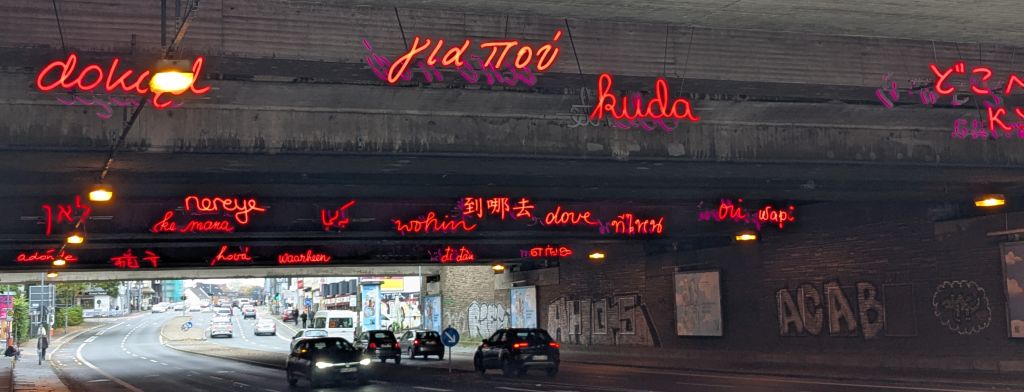
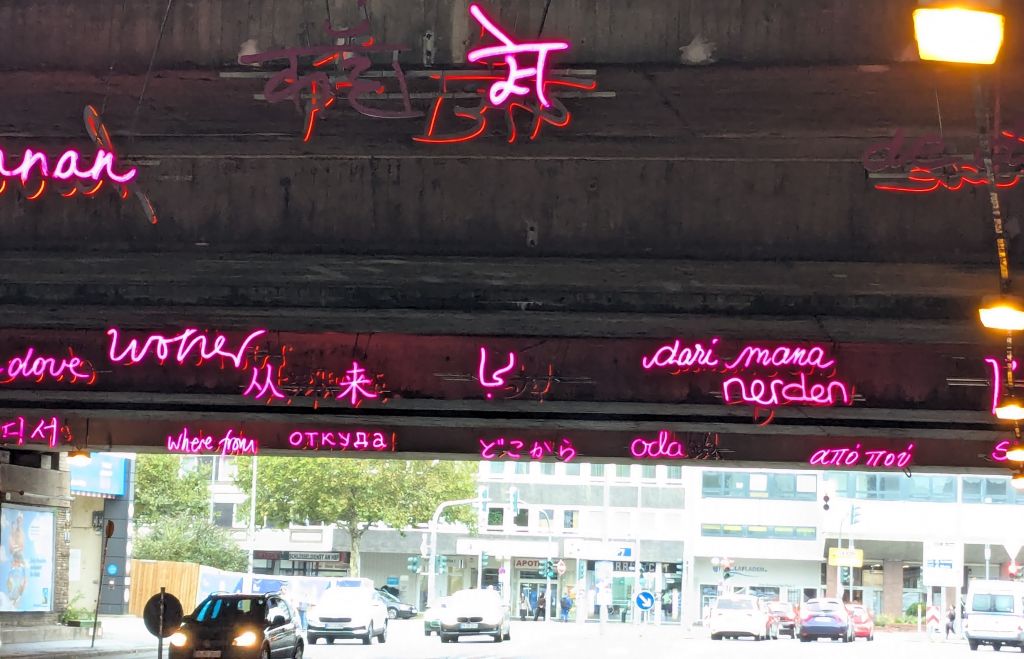
Uepo.de Übersetzerportal, 24.1.2025, Richard Schneider, https://uepo.de/2025/01/24/woher-wohin-bochumer-unterfuehrung-stellt-wesentliche-fragen-des-seins-in-24-sprachen/: Woher? Wohin? Bochumer Unterführung stellt wesentliche Fragen des Seins in 24 Sprachen / [Transl.] Where from? Where to? Bochum underpass poses fundamental questions of existence in 24 languages
Dortige Bildunterschrift: Wohin? Diese Frage wird den stadtauswärts fahrenden Bürgern in Bochum in 24 Sprachen gestellt. In der Gegenrichtung lautet die Frage: Woher? / [Transl.] Caption there: Where to? This question is asked in 24 languages to citizens leaving Bochum. In the opposite direction, the question is: Where from?
Text: … Will der Künstler … wesentliche Fragen des Seins aufwerfen? Woher kommen wir als Menschheit? Wohin gehen wir? … Das Projekt soll vor allem verdeutlichen, dass die Bochumer Dutzende von Muttersprachen sprechen. Bei der Einweihung der Woher-wohin-Installation … erklärte der in Essen ansässige Künstler: Einerseits ist das der Bezug zum Bahnhof, zum An- und Abreisen, andererseits hat es eine philosophische und religiöse Variante. Es verweist aber auch auf Migranten und erfüllt damit die politische Dimension. Christoph Hildebrand hatte sich von der Stadtverwaltung eine Statistik mit den 30 häufigsten Herkunftssprachen der Bochumer Wohnbevölkerung geben lassen. Dann ließ er sich die beiden Wörter wohin und woher in diese Sprachen übersetzen … von in der Stadt arbeitenden Muttersprachlern. Bei der Umsetzung der … auf Zetteln erhaltenen Übersetzungen übernahm der Künstler sogar die Handschrift der jeweiligen Muttersprachler … / [Transl.] Text: … Does the artist want to raise fundamental questions about existence? Where do we come from as humanity? Where are we going? … Above all, the project aims to highlight the fact that the people of Bochum speak dozens of different native languages. At the inauguration of the Woher-wohin installation, the Essen-based artist explained: On the one hand, there is the reference to the train station, to arrivals and departures, and on the other hand, there is a philosophical and religious aspect. But it also refers to migrants and thus fulfills a political dimension. Christoph Hildebrand asked the city administration for statistics on the 30 most common languages spoken by Bochum’s resident population. He then had the two words “wohin” (where to) and “woher” (where from) translated into these languages … by native speakers working in the city. When transcribing the translations he received on slips of paper, the artist even copied the handwriting of the respective native speakers ... [Translations by DeepL]
 Human ecology and health