15.1.2026, Arbeitskreis „Nachhaltige StadtGesundheit“ der Patriotischen Gesellschaft von 1765: Workshop „Gesunde Lebensumwelt in Hamburgs Südwesten“ / “Sustainable Urban Health” working group of the Patriotic Society of 1765: Workshop “A healthy living environment in southwest Hamburg”
Im Anschluss an öffentliche Veranstaltungen zur Integration von Gesundheit in die Stadt- und Verkehrsplanung im Hamburgs Südwesten (siehe hier) organisierte der Arbeitskreis „Nachhaltige StadtGesundheit“ der Patriotischen Gesellschaft von 1765 einen Workshop zum Thema „Gemeinsam für eine gesunde Lebensumwelt in Hamburgs Südwesten – Intersektorale Planung für Klimaanpassung und Hitzeschutz?“, 15.1.2026,13:00 – 17:00 Uhr, im Haus der Patriotischen Gesellschaft, Kirchhof-Saal, Trostbrücke 6, 20457 Hamburg / [DeepL] Following public events on integrating health into urban and transport planning in southwest Hamburg (see here), the “Sustainable Urban Health” working group of the Patriotic Society of 1765 organized a workshop on the topic of “Working together for a healthy living environment in southwest Hamburg – intersectoral planning for climate adaptation and heat protection?”, January 15, 2026, 1:00 p.m. – 5:00 p.m., at the House of the Patriotic Society, Kirchhof Hall, Trostbrücke 6, 20457 Hamburg.
8 Nov 2024, Φ Jahrbuch 2023/2024 der Patriotischen Gesellschaft von 1765, mit Beitrag zum AK Nachhaltige StadtGesundheit
3 Jun 2024, Φ Arbeitskreis Nachhaltige StadtGesundheit der Patriotischen Gesellschaft von 1765: Veränderung Sprecher:in-Rolle [Hier auch Auflistung älterer Web-Einträge]
27 Nov 2023, Φ Patriotische Gesellschaft von 1765 – Jahrbuch 2022/2023: Nachhaltigkeit in Hamburg – Impulse der Zivilgesellschaft / Patriotic Society of 1765 – Yearbook 2022/2023
14 Sep 2023, Φ Patriotische Gesellschaft von 1765: „Eine Gesunde Stadt für Alle“ am 14.11.2023.
18.11.2025, Herbstsymposium 2025 (UKE, HAW, TUHH): Gesundheitsbezogene Spannungsfelder in der Metropolregion Hamburg – Perspektiven aus Quartier und Stadtregion / Health-related areas of tension in the Hamburg metropolitan region – perspectives from neighborhoods and urban regions
(English version below)
Veranstalter:innen: Jobst Augustin (Universitätskrankenhaus Hamburg-Eppendorf, UKE), Susanne Busch (Hochschule für Angewandte Wissenschaften Hamburg, HAW), Carsten Gertz (Technische Universität Hamburg, TU-HH).
Aus dem Ankündigungs-Flyer: … Einblicke in interdisziplinäre Forschungsprojekte: „Gesunde Quartiere 2.0“ diskutiert erste Ergebnisse zur Entwicklung soziallagenabhängiger Ansätze bei der Gestaltung von Prävention und Gesundheitsförderung. „GeSGo“ – Integration von Gesundheit in die Stadt- und Verkehrsplanung: Neue Governancestrukturen in stadtregionalen Verkehrskorridoren – präsentiert ein Forschungsvorhaben zur Integration von Gesundheit in die Hamburger Verkehrs- und Stadtplanung … soll die Veranstaltung … auch zur Vernetzung entsprechender Vorhaben beitragen. Neben Kurzpräsentationen weiterer regionaler Vorhaben mit Gesundheitsbezug werden geförderte Juniorforschungsgruppen im Kontext von Stadtgesundheit vorgestellt …
Kleinräumige Analysen zur bedarfsgerechten Ausgestaltung von Präventionsleistungen in sozial benachteiligten Bevölkerungsgruppen – Gesunde Quartiere 2.0 (S. Busch, J. Pohlan, E. Swart, S. Wöhle, D. Behde, L. Corinth, L. Jenner-Nissen, D. Kubat, J. Popp, L. Völtzer, J. von Eitzen); hierzu 3 Präsentationen
Integration von Gesundheit in die Stadt- und Verkehrsplanung – Neue Governancestrukturen in stadtregionalen Verkehrskorridoren (GeSGo) (Jufo-Beteiligte: J. Augustin, S. Busch, C. Gertz, M. Helmrich, L. Jenner-Nissen, K. Schulze, L. Völzer); hierzu: Projektvorstellung (inkl. Film), 2 Präsentationen, Ausblick (Moderation: C. Gertz)
Vernetzungstreffen Hamburg (Moderation: S. Busch),mit folgenden Beiträgen:
Kleinräumige Analysen von Gesundheits- und Sozialdaten der Hamburger Sozialbehörde (A.C. Krefis)
Gesundheitsfolgenabschätzung in der Stadtentwicklung_Plus (B. Tolg, T. Adami)
Das Community Health Labor Veddel – ein dauerhafter Forschungsort für gesundheitsbezogene Forschung in und mit einer marginalisierten Nachbarschaft (S. Betscher)
Bewegung in Hamburg / Active City (N. Schumacher)
Well-being in Hamburg (A. Adedej)
JuFo-Netzwerktreffen [+ Impulspapier] (Moderation: L. Hausmann),mit folgenden Beiträgen:
Corona und Psyche (COPSY), Hamburg (A. Kaman F. Reiß)
Community Mental Health: Innenstädte als therapeutische Landschaften (UCoMH), Bochum (A. Mikhof)
Alternde Gesellschaft und Urbanisierung: Salutogene Stadtlandschaften im (Fenster-)Blick (AgeSAlus), Hamburg (L. Ascone-Michelis)
Natur und Gesundheit – wissenschaftliches Modellprojekt zu urbaner Stadtnatur, Berlin (M. Jeitler)
Sektoraler Brückenbau, Bielefeld (T. McCall)
Gesunde-Orte-Index (GO-IX) – Ein WebGIS-Tool zur Planung gesunder Lebensräume und Förderung der öffentlichen Gesundheit, Erfurt/Dresden (S. Völker, K. Janson)
Stadt der Zukunft / Urban Community Health – Impulse (Stiftungsbeirat) [Impulspapier vorgestellt durch Heike Köckler, Rainer Fehr]
Organizers: Jobst Augustin (Universitätskrankenhaus Hamburg-Eppendorf, UKE), Susanne Busch (Hochschule für Angewandte Wissenschaften Hamburg, HAW), Carsten Gertz (Technische Universität Hamburg, TU-HH).
The aim of the event was to provide insights into interdisciplinary research projects on urban and regional health. The focus was on the “Healthy Neighborhoods 2.0” project, with a discussion of initial findings on the development of socially-oriented approaches to prevention and health promotion, and the “GeSGo – Integration of Health into Urban and Transport Planning: New Governance Structures in Urban-Regional Transport Corridors”; the latter is a research project on the integration of health into Hamburg’s transport and urban planning. The event was also intended to contribute to the networking of relevant projects. In addition to short presentations of other regional health-related projects, funded junior research groups in the context of urban health will be introduced.
Small-scale analyses for the needs-based design of prevention services in socially disadvantaged population groups – Healthy Neighborhoods 2.0 (S. Busch, J. Pohlan, E. Swart, S. Wöhle, D. Behde, L. Corinth, L. Jenner-Nissen, D. Kubat, J. Popp, L. Völtzer, J. von Eitzen); 3 presentations on this topic
Integration of health into urban and transport planning – New governance structures in urban-regional transport corridors (GeSGo) (Jufo participants: J. Augustin, S. Busch, C. Gertz, M. Helmrich, L. Jenner-Nissen, K. Schulze, L. Völzer); on this topic: project presentation (including film), 2 presentations, outlook (moderator: C. Gertz)
Networking meeting in Hamburg (moderator: S. Busch), with the following contributions:
Small-scale analyses of health and social data from the Hamburg Social Authority (A.C. Krefis)
Health impact assessment in urban development_Plus (B. Tolg, T. Adami)
The Community Health Laboratory Veddel – a permanent research site for health-related research in and with a marginalized neighborhood (S. Betscher)
Movement in Hamburg / Active City (N. Schumacher)
Well-being in Hamburg (A. Adedej)
JuFo network meeting [+ discussion paper] (moderator: L. Hausmann), with the following contributions:
Corona and the psyche (COPSY), Hamburg (A. Kaman, F. Reiß)
Community Mental Health: City Centers as Therapeutic Landscapes (UCoMH), Bochum (A. Mikhof)
Aging society and urbanization: Salutogenic urban landscapes in (window) view (AgeSAlus), Hamburg (L. Ascone-Michelis)
Nature and health – scientific model project on urban nature, Berlin (M. Jeitler)
Sectoral bridge building, Bielefeld (T. McCall)
Healthy Places Index (GO-IX) – A WebGIS tool for planning healthy living spaces and promoting public health, Erfurt/Dresden (S. Völker, K. Janson)
City of the Future / Urban Community Health – Impulses (Foundation Advisory Board) [Impulse paper presented by Heike Köckler, Rainer Fehr]
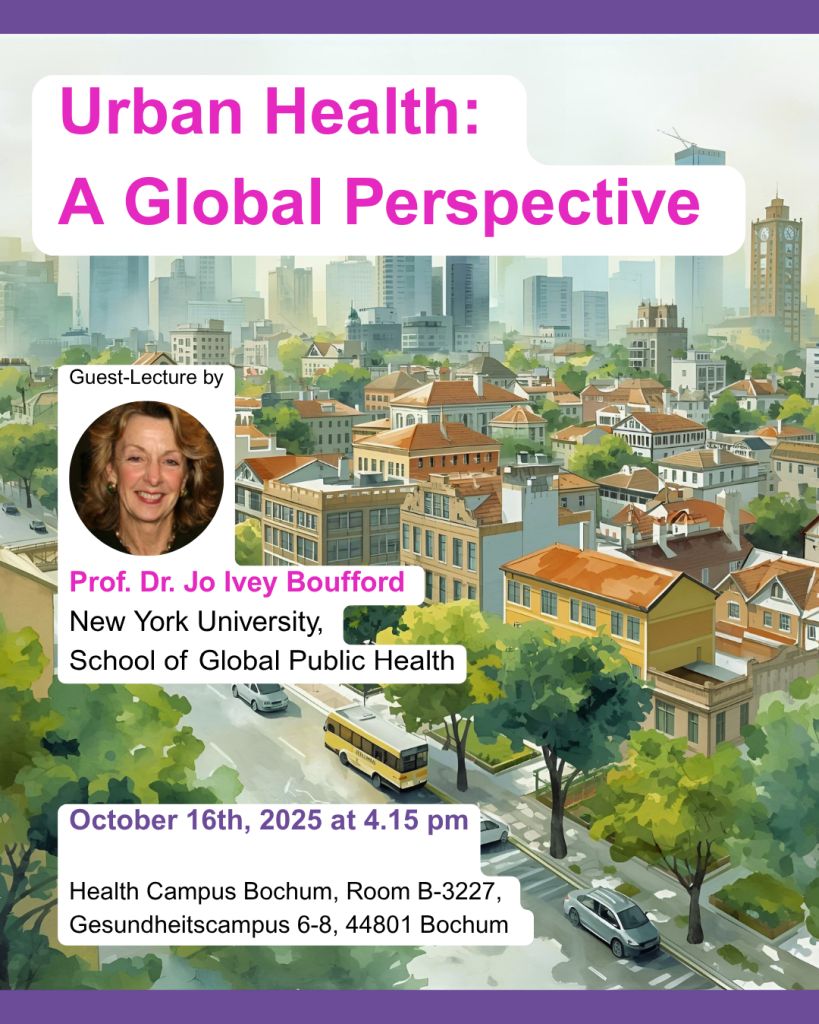
15.-16.10.2025, Dr. Boufford (NYU) visiting Hochschule Bochum
Within the framework of the research program “City of the Future – Healthy and sustainable metropolises”, Prof. Heike Köckler (University of Applied Sciences, Bochum, and Academy for Spatial Research and Planning/ARL) had invited Prof. Jo Ivey Boufford (New York University/School of Global Public Health, and International Society for Urban Health/ISUH) to give a guest lecture on the Health Campus Bochum and to locally collect impressions from urban and regional health activities.
The visit took place 15-16 October 2025 in Bochum and Witten. On behalf of the research program’s advisory board, Heike Köckler (Bochum) and Rainer Fehr (Bielefeld/Hamburg) welcomed the guest. Dr. Boufford’s guest lecture “Urban Health: A Global Perspective” was preceded by visits to the city of Witten and to the NRW Landesamt für Gesundheit und Arbeitsschutz / NRW State Office for Health and Occupational Safety (LfGA). In Witten, on the occasion of this visit, Klaus Völkel as coordinator of “Healthy City Witten” had convened a group representing a variety of urban health activities. This involves “Health in All Policies” as well as the sustainability – health nexus. The meeting took place in the “B63” centre for urban culture. In the LfGA, Dr.s Odile Mekel and Thomas Claßen from the Division Health literacy and community health promotion presented on “Implementing Health in Planning in North Rhine-Westphalia – a long way to go”. [25-09]
Cf.:
1 Sep 2025, Φ Inter-Academy Partnership & Berlin-Brandenburgische Akademie der Wissenschaften: International Urban Health Summit (IUHS) report
9-11 Apr 2025, Φ♣ Hannover-Herrenhausen, InterAcademyPartnership (IAP) et al.: International Urban Health Summit (IUHS).
1.9.2025, Inter-Academy Partnership & Berlin-Brandenburgische Akademie der Wissenschaften: International Urban Health Summit (IUHS) report
https://urbanhealth.bbaw.de/en/summit-publication/: Report [on the] International Urban Health Summit 2025, April 9–11, Herrenhausen Palace, Hanover. Urban health is one of the defining challenges of our time … at Herrenhausen Palace in Hanover. Organized by the Berlin-Brandenburg Academy of Sciences and Humanities (BBAW), in cooperation with the InterAcademy Partnership (IAP) and the International Society for Urban Health (ISUH), and supported by the Volkswagen Foundation, the summit brought together over 300 participants from 34 countries – researchers, decision-makers, civil society actors, and international organizations … Special emphasis … on interdisciplinary exchange, scientific evidence, and inclusive participation – especially of early-career researchers and local practitioners. Urban health was … framed … as a complex societal challenge that intersects with policy, infrastructure, democracy, and everyday life … The summit’s core message:Healthy cities require shared responsibility, scientific insight, and collaborative action.
Jo Ivey Boufford, Robin Fears (2025): Report, International Urban Health Summit / IUHS, 9 – 11 April 2025 Herrenhausen Palace, Hanover, Germany (22 pages).
… … … Four common themes to drive progress on urban health emerged throughout IUHS:
(i) The importance of governance, based on the understanding that government cannot act alone, but requires identifying, informing and engaging stakeholders and affected communities in the planning, implementation and evaluation of actions … Good governance involves political support for progressing health-in-all policies, commitment to health equity, and strong long-term partnerships.
(ii) That health is produced beyond the health sector and promoting urban health requires new ways of working in policymaking, practice, research, and education …
(iii) Engagement of affected communities is critical for success in identifying problems, creating sustainable solutions and evaluating the effectiveness of programmes and policies …
(iv) The importance of “place” in achieving urban health goals. Taking advantage of the value of proximity and density in urban planning; … honouring local culture and heritage; … bringing nature into cities for positive mental and physical health impacts.
Achieving these priorities also depends on filling some critical gaps identified by Summit participants:
i. Gaps in data: the lack of robust data and data systems … to both inform action and permit the use of AI and future digital technologies and forecasting expertise to collect and mobilize evidence that will advance health more effectively.
ii. Gaps in implementation: we increasingly know what to do but action is not taken for complex reasons including lack of capacity or technical knowledge, failure to implement approved legislation and regulations, and lack of political will.
iii. Gaps in communication: overcoming the barrage of bad information and disinformation …; and improving communication between policy makers, practitioners, academics, business and the public to enhance problem identification and development of solutions.
(p.4ff) Report
(p.5) … Jo Ivey Boufford (New York University, IAP and ISUH, USA) … A governance approach that progresses “health-in-all-policies” in housing, transportation, education, urban planning … and avoids health disparities, “your zip code is a better predictor of your health than your genetic code”, requires transformation from a medical to cross-sectoral model …. While the SDGs provide context for a new urban agenda …, truly joined-up policy requires more. For example, “urban” is not mentioned in SDG3 (good health and well-being) and “health” is not mentioned in SDG11 (sustainable cities and communities) …
(p.6) … Peter McGrath (IAP, Italy) explained …, how IAP is contributing to the continuing development of ideas. An Urban Health Working Group (UHWG) was launched in 2018 and IAP outputs in 2022 included an inventory of academy activity in urban health and a Statement on implications of urbanization in LMICs. The UHWG … will serve as advisors on the development of a new IAP regional-to-global project on urban health that was explored during the … Summit to help define potential scope and criteria for selecting priorities …
(pp.6-7) Plenary session 1: Urban planning and governance
In his introduction, the Chair Rainer Fehr … advised that knowledge generation alone is not enough to advance health in cities when barriers are created by competing, vested interests. The role of urban governance is central for “making things happen” andhas several dimensions: goals and values; actors and stakeholders; strategies (such as health-in-all-policies and addressing health inequities); and resources.
Marcus Grant (Editor-in-Chief of Cities & Health, London, UK) …
Heike Koeckler (Bochum University of Applied Sciences, Germany) …
Carlos Moreno (Paris-Sorbonne University, France) …
Samuel Gachohi Njuguna (UN-Habitat, Nairobi, Kenya) …
Wu Zhiqiang (Chinese Academy of Engineering, Beijing, China) …
Speakers agreed with the Chair’s proposition that a deeper understanding of good governance is essential for urban health … a consensus on the importance of learning from past mistakes, involving multiple stakeholders, and ensuring that plans are sustainable … importance of developing indicators for, and evaluation of, governance practices … Case studies that foster and embed a culture of evaluation will facilitate the development of evidence to inform the choice of “what to do” and “how best to do it” and improving governance to get things done.
(pp.7-9) Plenary 2: Built environment and urban health
… the Chair Giselle Sebag (ISUH, USA) acknowledged the collective responsibility to reimagine cities for health, equity and resilience.
Gil Penalosa (8-80 Cities, Toronto, Canada)
Mazda Adli (Interdisciplinary Forum on Neurourbanism, Berlin, Germany)
Jaime Montoya (National Academy of Science and Technology, Philippines)
Anne Bach Nielsen (University of Copenhagen, Denmark)
Locana Gunaratna (Institute of Architects, National Academy of Sciences, Sri Lanka)
Nathalie Laure Roebbel (WHO, Switzerland
Key points for advancing urban health through the built environment relate to breaking down silos across sectors and disciplines and changing the paradigm so that the healthy choice is the easy choice and not seen as a “sacrifice”.
(p.9) Plenary 3: Natural environment, climate change and urban health
Gabriel David (Technical University Braunschweig, Germany)
Bruno Marques (International Federation of Landscape Architects, New Zealand)
Georg Seifert (Charité University Hospital, Berlin, Germany)
The session Chair, Ourania Kosti (IAP, USA) stimulated further discussion of emerging points by asking “what are cities getting wrong?” perhaps by their insufficient inclusivity and flexibility in adopting solutions. Action is often catch-up, e.g. adding green space to an existing urban environment rather than initially planning the environment for health …
(p.9-11) Plenary 4: Public engagement and urban decision-making
… chaired by Blessing Mberu (African Population and Health Research, Kenya)…
Christopher Bailey (Arts and Health, WHO, Switzerland)
Waleska Teixeira Caiaffa (Federal University of Minas Gerais, Brazil)
Joerg Fingerhut (Berlin School of Mind and Brain, Germany)
Ethan Kent (PlacemakingX, New York, USA)
David Napier (UCL, UK)
Mari Vaattovaara (University of Helsinki, Finland)
… The speakers agreed that science must be publicly explained but in a way, that acknowledges people as experts in their own lives. Self-agency and trust are critical domains that have to take account of emotional reality as well as factual reality.
(pp.11-12) Plenary 5: AI and urban health
… … …The Chair Aljoscha Burchardt (German Research Center for AI, Berlin, Germany) introduced the session by observing that AI as a tool can now be used to address problem areas between multiple disciplines and across boundaries.
Betty Chemier (UNDP Panama Accelerator Lab)
Ahmed Hassoon (John Hopkins Bloomberg School of Public Health, USA)
Jude Kong (AI and Mathematical Modelling Lab, Toronto, Canada)
Kathrin Wolf (Helmholtz Munich, Germany)
Peter Speyer (Novartis Foundation, Basel, Switzerland)
… There is optimism that insights can be translated from data-rich regions to data-poorer populations particularly if augmented by local insight from lived experience …
(p.12-13) Plenary 6: Education and urban health
The Chair Annette Grueters-Kieslich (BBAW and ALLEA, Germany) remarked that comprehensive education strategies are essential for all dimensions of urban health and … required participatory approaches based on community engagement.
Atiya Mosam (Mayibuye Health and University of the Witwaterstrand, South Africa)
Keiko Nakamura (Institute of Science, Tokyo, Japan)
Tania Singer (Laboratory Social Neuroscience, Max Planck Society, Berlin, Germany)
… All agreed that a multilevel approach was needed. Early intervention must combine school and household settings and must extend to reforming the medical school curriculum to emphasise issues for preventive medicine and patient empowerment, for teacher training and in curricula for public health and urban planning.
(pp.13-17) Final plenary: Wrap-up and next steps
Jo Ivey Boufford … Four common themes [cf. Summary] … Thematic priorities …
Thematic priorities for urban health
Actions needed
Governance- “what it takes to get things done”
– … Identifying and engaging critical stakeholders and affected communities in the planning, implementation and evaluation of actions … – Progressing health-in-all policies and commitment to health equity – Renewing emphasis on legislative and regulatory frameworks that support implementation … – Understanding both co-benefits and unintended consequences of actions on health.
New ways of working needed in research, education, and practice to promote health
… … …
Community engagement
… … …
The importance of place
… … …
Filling gaps
… … …
Ourania Kosti and Peter McGrath moderated final interaction with national academy participants from the African, Asian, American and European regions to inform the proposed new IAP regional-to-global project on urban health. In his final synthesis, Christoph Markschies interpreted urban health challenges in terms of: (i) questions of power … and (ii) questions of how to share information in open discourse, while also balancing emotion-driven considerations and respecting cultural values.
Cf.
9-11 Apr 2025, Φ♣ Hannover-Herrenhausen, InterAcademyPartnership (IAP) et al.: International Urban Health Summit (IUHS)
6 Mar 2025, Φ International Urban Health Summit (9-12 April 2025): program update
6 Feb 2025, Φ Towards the International Urban Health Summit (IUHS), Hannover, 9-11 April 2025 – Draft program
8 Nov 2024, Φ Announcements of the International Urban Health Summit (IUHS), Herrenhausen Castle, Hannover, 9-11 April, 2025
6 Nov 2024, Φ♣ Akademientag 2024: In Städten gesund leben – in gesunden Städten leben
IAP Press release on IUHS, 11 Apr 2025, https://www.interacademies.org/news/future-urban-health-starts-hannover-summit: The future of urban health starts at the Hanover Summit …brought together over 350 experts from 30 countries to explore the growing impact of urbanisation on health and to lay the groundwork for a global, interdisciplinary initiative in urban health – one that aligns science, policy and innovation for the future of city living … “attention to urban health has not been a priority for those in public health or medicine until now,” said Jo Ivey Boufford, … founding board member of ISUH … Researchers, practitioners and policy-makers from all corners of the world … presented global trends in urbanisation and its challenges, including social density, the growth of mega-cities, pollution, the distress of those living on the margins of society and their isolation. “Urban health is an issue that brings together several disciplines, from the medical professions to urban planning, via architecture, social sciences and even the arts,” added Peggy Hamburg, IAP co-President. “The scientific academies … should play an important role in promoting a holistic approach in this field,” she emphasised. This is the starting point of a global project led by an IAP working group to design, including through the use of artificial intelligence, an interdisciplinary programme that will bring together education, transport, social justice and urban health promotion services for a more liveable and resilient city.
The research program “City of the Future- Healthy and sustainable metropolises” (www.urban-health.de, www.stadt-und-gesundheit.de), funded by Fritz and Hildegard Berg Foundation, was involved in the conference. Advisory Board and network members provided presentations, contributed to conference preparation, and (co-)chaired sessions:
Plenary session 1 “Urban planning and governance”
Breakout session 1-A “Urban planning for equity and cities’ resilience”
Marcus Grant, Editor in Chief – Cities & Health, United Kingdom
Heike Köckler, Bochum University of Applied Sciences / Academy for Territorial Development in the Leibniz Association (ARL), Bochum, Germany
Carlos Moreno, Université Paris 1, Panthéon-Sorbonne and École des Ponts ParisTech, France
Samuel Gachohi Njuguna, UN-Habitat, Nairobi, Kenya
Wu Zhiqiang, Chinese Academy of Engineering, Beijing, China
Chair: Rainer Fehr, Medical Faculty OWL, U Bielefeld.
Session exposé: Managing the pace of urbanization and promoting an approach to urban planning that fosters human health and wellbeing are at the core of the issues to be explored in this plenary session. The session will also examine ways to mobilize the political leadership to bring multiple stakeholders to the table. To advance a ‘Health in All Policies’ approach that promotes equity is a critical challenge for the future of cities.
Foto credits (above): Sofia Nitti/ The InterAcademy Partnership (IAP)
Breakout session 1-A “Urban planning for equity and cities’ resilience”
Sainath Banerjee, Urban Plus Solutions, India
Sabine Baumgart, Bremen, formerly TU Dortmund, Germany: Urban Planning for healthy and resilient cities – insights from Germany
Lisa Waegerle, University of Applied Sciences in Bochum, Germany, and Julia Espinoza, Founder of the self-managed housing cooperative “Luchadores de Lo Hermida” in Santiago de Chile, Chile: Health justice through self-organized structures in urban planning: The example of dignified housing projects in Santiago de Chile
Dennis Schmiege, Institute for Urban Public Health, Essen, Germany / Global Health Hub: Urban Health governance tools, from Global Health Hub perspective
Chair: Heike Köckler, Bochum University of Applied Sciences / Academy for Territorial Development in the Leibniz Association (ARL), Bochum, Germany
Session exposé: Urban planning as one policy field addressing relevant determinants of health is dealt with in this breakout session. The focus will be on ways to reach more health equity within urban societies and to increase cities resilience towards existing challenges like climate change, housing scarcity and pandemics. Insights from Germany, Chile, India and a global perspective will be put for discussion.
Julius Freymüller, University Bielefeld, Germany: Good governance for urban green – Explorative review
Thomas Claßen, LZG.NRW, Bochum, Germany: Implementing Municipal Public Health Action Plans in North Rhine-Westphalia
Kolja Lange, Region of Hannover, Germany / Gesunde-Städte-Netzwerk (GSN): Healthy Cities networking to foster good governance
Anne-Lisa Heye, University Applied Sciences, Bochum, Germany: The Innovations Community Urban Health (ICUH) Project
Franz Gatzweiler, Bonn University: A measure and method for assessing the systemic health of cities and human settlements.
Chairs: Samuel Gachohi Njuguna, UN-Habitat, Nairobi, Kenya; and Claudia Hornberg, Medical Faculty University of Bielefeld, Bielefeld (substituted by Rainer Fehr).
Session exposé: Even with the best of intentions, urban health and sustainability cannot materialize without robust implementation mechanisms. Implementation of programs and/or legal regulations means “real world” changes – in the environment and in institutions, fostering healthy living conditions. Non-implementation, however, is widespread and needs to be addressed. This session aims to identify steps forward, e.g. via dedicated (legal) case studies concerning the implementation and evaluation of health-promoting and health-protecting tools and actions.
Health governance – significant materials from UN Habitat:
Schloss Herrenhausen, https://de.wikipedia.org/wiki/Schloss_Herrenhausen: … ehemalige Residenz der Kurfürsten und Könige von Hannover … klassizistische Dreiflügelanlage … 1819 bis 1821 durch König Georg IV. von Georg Ludwig Friedrich Laves erbaut. Nach der Zerstörung 1943 wurde das Schloss 2011 bis 2013 wiederaufgebaut … Sitz des Tagungszentrums und des Museums Schloss Herrenhausen …
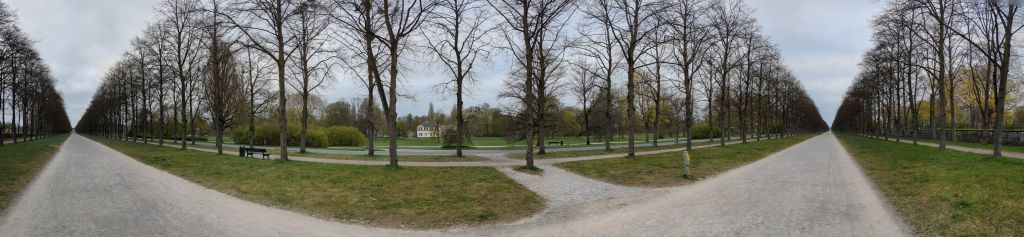
Herrenhäuser Gärten, https://de.wikipedia.org/wiki/Herrenh%C3%A4user_G%C3%A4rten: … Der Große Garten … zählt zu den bedeutendsten Barockgärten in Europa … das historische Kernstück der Herrenhäuser Gärten … Georgengarten … 1726 … Anlage der zwei Kilometer langen, vierreihigen Herrenhäuser Allee …
[23-23]
Cf.:
6 Mar 2025, Φ International Urban Health Summit (9-12 April 2025): program update
6 Feb 2025, Φ Towards the International Urban Health Summit (IUHS), Hannover, 9-11 April 2025 – Draft program
25-26 Nov 2024, Φ♣ Wattenscheid: 10. Konferenz Stadt der Zukunft – Gesunde, nachhaltige Metropolen
8 Nov 2024, Φ Announcements of the International Urban Health Summit (IUHS), Herrenhausen Castle, Hannover, 9-11 April, 2025
6 Nov 2024, Φ♣ Akademientag 2024: In Städten gesund leben – in gesunden Städten leben
20 Mar 2024, Φ Ausschreibung: Junior-Forschungsgruppe zu Gesunden Nachhaltigen Metropolen / Call for proposals: Junior research group on Healthy Sustainable Metropolises
21-22 Nov 2023, Φ♣ KIX – IX. Konferenz Stadt der Zukunft, Bonn / 9th Conference City of the Future, Bonn
20 Nov 2020, Φ Dt. Stiftungszentrum: Jahresbericht 2020 „Lichtblicke“, inkl. „Stadt der Zukunft“



 Human ecology and health