European Public Health Association (EUPHA) and UK Society for Social Medicine: “7th European Public Health conference – Mind the gap: Reducing inequalities in health and health care“, Glasgow / Europäische Public Health Gesellschaft (EUPHA) und UK Society for Social Medicine: “7. Europäische Public Health Konferenz – Mind the gap: Reducing inequalities in health and health care, Glasgow (UK), 19–22 Nov 2014 [13-31]
Workshop I.1: Health Technology Assessment and Health Impact Assessment – Two key examples of health assessment
Organised by: EUPHA section on Health impact assessment and (proposed) EUPHA section on Health technology assessment [14-2]. Key messages:
- While HIA and HTA already play important roles in many European countries, their potential still seems underrecognized and deserving closer scrutiny
- Both HIA and HTA would benefit from a ‘‘unified’’ perspective on assessment approaches, including commonalities, differences, and mutual learning opportunities.
Workshop presentations:
- Introduction to and international trends in Health Impact Assessment through case study experiences. Salim Vohra, Public Health by Design, London, UK; Health Section, IAIA, Fargo, USA
- Three approaches to quantitative health impact assessment in Copenhagen. Astrid Ledgaard Holm, H Bronnum-Hansen, F Diderichsen, Section of Social Medicine, Department of Public Health, University of Copenhagen, DK
- Assessing health technologies through HTA: requisites, methods, challenges and perspectives. Chiara de Waure, F Kheiraoui, C Favaretti, W Ricciardi, Catholic University of the Sacred Heart, Rome, IT
- Bridging research and policy making: what do decision makers have and what do they want? Aileen Clarke, Division of Health Sciences, Warwick Medical School, University of Warwick, Coventry, UK
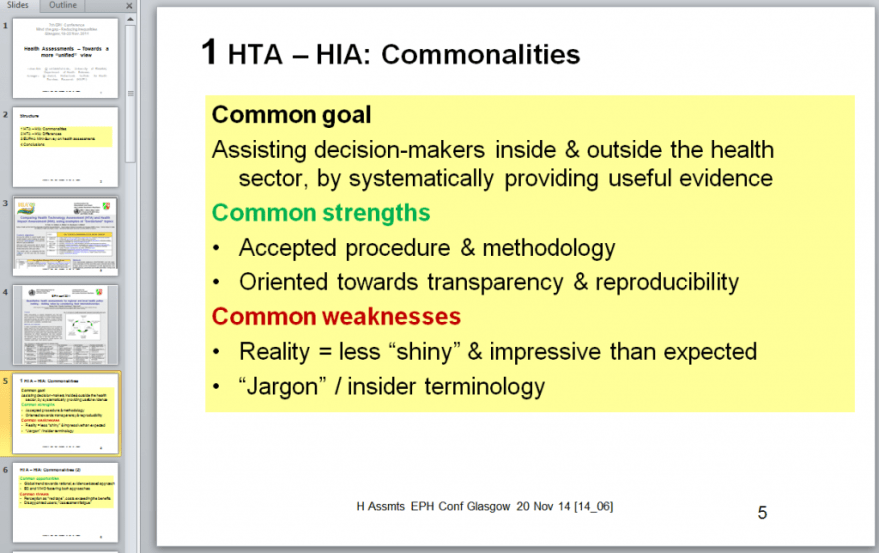
- Health assessments – Towards a more ‘‘unified’’ view. Rainer Fehr, University of Bielefeld, Bielefeld, DE; Dineke Zeegers Paget, EUPHA [14-6]. „Lessons: In many countries, HIA and/or HTA already play important roles for the protection and promotion of human health. The assessments (especially in a ‘‘unified’’ perspective) deserve closer attention in research projects, in the science – policy discussion, and in Public Health curricula.”
Poster: Health in Impact Assessments – Opportunities & Challenges. Julia Nowacki, WHO Regional Office for Europe; Francesca Viliani, SOS International; Rainer Fehr, University of Bielefeld; Marco Martuzzi, WHO Regional Office for Europe [14-4]

Presentation: Health foresight – A survey on quantifying tools. Odile Mekel, NRW Centre for Health (LZG.NRW), Bielefeld, DE; R Fehr, University of Bielefeld, DE; JP Mackenbach, Erasmus Medical Centre (EMC), Rotterdam, NL; F Hurley, Institute of Occupational Medicine (IOM), Edinburgh, UK [14-7]
Discussion: “Interpretations of, and attitudes towards, tool evaluation differ and need to be explored further. Results of this current survey will be merged with existing knowledge, including from earlier workshops on impact quantification. In additional steps, two further groups are planned to be surveyed: (i) advanced HIA practitioners as key users of quantifying tools, and (ii) policymakers as primary target group for the information produced with these tools.”
Key messages:
- For quantitative health foresight and impact assessment, a diverse and valuable set of tools does exist; but most tools have emerged individually – and unnoticed by many potential users.
- If existing tool developments interacted more closely with each other and with potential users, this could booster health foresight as a contribution to health-supportive policy-making.


