13 Jun 2016, Φ HafenCity University: “Finding Places” for refugees’ accommodations

HafenCity University (HCU): “Finding Places” for refugees’ accommodations in Hamburg / HafenCity-Universität (HCU): Projekt “Finding Places” zur Standortsuche für Flüchtlingsunterkünfte
IMG_5526

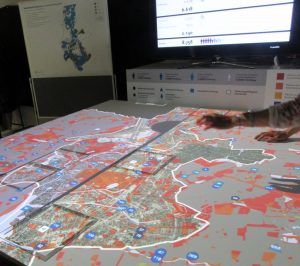
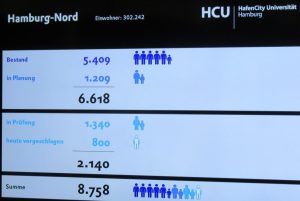
To provide adequate housing for refugees in the city state, the Hamburg senate searches for additional locations, also relying on public participation based on advanced visualization methods / Um geflüchteten Menschen im Stadtstaat Hamburg geeignete Wohnunterkünfte zu bieten, sucht der Hamburger Senat zusätzliche Standorte und baut dabei auch auf BürgerInnenbeteiligung mit fortgeschrittener Visualisierungstechnik (taz 12.5.16: „Neues Such-Werkzeug für Bauflächen“).

HCU’s City Science Lab (a cooperation with MIT Media Lab) hosts a series of – according to schedule – 42 workshops, involving project work at three stations: city, district, and quarters. Considering both “hard” (e.g., nature reserves) and “soft” (e.g., park) characteristics, areas are being proposed; the city government is committed to publish their replies within 2 weeks / In dem in Kooperation mit dem MIT Media Lab betriebenen City Science Lab der HCU erfolgt eine Serie von (geplant) 42 Workshops, in denen an drei Stationen (Gesamtstadt; Bezirk; Quartier) gearbeitet wird. Unter Berücksichtigung von „harten“ (z.B. Naturschutzgebiet) und „weichen“ (z.B. Grünanlage) Merkmalen werden Flächenvorschläge erarbeitet; Antworten der Stadt sollen nach 14 Tagen veröffentlicht werden, www.findingplaces.hamburg.

IMG_5525

Personal commentary / Persönlicher Kommentar

  • Impressive approach for launching a well-informed process of discussion and proposal-making for a current topic of societal relevance / Eindrucksvoller Ansatz, um einen gut informierten Diskussions- und Vorschlagsprozess für ein aktuell wichtiges Thema in Gang zu bringen
  • Challenges include providing appropriate information (selection of indicators, timeliness, relevance, intelligibility) and adequate weighing of workshop results, with participants representing a self-selected, tiny fraction of population potentially affected / Herausforderungen liegen u.a. im Vorhalten geeigneter Informationen (Indikatorenauswahl, Aktualität, Relevanz, Verständlichkeit) und in der angemessenen Gewichtung der Workshopergebnisse, da TeilnehmerInnen ja einen selbst-selektierten, winzigen Anteil der potentiell betroffenen Bevölkerung ausmachen
  • This process aiming at public property needs to be complemented by thoroughly exploring the potential of private property (survey of interest; discussion on social obligations of property ownership; nudging, etc.) / Parallel zu diesem auf städtische Flächen ausgerichteten Prozess sollte nachdrücklich auch das Potenzial geeigneter Flächen im Privatbesitz erkundet werden (Interessensabfrage; Diskussion mit Blick auf Sozialbindung des Eigentums; Nudging etc.)

Conclusion / Folgerung

Recommendation to participate – contribute to tackle an urgent issue; explore a cutting-edge participatory approach; visit the charming HCU premises / Teilnahme empfehlenswert – Lösungsbeitrag zu einer dringenden Problemlage; Erkundung eines innovativen Partizipationsansatzes; Besuch im reizvollen HCU-Gebäude.

29 May 2016, Braunschweig: 6th Community Brunch

Initiated by the Civic Foundation Braunschweig, the sixth “Community Brunch” took place, with thousands of participants sitting at 850 tables in the streets and squares, as well as with mobile artistic and musical performances / Initiiert von der Bürgerstiftung Braunschweig fand hier zum sechsten Mal ein „Bürger-Brunch“ statt, mit Tausenden von TeilnehmerInnen an 850 Tischen auf Straßen und Plätzen sowie mit mobiler Kunst und Musik.

The Bürgerstiftung manages c. 30 loal foundations and supports six fields of activity, including: Education (Literacy project); Integration and violence prevention (Language tutors); Sports and health (Shelter); Nature and environment (Centre for nature experience) / Die Bürgerstiftung verwaltet ca. 30 Stiftungen und unterstützt sechs Bereiche, darunter: Bildung und Erziehung (Leseförderprojekt “Auf dem Weg zum Buch”, mit Lesepaten); Integration, Gewaltprävention und Konfliktberatung (SprachPaten); Sport und Gesundheit (Tagestreff IGLU); Natur und Umwelt (Naturerlebniszentrum).

29 Apr – 1 May 2016, Amsterdam

Science Centre Nemo, www.nemosciencemuseum.nl/en/

1 Fenomena: Experience how science works, 2 Technium: Unravel everyday technology, 3 Elementa: Learn about the building blocks of the cosmos, 4 Humania: Discover more about who you are, 5 Energetica: Play with energy

On top: Viewpoint “Panorama Amsterdam” (Jan Rothuizen) / Auf dem Dach: Aussichtspunkt “Panorama Amsterdam” (Jan Rothuizen)


IMG_4541Rijksmuseum, www.rijksmuseum.nl/en


Bimhuis, www.bimhuis.nl

Doek ABC Festival 2016 – Amsterdam / Berlin / Chicago: Capitals of Improvisation, www.doek.org/festival-2016/

  • Warelis, Govaert, Dejoode: Marta Warelis – piano, Onno Govaert – drums, Wilbert de Joode – double bass
  • Annette Krebs – Konstruktion #2, annettekrebs.eu/
  • Jason Roebke Ensemble, jasonroebke.info/


Restaurant PiazzaIMG_4463

27 Jan 2016, Self-representations of crisis – Artistic practices and cultural forms of protest in Spain

Self-representations of crisis – Artistic practices and cultural forms of protest in Spain. Presentation and discussion with author Dr. Anja Steidinger, member of “Enmedio” and “La Maleta del Cine”, Barcelona / Selbst-Repräsentationen von Krise – Künstlerische Praktiken und kulturelle Protestformen in Spanien.  Vortrag und Diskussion mit Dr. Anja Steidinger, Mitglied von “Enmedio” and “La Maleta del Cine”, Barcelona

IMG_3110
Anja Steidinger

An event of Rosa Luxemburg Stiftung Hamburg; sponsored by State Agency for Civic Education, Hamburg; Venue: “Centro Sociale”, Sternstr. / Eine Veranstaltung der Rosa Luxemburg Stiftung Hamburg; gefördert von der Landeszentrale für Politische Bildung, Hamburg; Ort: “Centro Sociale”, Sternstr.


Cutback I: Transition or transaction (Transición o transacción) / Rückblende I: Übergang oder Transaktion

Cutback II: Global movement and crisis (Movimiento global y crisis) / Rückblende II: Globale Bewegung und Krise

Cultural forms of protest in Spain since the 1970s, using performance and new technologies of visualization, e.g. / Kulturelle Protestformen in Spanien seit den 1970er Jahren, mit Performance und neuen Bildtechnologien, z.B.:

  • “V de Vivienda” (~ A right to the city) / ~ “Recht auf Stadt”
  • “Monumento en huelga” (Monument on strike) / “Denkmal im Streik”
  • Enmedio’s intervention “#SinMordaza” against the Ley Orgánica de protección de la seguridad ciudadana, alternatively called Ley Mordaza / Intervention gegen das “Gesetz zur Sicherheit der Bürger”, auch Ley Mordaza (Knebelgesetz) genannt
  • Enmedio’s campaign with Plataforma de Afectados por la Hipóteca (PAH) (People affected by the mortgage crisis), directed at parliamentarians to support a citizen’s initiative for solutions to the housing problem, including avoidance of evictions: “Sí se puede – Pero no quieren” (Yes, we can – but they don’t want to) / Enmedios Kampagne mit Plataforma de Afectados por la Hipóteca (PAH) (Plattform der von der Hypothekenkrise Betroffenen), die ParlamentarierInnen auffordert, ein Bürgerbegehren zur Lösung der Wohnungsproblematik zu unterstützen, einschließlich Vermeidung von Wohnungsräumungen: “Ja, wir können – Aber sie wollen nicht”
  • La Fiambrera group: “Aunque estés empadronado, no eres nadie frente a la especulación” (Even if you are officially registered, you are a nobody when facing speculation) / “Selbst wenn du gemeldet bist, bist du ein Niemand wenn es um Spekulation geht”
  • GILA group (GILA Groupo de Intervención de Lavapiés. Artivismo Cutregamberro: humor, creatividad y acción directa), an intervention with human beings demonstrating a domino effect / Intervention: Dominoeffekt mit Menschen

Steidinger, Anja (2015): Unbehagen. Selbst-Repräsentationen von Krisen. Verlag Silke Schreiber, München. Zugleich Dissertation “Auto-representaciones del malestar. De la autobiografía de los trabajadores en el siglo XIX hasta la occupación de las plazas  (no nos representan)”; Universidad de Barcelona 2013