3-6 Sep 1997, Φ Münster, IEA European Regional Meeting: The health of populations in a changing Europe

3.-6.9.1997, Münster, International Epidemiological Association (IEA) – European Regional Meeting: The health of populations in a changing Europe

International Epidemiological Association (IEA) – European Regional Meeting; organized by Institute für Epidemiologie und Sozialmedizin, U Münster; Akademie für öffentliche Gesundheit; in cooperation with IEA European Epidemiological Group and Deutsche Arbeitsgemeinschaft für Epidemiologie

  • Venue: University of Münster, Zentralklinikum, Lehrgebäude of the Medical School
  • Scientific Secretariat: U. Keil, H.-W. Hense
  • Satellite Symposium (3.9.1997): Cancer Registration in Europe (U. Keil, E. Grundmann)

Flyer


Own contribution: R. Fehr, Surveillance approaches for “Agenda 21”: Regional mortality predictors in Germany. Beitrag 199, Oral presentation, Session “Surveillance and Monitoring I” [96-40].

Abstract (Program book, p.63):

  • Purpose: To improve the basis for Environmental Health policy-making and for establishing a regional or local “Agenda 21“, as demanded by international agreement at the UN Conference on Environment and Development in 1992.
  • Methods: All-cause mortality is taken as a useful, complex indica­tor of overall population health. Age-standardized mortality rates were computed for 416 cities and counties in Germany, 1994. After appropriate transformations, the association of geographic location and population density with all-cause mortality was ex­amined by multiple regression. Outlier analysis (1st and higher de­grees) was used to characterize individual regions.
  • Results: Regional mortality was found to be associated signifi­cantly with geographic latitude (positive, p<.0001), population density (negative, p<.0001), and location in former East vs. West Germany (higher in the East, p<.0001). The model predicted 65% of the mortality variance. The negative relationship between po­pulation density and mortality was confirmed in all federal states of Germany except for one. – Accounting for basic regional cha­racteristics, the model provides “expected” mortality rates that can be compared to current rates, and used for rating purposes in the process of regional policy-making for “Agenda 21″. For re­gions with higher-than-expected mortality rates, the expected rates can serve as “target lines”. “Outlier” regions may warrant special investigations into causative or protective factors, respec­tively.
  • Conclusions: Surveillance based on readily available data can be useful for regions striving to establish “baselines” and “targets” and to define regional characteristics. – Next steps refer to the inclusion of additional environmental and socio-economic data and to the examination of temporal trends.
9-11 Jun 1997, Φ HH, UBA-Workshop „Gesundheitsbezogene Umweltstandards: Stand und Perspektiven“

9.-11.6.1997, HH, UBA-Workshop „Gesundheitsbezogene Umweltstandards: Stand und Perspektiven“

  • Veranstalter: Umweltbundesamt (UBA) Berlin
  • Tagungsleitung: Fischer (UBA-WaBoLu), Kappos (BAGS Hamburg)
  • Tagungsort: Haus Rissen, Hamburg
  • Organisation: Behörde für Arbeit, Gesundheit und Soziales (BAGS) Hamburg im Auftrag des UBA-WaBoLu.

Eigener Beitrag – Mekel O, Nolte E, Fehr R: Probabilistische Expositionsabschätzung im Rahmen der Standardsetzung:

  • 1 Kontext
  • 2 Variabilität und Ungewissheit bei Exposiitonsabschätzung
  • 3 Punktschätzung für Expositionen
  • 4 Probabilistische Schätzung für Expositionen
  • 5 Exemplarische Anwendung
  • 6 Entwicklungsstand
  • 7 Empfehlungen
  • Ergänzungen: 1 Sensitivitätsanalyse; 2 Software für probabilistische Analysen; 3 Exemplarische Anwendungen.

Ein Ergebnis des Workshops war die Bildung einer informellen Arbeitsgruppe zum Themenkomplex „probabilistische Expositionsabschätzung“ und „Quotierung“, die für den 24.7.97 ein erstes Arbeitstreffen in Bielefeld vereinbarte.

Kurzbericht:

25-27 Sep 1996, Φ Witten, DGSMP-Jahrestagung: Gesundheitswesen im Wandel

25.-27.9.1996, Witten, Deutsche Gesellschaft für Sozialmedizin und Prävention (DGSMP): Gesundheitswesen im Wandel


Own contribution:

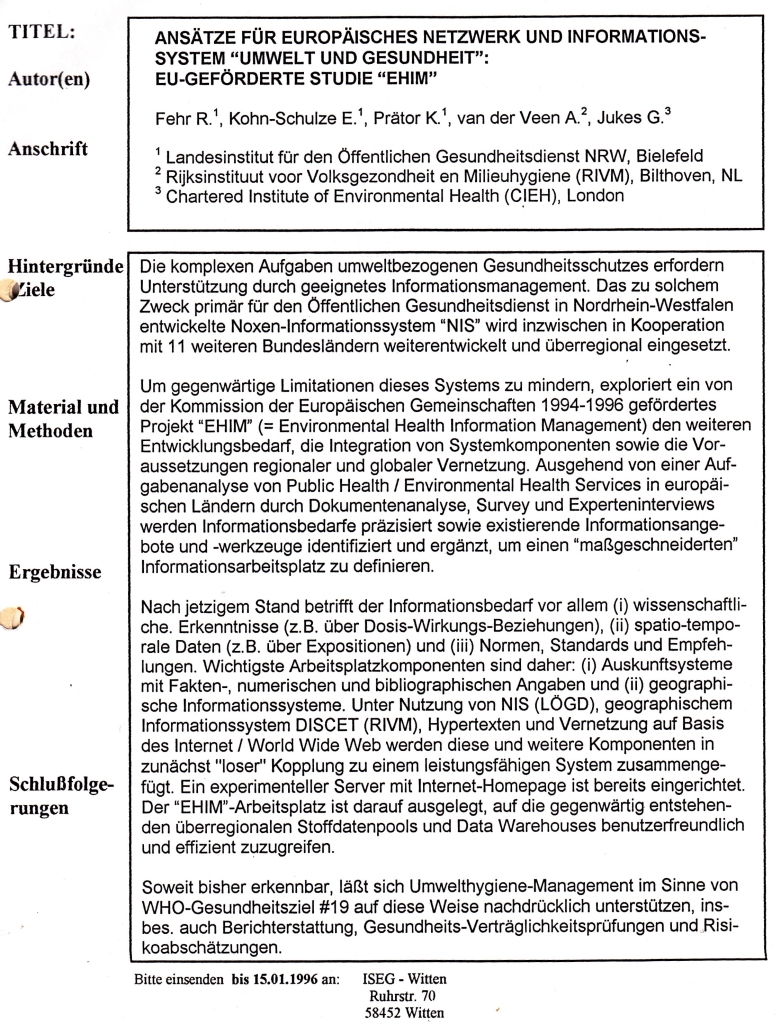
  • Fehr, R., Kohn-Schulze, E., Prätor, K., van der Veen, A., Jukes, G. (1996): Ansätze für europäisches Netzwerk und Informationssystem “Umwelt und Gesundheit”: EU-geförderte Studie “EHIM”. Abstract published in:  Jahrestagung der Deutschen Gesellschaft für Sozialmedizin und Prävention (DGSMP), 25.-27.9.96, Witten-Herdecke. Gesundh.-Wes. 58, p.LXXIX [96-06].

EHIM = Environmental Health Information Management, cf. project.

96_06 Fehr et al 1996_09_25 EHIM Abstract

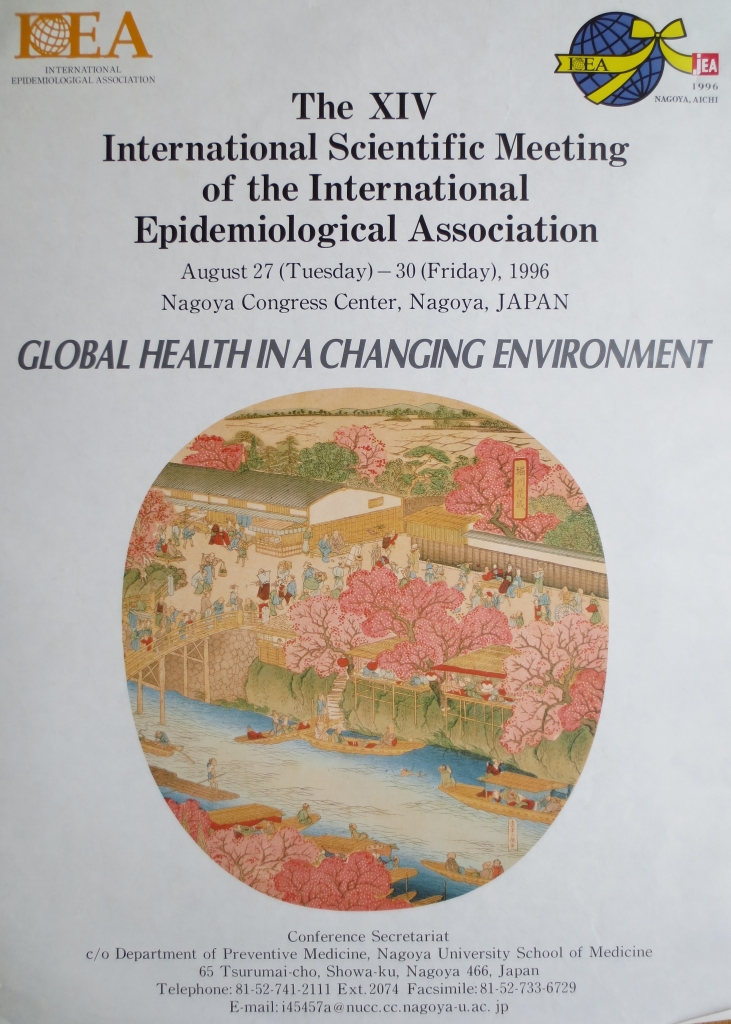
27-30 Aug 1996, Φ Nagoya (JP), XIVth IEA meeting: Global Health in a Changing Environment

27.-30.8.1996, Nagoya (JP), XIVth International Scietific Meeting of the International Epidemiological Association (IEA): Global Health in a Changing Environment

Venue: Nagoya Congress Center

Incl. Global Environmental Epidemiology Network (GEENET) meeting, 28 Aug 1996 (J. Last, C. Corvalàn)

Own contribution:

  • Fehr, R., Kobusch, A.-B., Protoschill-Krebs, G., Serwe, H.-J. (1996): Environmental Health Impact Assessment (EHIA): Underutilized tool for ecologic health protection and promotion. Abstract 29PMPS1115, Program book, p.213 [96-01]

Abstract:

  • Purpose: To explore the potential of EHIA as a tool for health promotion; to develop a generic EHIA model; to contribute to efficient EHIA practice.
  • Methods: Status quo assessment by survey and document analysis; development of comprehensive EHIA approach; evaluation of model applications.
  • Results: Requirements of European law on Environmental Impact Assessment (EIA) include the assessment of human health impacts. In 71 EIA documents analyzed, health im­plications were rarely treated explicitly. A survey of 54 local health departments demonstrated current proced­ural deficiencies. A novel 10-step EHIA approach inte­grating quantitative risk assessment (QRA) methodology has been developed, covering prediction, assessment, communication, and evaluation. The approach was tested successfully in model applications concerning waste ma­nagement and highway planning and is now endorsed by the German Conference of Health Ministers. Recent develop­ment of dedicated Environmental Health information work­places also allows to provide for specific tools and re­sources for EHIA.
  • Conclusion: Comprehensive EHIA has a great potential for environmental health promotion. Current obstacles to wide-spread use can be overcome by provision of adequate concept, efficient tools, and professional training.

Left: Conference poster; Right: Our poster (required size was 90cm in width, 180cm in height; foto of downsized model)