
21.1.2026, Jungen & Nastold (2025): “Digging, composting, net-working”. Towards a post-anthropocentric understanding of plants and humans as interacting actors (Book chapter)
Buchkapitel / Book chapter: Thari Jungen, Friederike Nastold (2025): Umgraben, Kompostieren, Netz-Werken. Mehr-als-menschliche Gefährt*innen gärtnern / Digging, composting, net-working. More-than-human companions gardening (pp.85-108, in German). Abstract: „Der Beitrag untersucht die Rolle von Pflanzen in Kunst und visueller Kultur im Anthropozän und fragt nach Formen der Co-Autor*innenschaft. Künstlerische Beispiele, wie der bengalische Gemüsegarten von Britto Arts Trust [auf der documenta fifteen] und Precious Okoyomons Garten auf der Biennale 2022, zeigen, wie Pflanzen soziale, ökologische und koloniale Narrative verkörpern und wi(e)der/erzählen. Der Beitrag plädiert für ein post-anthropozentrisches Verständnis von Pflanzen und Menschen als interagierende Akteur*innen“/ Abstract: „This article examines the role of plants in art and visual culture in the Anthropocene and explores forms of co-authorship. Artistic examples, such as the Bengali vegetable garden by Britto Arts Trust [at the documenta fifteen] and Precious Okoyomo’s garden at the 2022 Biennale, show how plants embody and (re)tell social, ecological, and colonial narratives. The article advocates for a post-anthropocentric understanding of plants and humans as interacting actors.”
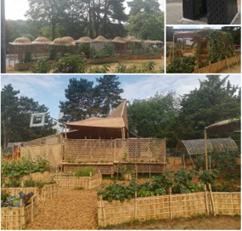
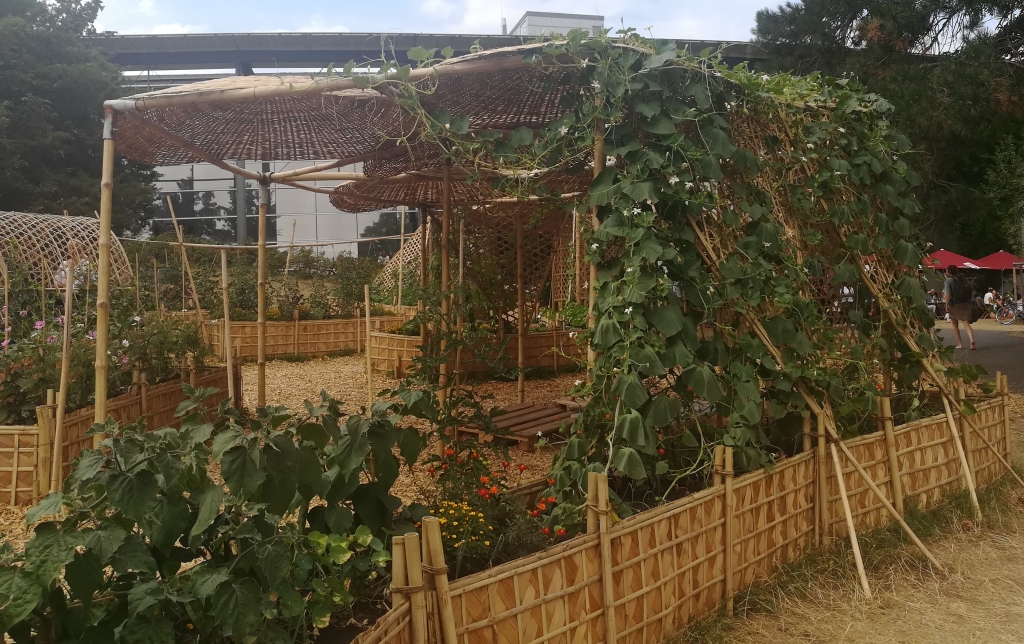
Randbemerkung / Side note: Nach erfolgter Absprache verwenden die Autorinnen in ihrem genannten Beitrag ein von dieser Website rfehr.eu stammendes Foto des bengalischen Gemüsegartens von Britto Arts Trust, einem Kollektiv aus Dhaka (Bangladesch), wie auf der documenta fifteen in 2022 in Kassel zu sehen. Danke für die passende Referenzierung / Following proper consultation, in their aforementioned article, the authors use a photo from this website rfehr.eu of the Bengali vegetable garden by Britto Arts Trust, a collective from Dhaka (Bangladesh), as seen at documenta fifteen in Kassel in 2022. Thank you for the appropriate referencing.
Sternath, Vanessa-Nadine; Lang, Silvie; Riess, Christine (Hg.) (2025): Menschen-Pflanzen-Netzwerke. Vegetabile agency in der Klimakatastrophe. [Human-plant networks. Vegetable agency in the climate catastrophe]. Climates – Cultures – Contexts, vol. 2. Transcript Verlag, Bielefeld.
Auswahl weiterer Beiträge im Buch / Selection of further book chapters:
- Catherin Persing: Pflanzen performen. Bühnen des Mehr-als-Menschlichen im Anthropozän / Plants perform. Stages of the more-than-human in the Anthropocene
- Lisa Hinterleitner: Wie man eine Nirnwurz zum Schweigen bringt. Interdependenzen zwischen spielerischer und vegetabiler agency in Open-World-Spielen und Strategiespielen / How to silence a Nirnroot. Interdependencies between playful and vegetal agency in open-world games and strategy games
- Sophia Sternath: Eco Enzyme. Tackling the Climate Catastrophe with Plant-Based Reusable Products
- Elsa Romfeld: Der Ruf der Pflanze. Eine Erinnerung an unsere natürliche Verbundenheit / The Call of the Plant. A reminder of our natural connection.
[English translations: DeepL]
Cf.:
- 17 Jan 2026, ♣ Berlin, Delphi Lux, Enyedi: Silent Friend
- 29-30 Jul 2022, ♣ Kassel: Documenta 15 – Personal parcour / Persönliche Tour [incl. Bengali vegetable garden]
- 29 Nov 2019, ♣ Berlin, Gropius-Bau: Garten der irdischen Freuden, inkl. Victory Gardens – Futurefarmers San Francisco7-9 May 2015, Φ Sommerhausen: DGH-Tagung “Umwelt und Gesundheit – Ökologie der Person im Anthropozän”
- 18 Dec 2015, München, Deutsches Museum: Anthropocene
- 31 Jan 2015, München: Deutsches Museum “Willkommen im Anthropozän”
- 11 Jul 2013, Berlin HKW: Anthropocene Observatory, Episode 1
- 1 Jun 2013, Berlin, HKW: The Whole Earth
 Human ecology and health