3 May 2014, Wien: Sigmund Freud Museum

Sigmund-Freud-Museum, Berggasse 19, 1090 Wien


Special exhibition: “Freud’s journeys. Cultural experience – psychoanalytic thinking” / Sonderausstellung “Freuds Reisen. Kulturelles Erfahren – psychoanalytisches Denken”, 7.3.-5.10.2014. Curated by / Kuratiert von Daniela Finzi & Simone Faxa

The exhibition looks at Freud’s numerous journeys, undertaken for private and professional purposes. It investigates the role of travelling for Freud’s theoretical work and underlines the role of global sites for Freud’s live / Die Ausstellung geht den zahlreichen Reisen nach, die Sigmund Freud beruflich und privat unternahm. Beleuchtet werden neben der erzwungenen Flucht vor den Nationalsozialisten nach England auch die Übersiedlung der Freuds von Freiberg nach Wien als erste Reise des dreijährigen Sigmund, Rundreisen an antike Schauplätze in Italien und Griechenland sowie die 1909 per Schiff unternommene Vortragsreise an die US-Ostküste. Die Ausstellung untersucht auch die Bedeutung der Reisen für Freuds theoretische Arbeit und verweist auf die zentrale Rolle, die weltweite Schauplätze in Freuds Leben spielten.

DE: www.freud-museum.at/de/media/aussendung/freuds-reisen-kulturelles-erfahren-psychoanalytisches-denken-im-sigmund-freud-museum.html

18 Apr 2014, Bucerius Forum: Mondrian Farbe

Bucerius Kunst Forum, Hamburg: Mondrian Colour / Mondrian Farbe, 1.2.-11.5.2014

“Piet Mondrian’s work is known for his use of red, yellow and blue in his paintings. By 1921 he had begun to paint only in these primary colours, combining them with white planes and black lines… Mondrian developed into the pioneer of Colour Field painting” / “Rot, Gelb und Blau sind die Farben, die Piet Mondrians (1872-1944) Werk berühmt gemacht haben. Seit 1921 malte er ausschließlich mit den Primärfarben und kombinierte sie mit weißen Flächen und schwarzen Linien… entwickelte sich Mondrian zum Pionier der Farbfeldmalerei.“

“Goethe’s theory of colours drew his attention for the first time to the primary colours… In his dune paintings, Mondrian transformed colour to create abstract works of art… He painted numerous variations of colours in perpetually changing relationships in a never ending series of images…” / „Goethes Farbenlehre lenkte seine Aufmerksamkeit erstmals auf die Primärfarben… In seinen Dünenbildern entließ Mondrian die Farbe in die Abstraktion… In zahlreichen Variationen und unabschließbaren Bildreihen zeigt er die Farben in immer neuen Beziehungen…“

5 Apr 2014, Stockholm: Dance machines – From Léger to Kraftwerk

Moderna Museet, Stockholm: Dansmaskiner – Från Léger to Kraftwerk / Dance machines – From Léger to Kraftwerk, 22..-27.4.2014

Including / Einschließlich:

  • Oskar Schlemmer (1922): The Triadic Ballet
  • Fernand Léger (1924): Balle Mécanique
  • Kraftwerk (Ralf Hütter, Florian Schneider) (2013): 12345678 (3-D installation)

“The exhibition focuses on the modernists’ fascination with the machine and mechanised everyday life, and how Kraftwerk has explored the relationship between man and machine in multidisciplinary projects… In the first decades of the 20th century, industrialised, mechanised society made inroads into art and everyday life. The Italian futurists proclaimed a new era, with the industrial sector and its machines as an aesthetic ideal. In Paris, the hub of European avant-garde, … Fernand Léger … and … Guillaume Apollinaire … were among the first to use modernity – and the modern city – as their subject matter… film, choreography and dance became essential to portraying movement, energy and dynamism. …”

“The machine became a modernist icon, and anonymous engineers were looked upon as the true artists. Gradually, industrial rationalism and experiences from the war gave rise to notions of the body as a soulless engine. … Kraftwerk founders and electro pioneers Ralf Hütter and Florian Schneider have been creating futuristic electro music since 1970 at their Kling Klang Studio in Düsseldorf, Germany using synthetic sounds and voices, minimalist speech singing and lyrics with monotonous industrial rhythms. With the robot as their artistic alter ego and the 3-D visuals of their performances, they have explored the relationship between man and machine in multidisciplinary projects.“

www.modernamuseet.se/press/en/press-releases/?view-newsletter=12391

1 Apr 2014, Hamburger Kunsthalle: Gego and Eva Hesse

Hamburger Kunsthalle, Glockengießerwall, Hamburg: (1) Gego – Line as object. (2) Eva Hesse: One more than one, 29 Nov 2013 – 2 Mar 2014

  1. Gego – Line as object

“Gertrud Goldschmidt, known as Gego (Hamburg 1912 – 1994 Caracas), was one of the most important women artists in Latin America. Her best-known works are the Reticuláreas – net-like spatial installations she created using thin wire and metal in the late 1960s… numerous works on paper, prints, artist’s books, watercolours and drawings…” / “Gertrud Goldschmidt, genannt Gego (*1912 in Hamburg, †1994 in Caracas) zählt zu den bedeutenden Künstlerinnen Lateinamerikas. Vor allem bekannt wurde Gego für ihre netzartig angelegten Rauminstallationen, den so genannten Reticuláreas, die sie Ende der 1960er Jahre aus feinem Draht und Metall entwickelte… in vielfältigen Arbeiten auf Papier, in Druckgraphiken, Künstlerbüchern, Aquarellen und Handzeichnungen…“

“In 1939 she emigrated to Venezuela after a brief stay in England. Having settled in Caracas, she initially worked as an architect and furniture designer before devoting her full attention to fine art … „Gego’s revolutionary and experimental approach to line, sculpture and ‘drawing in space’ had a significant influence on countless Latin American artists and has left its mark on contemporary art far beyond Venezuela” / „…1939 über England nach Caracas emigriert. Dort arbeitetet sie zunächst als Architektin und Möbeldesignerin, bevor sie … sich der Kunst zuwendet. Gegos revolutionäre und experimentelle Auffassung von Linie, Skulptur und Zeichnung im Raum wurde wegweisend für eine junge Generation von Künstlerinnen und Künstlern in Lateinamerika und prägte die zeitgenössische Kunst weit über Venezuela hinaus.“

  1. Eva Hesse: One More than One

Eva Hesse (Hamburg 1936 – 1970 New York) was one of the foremost women artists of the 20th century. In the mid-1960s she began to experiment with new materials that until then had never been used for sculpture, such as polyester, fibreglass and latex. Influenced by the emerging Minimal Art movement, Hesse developed an interest in serial processes and reduction, but in her own work these were accompanied by sensuous materiality and physicality…” / “Eva Hesse (*1936 in Hamburg, †1970 in New York) gilt als eine der herausragenden Künstlerinnen des 20. Jahrhunderts. In der zweiten Hälfte der 1960er Jahre experimentierte sie mit neuen Materialien, die in der Objektkunst bis dahin noch keine Verwendung gefunden hatten, wie Polyester, Glasfaser und Latex. Eine von der aufkommenden Minimal Art geprägte Serialität und Reduktion wird in Hesses Werk von sinnlicher Materialität und Körperhaftigkeit bestimmt.“

“When she was just two years old, her parents sent Eva and her older sister Helen to The Hague on a Kindertransport (children’s transport). The family was reunited in 1939 and emigrated to New York City… In the 1950s, Eva Hesse studied painting at New York’s Cooper Union and continued her studies in the master class of Josef Albers at Yale School of Art and Architecture …”  / “Als Zweijährige muss sie zusammen mit ihrer älteren Schwester Helen in einem Kindertransport ohne ihre Eltern ihre Heimatstadt verlassen. 1939 emigriert die Familie … nach New York. Dort studiert Hesse in den 1950er Jahren Malerei an der Cooper Union School und an der Yale School of Art and Architecture als Meisterschülerin von Josef Albers..”

“Eva Hesse’s breakthrough came in 1968, when she had her first solo exhibition as a sculptor at the Fischbach Gallery in New York. Just six months later she was diagnosed with a brain tumour, and she died in 1970 at the age of 34” / “Ihre erste Einzelausstellung als Objektkünstlerin hat sie 1968 in der Fischbach Gallery, New York, mit der ihr der künstlerische Durchbruch gelingt. Ein halbes Jahr später wird ein Hirntumor bei Eva Hesse diagnostiziert, an dem sie 1970 mit nur 34 Jahren stirbt.“

10 Mar 2014, Marseille: MUCEM

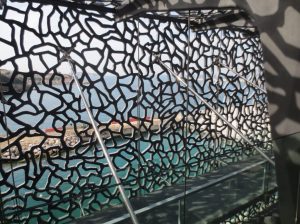
img_3794Musée des Civilisations de l’Europe et de la Méditerranée (MUCEM), Marseille

„Suspendu entre ciel et eau, flottant à l’entrée du Vieux-Port de Marseille, le MuCEM déploie de nouvelles passerelles. Ouvert sur le large, ce musée est par sa situation même un grand projet pour la Méditerranée dont il redessine l’horizon, désormais point de rencontr…” / “Suspended between sky and water, floating at the entrance to the Vieux Port in Marseille, the MuCEM is building new bridges. In its very location, facing the open sea, this museum is a major project for the Mediterranean, reshaping its future and forming a meeting point… ”

Jamais aucun musée n’avait été consacré aux cultures de la Méditerranée: la singularité du MuCEM est de retracer, d’analyser et d’éclairer, dans un même élan et un même lieu, les antiques fondations de ce bassin de civilisation si fertile, ainsi que les tensions qui le traversent jusqu’à l’époque contemporaine…“ / “This is the first time that a museum has been devoted to the cultures of the Mediterranean: the MuCEM is unique in that it retraces, analyses and sheds light on, in a single dynamic and a single place, the ancient foundations of this fertile cradle of civilization, as well as the tensions that have been a feature right up to the present day…”


SZ 30.7.2013, Joseph Hanimann: „Der Dampfer vom Mittelmeer.“ „… Marseille, die Anlaufstelle Nordafrikas und die einzige französische Großstadt, die ihre unterpriviligierten Bevölkerungsschichten nicht in die Banlieue auslagert… Völkerkundemuseen sind ein Auslaufmodell aus dem 19. Jahrhundert, das Mucem will einen neuen Typus von Zivilisationsmuseum schaffen.“