The research program “City of the Future – Healthy and sustainable metropolises”, funded by the Fritz and Hildegard Berg Foundation, supports research work under the headline of HealthyLiving in Berlin, since 1 Sept 2016 / Im Programm “Stadt der Zukunft – Gesunde und nachhaltige Metropolen” der Fritz und Hildegard Berg-Stiftung wird seit 1.9.2016 Forschungsarbeit unter der Überschrift HealthyLiving in Berlin gefördert.
A kick-off meeting takes place at TU Berlin on 30 Nov 2016. The event’s headline is “Healthy city of the future – where do we stand? Challenges on the way forward”. The meeting language is German / Eine Auftaktveranstaltung erfolgt am 30.11.16 an der TU Berlin. Die Veranstaltung steht unter der Überschrift: “Gesunde Stadt der Zukunft – wo stehen wir? Herausforderungen auf dem Weg zur gesunden Stadt”.
Workshop 10.K: Health assessments in support of decision-making
Organized by EUPHA sections Health Impact Assessment (HIA), Health Services Research, Public Health Economics, Public Health Practice and Policy; WHO; chairs: Rainer Fehr – Germany, Piedad Martin-Olmedo – Spain
Presentations:
Health Systems Performance Assessment. Judith de Jong (NIVEL, NL), presented by Tit Albreht (NIPH, SVN), Presentation: PDF
Do economic evaluations add value to health assessments in the decision-making process? Tek-Ang Lim (Santé publique France, FR), Presentation: PDF
Evidence-informed Policy-making – Where is the place for health assessments? Tim Nguyen (WHO EURO)
Fostering receptive policy settings for Health Assessments: power, process, and personality. Marleen Bekker (Radboud U & Maastricht U, NL), Presentation: PDF
Public health leadership and training opportunities for health assessments. Martin Mengel (Agence de Medicine preventive, FR), KM Czabanowska (Maastricht U, NL), Presentation: PDF
From the workshop abstract:
The commissioning, production, and utilization of health assessments of various types (assessment of status/impact/ technology/systems performance) is part of the working routine within the health sector and in other sectors, e.g. environment or economy. Such assessments, in the future, may be recognized for securing best use of evidence for decision-making. From this perspective, they should be included into Public Health curricula on a regular basis, preferably in an integrated way. Similarly, ways should be explored to advance various types of assessments in joint projects, thus fostering useful ‘‘co-evolution’’.
Key messages:
Based on 2014 & 2015 predecessors, the workshop illustrates how health assessments gain shape and visibility for evidence-based policy-making, both within and beyond the health sector
The integrative notion of health assessments calls for novel, practice-based approaches for educational curricula, and can add significantly to the development of Public Health leadership.
Both workshops organized by EUPHA section Health Impact Assessment (HIA). Partial funding for several participants was provided by the University of Bielefeld; many thanks to Prof. C. Hornberg.
Cardinal points (Braille)
From the workshop abstract:
An orientation of foresight and precaution is among the core virtues of Public Health. … Quantitative modeling is meant to help in estimating impacts of developments, policies and interventions, in identifying group differentials, comparing scenarios, ranking interventions, and thus to support governance and decision-making. A range of impact quantification tools are available, providing approaches to strengthen ‘‘foresight’’ awareness, and to contribute to the development of health impact modeling as a component of good Public Health practice. … The current workshop focuses on practical experiences with existing models and tools, compares and critically discusses them, and identifies appropriate steps forward. A range of reallife examples of tool application will be discussed, in the light of the following questions:
What was the (governance) question or problem that triggered the analysis?
What model was applied, what data used?
How were the following issues dealt with: (systemic) interactions, differential impacts/(in)equity, changes over time, uncertainty of estimates, visualization of results?
How did decision-makers and/or the public react?
Part 1 = Workshop 8.K
Chairs: Johan Mackenbach – Netherlands, Rainer Fehr – Germany
Modelling the economics of chronic disease with the EConDA tool and the UKHF microsimulation model. Abbygail Jaccard, Laura Webber (UK Health Forum, UK), Presentation: PDF
Risk factor modelling with the Proportional Multi-State Life Table model. Lennert Veerman (U Queensland, AUS), Presentation: PDF
The exposome and Health Impact Assessment. Dimosthenis A Sarigiannis, SP Karakitsios, A Gotti, E Handakas, K Papadaki (Aristotle U of Thessaloniki, GR, and other institutions), Presentation: PDF
Assessing Cancer Control Initiatives in Canada – the Role of CRMM [now: The Oncology Simulation Model OncoSim]. Michael Wolfson (U Ottawa, CAN), Presentation: PDF
Key messages:
The essential Public Health virtues of foresight and precaution call for assessing future impacts on health and disease
Using impact quantification tools, health impact modeling can develop into a component of good Public Health practice.
Part 2 = Wokshop 9.K
Chairs: Rainer Fehr – Germany, Johan Mackenbach – Netherlands
Modelling the effect of food and smoking policies on the unequal distribution of the burden of coronary heart disease: IMPACT models. Martin O’Flaherty (U Liverpool, UK), Presentation: PDF
If your mission includes „foresight“, efficient modeling tools are needed. Odile Mekel (LZG.NRW, DE), Rainer Fehr (U Bielefeld, DE), Presentation: PDF
Integrated environmental impact assessment with ECOSENSE – the impact pathway approach. Rainer Friedrich (U Stuttgart, DE), Presentation: PDF
Modeling of health and disease in support of governance and decision-making – Conclusions. Claudia Hornberg, Rainer Fehr (U Bielefeld, DE), Presentation: PDF
Key messages:
One step towards tapping the potential of health impact modeling for improving the health of the public is broadening the awareness of existing modeling tools and ‘‘good practice’’ examples
Typifying tasks and challenges at the science–governance interface may help to identify situations in which health impact modeling can be deployed efficiently and successfully.
Workshop 7.A, organized by EUPHA sections Health Impact Assessment (HIA) and Environment-related Diseases; chairs: Rainer Fehr – Germany, Dineke Zeegers Paget – EUPHA. Abstract (Workshop & presentations): https://eupha.org/repository/sections/HIA/2016_HIA_ENV_7A.pdf.
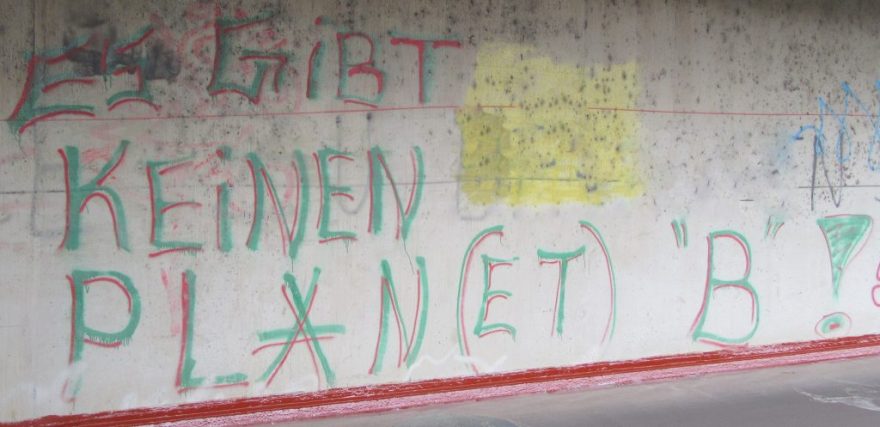
Donau-Reichsbrücke, Wien 11.11.16: “There is no plan(et) B!”
Presentations:
“Greening” conferences – Experiences from the International Society for Environmental Epidemiology (ISEE). N Kuenzli, MS Ragettli, M Röösli (U Basel, CH), Presentation: PDF
Guideline for a sustainable organization of events – Theory and practice. HH Eggers, D Huth, K Stechemesser, M Tobollik (Federal Environmental Agency / Umweltbundesamt, DE)
Footprint reduction: What can we learn from related initiatives within, e.g., the United Nations, World Health Organization, European Commission, and European Environment Agency? R Fehr, P van den Hazel, P Martin-Olmedo, M Martuzzi, O Mekel, G Morris (U Bielefeld and other institutions), Presentation: PDF
From the workshop abstract:
“To strive for sustainability is recognized as a prerequisite for improving people’s health and their environment in the 21st century. At the EPH 2015 conference in Milano, the issue received prominent attention; topics included the anthropocene, human impacts on global processes and systems, and the planetary boundaries consistent with human health and survival. … … Areas of concern include: mode of travel (especially by air); conference venue and accommodations; flow of energy and materials; food consumption; waste avoidance and disposal; physical activity; and equity, e.g. (financial) barriers to conference attendance. While previous conferences have not been oblivious to these issues, more should be done. … … success for EUPHA in this venture could provide a template for adoption by other, e.g. national, professional associations. In addition, the ‘‘greening’’ of EPH conferences can stimulate and encourage both individuals and institutions to move along similar pathways.”
Key messages:
For an ambitious association like EUPHA, concern for the impacts of our own activities features amongst our core values; this ought to be reflected in the arrangements for our annual conferences
Building on existing examples, EUPHA is challenged to prove that it has the profile and capacity to create positive example.
31 Jan 2017 Addendum: The BCSSS added a news item concerning this colloquium / Nachtrag: Das BCSSS stellte in der “News”-Rubrik eine Nachricht zum Colloquium ein: “Modeling health impacts for decision-making – On status and perspectives”, www.bcsss.org/news/
Vienna is home to the Bertalanffy Center for the Study of Systems Science (BCSSS), an Austrian independent research institute, working on Systems Science and Systems Design / Wien beheimatet das Bertalanffy Center for the Study of Systems Science (BCSSS), ein österreichisches unabhängiges Forschungsinstitut, welches den Grundlagen der Systemwissenschaft sowie dem Systems Design gewidmet ist.
Vienna’s doors providing access to many a treasure
The profile of the BCSSS was found to overlap with the Health Impact Quantification (HIQ) initiative, so a colloquium was planned for mutual benefit / Angesichts deutlicher Nähe zwischen dem BCSSS-Profil und den Anliegen der Initiative „Health Impact Quantification“ (HIQ) wurde zum wechselseitigen Nutzen ein Kolloquium geplant.
Colloquium agenda / Agenda des Kolloquiums:
Introduction / Einleitung (J. Mackenbach, R. Fehr, F. Tretter)
Round-table: Participants outlining their focus of interest in health impact quantification, incl. brief discussion of selected modeling tools / Runder Tisch: TeilnehmerInnen skizzieren ihre Interessensschwerpunkte in Health Impact Quantification, inkl. kurzer Diskussion ausgewählter Modellierungswerkzeuge
Actual vs. potential role of Health impact quantification for Public Health governance, incl. prudent foresight and prevention / Bisherige vs. potenzielle Rolle von Health Impact Quantification für Steuerungsaufgaben in Public Health samt vorausschauender Umsicht und Vorsorge
Options for future developments / Künftige Entwicklungsoptionen.
Colloquium participants: presenters and chairpersons (from Australia, Canada, Germany, Greece, the Netherlands, and the United Kingdom) of the Workshops 8.K and 9.K at the European Public Health (EPH) conference, 12 Nov 2016 plus additional modelers, BCSSS members, and interested parties / KolloquiumsteilnehmerInnen: Vortragende und Chairs (aus Australien, Kanada, Deutschland, Griechenland, den Niederlanden und UK) der Workshops 8.K und 9.K der EPH-Konferenz am 12.11.16 sowie zusätzliche Modellierer, BCSSS-Mitglieder und weitere interessierte Personen.
This was one of the rare occasions where different types of health modeling (environmental health; personal risk factors; national disease control system) were jointly discussed, from a Public health perspective / Eine der seltenen Gelegenheiten, unterschiedliche Arten der Gesundheitsmodellierung (Umwelt und Gesundheit; persönliche Risikofaktoren; nationales Krankheitsbekämpfungssystem) gemeinsam aus Public Health-Perspektive zu diskutieren.
Partial funding for several participants was provided by the University of Bielefeld; many thanks to Prof. C. Hornberg / Anteilige Förderung für mehrere TeilnehmerInnen wurde von der Universität Bielefeld zur Verfügung gestellt; Frau Prof. C. Hornberg sei hierfür gedankt.
Karl Ludwig von Bertalanffy (born 1901 near Wien, died 1972 in Buffalo, New York), trained as a biologist, was one of the founders of general system theory (GST) / Karl Ludwig von Bertalanffy (geboren 1901 nahe Wien, gestorben 1972 in Buffalo, New York), ausgebildet als Biologe, war einer der Gründer der Allgemeinen Systemtheorie.
“General system theory is intended to elaborate properties., principles and laws that are characteristic of “systems” in general, irrespective of their particular kind, the nature of their component elements, and the relations or “forces” between them. A “system” is defined as a complex of elements in interaction, these interactions being of an ordered (non-random) nature. … general system theory is interdisciplinary, that is, it can be employed for phenomena investigated in different traditional branches of scientific research. … General system theory can be developed in various mathematical languages, in vernacular language, or can be computerized.” Source: L. von Bertalanffy (1981): A Systems View of Man. Edited by Paul A. LaViolette. Westview Press, Boulder, CO, p.109.




 Human ecology and health