10 Nov 2016, Φ Health Impact Quantification meets Systems Science

31 Jan 2017 Addendum: The BCSSS added a news item concerning this colloquium / Nachtrag: Das BCSSS stellte in der “News”-Rubrik eine Nachricht zum Colloquium ein: “Modeling health impacts for decision-making – On status and perspectives”, www.bcsss.org/news/


Vienna is home to the Bertalanffy Center for the Study of Systems Science (BCSSS), an Austrian independent research institute, working on Systems Science and Systems Design / Wien beheimatet das Bertalanffy Center for the Study of Systems Science (BCSSS), ein österreichisches unabhängiges Forschungsinstitut, welches den Grundlagen der Systemwissenschaft sowie dem Systems Design gewidmet ist.

img_6887
Vienna’s doors providing access to many a treasure

The profile of the BCSSS was found to overlap with the Health Impact Quantification (HIQ) initiative, so a colloquium was planned for mutual benefit / Angesichts deutlicher Nähe zwischen dem BCSSS-Profil und den Anliegen der Initiative „Health Impact Quantification“ (HIQ) wurde zum wechselseitigen Nutzen ein Kolloquium geplant.

Colloquium agenda / Agenda des Kolloquiums:

  • Introduction / Einleitung (J. Mackenbach, R. Fehr, F. Tretter)
  • Round-table: Participants outlining their focus of interest in health impact quantification, incl. brief discussion of selected modeling tools / Runder Tisch: TeilnehmerInnen skizzieren ihre Interessensschwerpunkte in Health Impact Quantification, inkl. kurzer Diskussion ausgewählter Modellierungswerkzeuge
  • Actual vs. potential role of Health impact quantification for Public Health governance, incl. prudent foresight and prevention / Bisherige vs. potenzielle Rolle von Health Impact Quantification für Steuerungsaufgaben in Public Health samt vorausschauender Umsicht und Vorsorge
  • Options for future developments / Künftige Entwicklungsoptionen.

Colloquium participants: presenters and chairpersons (from Australia, Canada, Germany, Greece, the Netherlands, and the United Kingdom) of the Workshops 8.K and 9.K at the European Public Health (EPH) conference, 12 Nov 2016 plus additional modelers, BCSSS members, and interested parties / KolloquiumsteilnehmerInnen: Vortragende und Chairs (aus Australien, Kanada, Deutschland, Griechenland, den Niederlanden und UK) der Workshops 8.K und 9.K der EPH-Konferenz am 12.11.16 sowie zusätzliche Modellierer, BCSSS-Mitglieder und weitere interessierte Personen.

This was one of the rare occasions where different types of health modeling (environmental health; personal risk factors; national disease control system) were jointly discussed, from a Public health perspective / Eine der seltenen Gelegenheiten, unterschiedliche Arten der Gesundheitsmodellierung (Umwelt und Gesundheit; persönliche Risikofaktoren; nationales Krankheitsbekämpfungssystem) gemeinsam aus Public Health-Perspektive zu diskutieren.

Partial funding for several participants was provided by the University of Bielefeld; many thanks to Prof. C. Hornberg / Anteilige Förderung für mehrere TeilnehmerInnen wurde von der Universität Bielefeld zur Verfügung gestellt; Frau Prof. C. Hornberg sei hierfür gedankt.


Karl Ludwig von Bertalanffy (born 1901 near Wien, died 1972 in Buffalo, New York), trained as a biologist, was one of the founders of general system theory (GST) / Karl Ludwig von Bertalanffy (geboren 1901 nahe Wien, gestorben 1972 in Buffalo, New York), ausgebildet als Biologe, war einer der Gründer der Allgemeinen Systemtheorie.

“General system theory is intended to elaborate properties., principles and laws that are characteristic of “systems” in general, irrespective of their particular kind, the nature of their component elements, and the relations or “forces” between them. A “system” is defined as a complex of elements in interaction, these interactions being of an ordered (non-random) nature. … general system theory is interdisciplinary, that is, it can be employed for phenomena investigated in different traditional branches of scientific research. … General system theory can be developed in various mathematical languages, in vernacular language, or can be computerized.” Source: L. von Bertalanffy (1981): A Systems View of Man. Edited by Paul A. LaViolette. Westview Press, Boulder, CO, p.109.

10 Nov 2016, Φ Wien/Vienna Pre-conference: Evidence-based Public Health

(Participation / Teilnahme)

Preceding the 9th European Public Health (EPH) conference in Vienna, there was a pre-conference /  Im Vorfeld der 9. Europäischen Public Health-Konferenz in Wien erfolgte eine Vorkonferenz:

Evidence-based Public Health – decision-support for health (care) policy, https://ephconference.eu/2016-pre-conference-programme-239.

This pre-conference was organized by the Ludwig Boltzmann Institut – Health Technology Assessment (LBI-HTA) (http://hta.lbg.ac.at/page/homepage/en), in cooperation with EUPHA’s HTA section / Diese Vorkonferenz wurd organisiert vom Ludwig Boltzmann Institut – Health Technology Assessment (LBI-HTA) (http://hta.lbg.ac.at/page/homepage), in Kooperation mit der EUPHA-Sektion HTA.

Part I: Evidence-based Public Health: contribution of different organisations

Part II: Evidence generation for complex interventions

From the abstract: “These interventions represent a research field, where public health and HTA expertise are of utmost importance to overcome methodological challenges”

  • Introduction: What is a complex intervention? (Elizabeth Goyder)
  • Systematic reviews of complex interventions (Mark Petticrew)
  • Experiences with Overviews of Reviews of complex interventions (Roman Winkler)

The pre-conference included discussions on the project “Integrated assessment of complex health technologies” (INTEGRA-HTA), funded within the EU 7th Framework Programm, www.integrate-hta.eu/wp-content/uploads/2016/02/Guidance-for-the-Assessment-of-Context-and-Implementation-in-HTA-and-Systematic-Reviews-of-Complex-Interventions-The-Co.pdf

10-12 Nov 2016, Φ Wien/Vienna: 9th European Public Health (EPH) conference

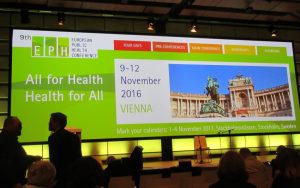
img_7985Organised by the European Public Health Conference Foundation, the European Public Health Association (EUPHA) and the Austrian Public Health Association (ÖGPH), [updated:] https://ephconference.eu/conference-2016-vienna-48 / veranstaltet von der European Public Health Conference Foundation, der European Public Health Association (EUPHA) und der Österreichischen Gesellschaft für Public Health (ÖGPH), [updated:] https://ephconference.eu/conference-2016-vienna-48
img_7994Venue / Tagungsort: Austria Center Vienna (ACV), Bruno-Kreisky-Platz 1, A-1220 Wien

For the first time, there was a mobile conference app / Erstmals gab es ein Konferenz-App für mobile Endgeräte: 2016 EPH Conference App.

Vienna Declaration, [updated link:] https://eupha.org/repository/advocacy/Vienna_Declaration_final_version_def.pdf: set up by EUPHA and ÖGPH to reiterate their commitment to the principles of the Ottawa Charter on Health Promotion, taking into account new and emerging threats to public health that have arisen in the three decades since the adoption of the Ottawa Charter / Erklärung von Wien, [updated link:] https://eupha.org/repository/advocacy/Vienna_Declaration_final_version_def.pdf: aufgestellt von EUPHA und ÖGPH, um ihr Engagement für die Prinzipien der Ottawa-Konferenz zu bekräftigen, unter Berücksichtigung neuer und absehbarer gesundheitlicher Bedrohungen, die sich in den drei Jahrzehnten seit Verabschiedung der  Ottawa eingestellt haben.


Green conference / Umweltfreundliche Konferenz

(only presented in the printed program, p.99 / nur im gedruckten Programmheft, p.99)

“The EPH conference is committed to reducing the environmental impact of the conference and finding ways to be more environmentally responsible” / Die EPH-Konferenz legt es darauf ab, negative Umweltauswirkungen zu mindern und umweltgerecht durchgeführt zu werden…

“… some initiatives we have taken…” / einige Maßnahmen:

  • Refillable water bottles … / Nachfüllbare Wasserflaschen …
  • Catering – Coffee and tea are served in recycled cups. Most lunch ingredients are from regional and organic origin… / Versorgung – Kaffee und Tee in recycelten Bechern. Beim Mittagessen haben die meisten Zutaten einen regionalen, organischen Ursprung …
  • Reduced printing – … by switching to E-Posters, digital marketing and email communication / Vermindertes Drucken – … Wechsel zu E-Posters, digitaler Vermarktung und Email-Kommunikation
  • Abstract submission, registration and invoicing are fully web-based. The Conference Programme and abstracts can be accessed online / Abstract-Einreichung, Registrierung und Rechnungsstellung erfolgen vollständig web-basiert. Das Konferenz-Programm und die Abstracts sind online zugänglich
  • The Conference Bag is made of recycled materials. The Programme Book is printed on FSC Mix paper…” [i.e. certified by Forest Stewardship Council, https://ic.fsc.org/en] / Der Konferenz-Beutel ist aus recyceltem Material gefertigt. Das Programmheft ist auf FSC Mix paper gedruckt [d.h. zertifiziert durch den Forest Stewardship Council, https://ic.fsc.org/en]

The Austria Center Vienna is awarded as Green Conference Center / Das Austria Center Vienna ist als Green Conference Center ausgezeichnet.

Cf. 11 Nov 2016, Φ Workshop 7.A: Reducing the health and environment footprint of European Public Health conferences?


Selected program elements / Ausgewählte Veranstaltungsteile:

10 Nov, Session 1.A Round table: Challenges to ethical research conduct: Perspectives, issues and implications for practice and policy

Chairs: Jihad Makhoul – Lebanon, Els Maeckelberghe – NL

  • Juggling With Varying Ethics Clearance Practices: Experiences From A 7-Country Policy Study (Arja Aro – DK)
  • The Smartphones Study: An Analysis Of Disciplinary Differences In Research Ethics Committee Responses To Phone App-based Automated Data Collection (Mark Mccann – UK)
  • Common Misconceptions And Publication Ethics Issues In Non-therapeutic Research (Silviya Yankulovska – BG)
  • Completing The Picture: Research Participants’ Experiences Of Biomedical Research (Jihad Makhoul – Lebanon)

One remarkable issue was disciplinary differences in Research Ethics committee responses / Ein bemerkenswertes Teilthema betraf disziplinäre Unterschiede zwischen den Antworten von Forschungsethik-Kommissionen.

10 Nov, Plenary 1: From Ottawa to Vienna – 30 years of the Ottawa Charter

Organised by EUPHA and EuroHealthNet.

  • Gauden Galea (WHO Europe): Ottawa charter – Presentation on the future of/for the five Ottawa
  • Charter action areas by 5 young pitchers
  • Reflection (Evelyne de Leeuw – Australia)
  • Panel discussion

11 Nov, Workshop 4.C: Indicators for evidence-informed policy-making – Development, validation, contextualization (Adriana Valente, Arja Aro)

Chairs: Adriana Valente – Italy, Arja Aro – Denmark

  • Frameworks and participatory processes for developing indicators for evidence-informed policy making (Adriana Valente – Italy)
  • REPOPA indicators for evidence-informed policy making validated by an international Delphi study (Valentina Tudisca – Italy)
  • Contextualization of indicators for evidence-informed policy making: results from Denmark and Italy (Arja Aro – Denmark)

The EC-funded project REsearch into POlicy to enhance Physical Activity (REPOPA, www.repopa.eu/content/project-repopa) “aims to integrate scientific research knowledge, expert know-how and real world policy making process to increase synergy and sustainability in promoting health and preventing disease, and to promote physical activity in structural policy making, by:

  • Building on evidence and experiences on policy making processes
  • Studying innovative ’win-win’ ways to collaborate between academia and policy makers
  • Establishing structures and best practices for future health promotion.”

11 Nov, Plenary 2: Achieving health in fragmented systems

Collaboration: Hauptverband für Sozialversicherung (HVB), Austria

Keynote speaker and moderator: Stephen Peckham, Professor of Health Policy, University of Kent, United Kingdom. Panellists: Josef Probst (HVB, Austria), Herwig Osterman (Austrian Public Health Institute, Austria), Tit Albreht (National Institute of Public Health, Slovenia), Claudia Stein (WHO Regional Office for Europe).

12 Nov, Plenary 5: Health for all

Organised by EUPHA

Moderator: Juergen Soffried (Austria); Speakers/panelists: Natasha Azzopardi Muscat (EUPHA President-elect, Malta), Michael Moore (WFPHA President, Australia), David Stuckler (Oxford University, UK), Allan Krasnik (U Copenhagen, DK) , Teodora Krumova (Amalipe NGO, BG).

See also / Siehe auch:

  • 11 Nov 2016, Φ Workshop “Reducing the health and environment footprint of European Public Health conferences?”
  • 12 Nov 2016, Φ Double workshop: “Health Impact Quantification”
  • 12 Nov 2016, Φ Workshop “Health Assessments”

26 Oct 2016, Φ EUPHA: “Vienna 2016 – A green conference”

The European Public Health Association (EUPHA, https://eupha.org/), together with the Association of Schools of Public Health in the European Region (ASPHER), organizes the 9th European Public Health Conference: All for health – Health for All, 9-12 Nov 2016, Austria Center Vienna (ACV), Vienna, [updated:] https://ephconference.eu/conference-2016-vienna-48 / Die Europäische Public Health Gesellschaft, zusammen mit der Association of Schools of Public Health in the European Region (ASPHER), organisiert die 9. Europäische Public Health-Konferenz: All for health – Health for All, 9.-12.11.2016, Austria Center Vienna (ACV), Wien, [updated:] https://ephconference.eu/conference-2016-vienna-48.

Quotation from EUPHA’s Conference Newsletter / Auszug aus EUPHAs Konferenz-Newsletter, 26 Oct 2016:

VIENNA 2016 – A GREEN CONFERENCE

We are committed to reducing the environmental impact of the conference and finding ways to be more environmentally responsible. We encourage our delegates to travel CO2 neutral and have taken the following actions to help minimize the environmental impact of the conference:

  • With your Conference Bag you will receive a water bottle which you can refill at water fountains located around the ACV. The water bottle is kindly offered by the European Patients Forum (EPF).
  • Coffee and tea are served in recycled cups. Most lunch ingredients are from regional and organic origin.
  • Printing of posters, announcements and other materials is reduced by switching to E-Posters, digital marketing and email communication.
  • The Conference Programme and Abstracts can be accessed online.
  • The Conference Bag is made of recycled materials and the Programme Book is printed on FSC Mix paper.

WORKSHOP: REDUCING THE HEALTH & ENVIRONMENT FOOTPRINT OF EUROPEAN PUBLIC HEALTH CONFERENCES?

Friday 11 November, 16:40-17:40, Room M2

With: Rainer Fehr, Germany, Dineke Zeegers Paget, EUPHA, Nino Künzli, Switzerland, Myriam Tobollik, Germany

For details / Details: 7 July 2016.

4 Oct 2016, Φ Hannover: ARL Working group “Planning for health-promoting urban regions”

13_24-arl-ak-flyer-auszug2
From: ARL Working group flyer 2014

Initiated by the Academy for Spatial Research and Planning – Leibniz Forum for Spatial Sciences (ARL) in 2013, the Working group “Planning for health-promoting urban regions” held its final meeting at the Technical University of Dortmund (TU Dortmund) today / Der von der Akademie für Raumforschung und Landesplanung – Leibniz-Forum für Raumwissenschaften (ARL) in 2013 eingerichtete Arbeitskreis “Planung für gesundheitsfördernde Stadtregionen” hatte heute in der Technischen Universität Dortmund (TU Dortmund) seine Abschluss-Sitzung.

Call for membership / Bewerbungsaufruf, 22 Apr 2013, Link File

Working group / Arbeitsgruppe: Link; Chair / Leiterin: Frau Prof. Dr.-Ing. Sabine Baumgart, TU Dortmund.

Working group participants: from universities and colleges, cities – city governments, institutes, insurance companies / TeilnehmerInnen: aus Universitäten und Hochschulen, Städten und Ämtern, Instituten, Krankenkassen.

Flyer / Infoblatt, 2014, File

Earlier meetings included 9 Feb 2015 and 24 Jun 2015 in Hannover. A workshop with invited guests was held in Dortmund on 8-9 Jun 2015 / Frühere Treffen fanden u.a. am 9.2.15 und 24.6.15 in Hannover statt. Ein Workshop mit eingeladenen Gästen erfolgte am 8.-9.6.2015 in Dortmund.

Position paper / Positionspapier 2014: Baumgart, S., Behrends, H.-B., Böhme, C., Claßen, T., Dilger, U., Fehr, R., Kawe, C., Kistemann, T., Knetschke, T., Köckler, H., Kühling, W., Quilling, E., Rauland, H., Ritzinger, A.,Tran, M.-C. (2014): Umwelt- und Gesundheitsaspekte im Programm Soziale Stadt – Ein Plädoyer für eine stärkere Integration. Positionspapier aus der ARL 97. Akademie für Raumfoschung und Landesplanung, Leibniz-Forum für Raumwissenschaften, Hannover, File

The working group’s full results are going to be presented in a book publication / Die Gesamtergebnisse der Arbeitsgruppe werden in Buchform veröffentlicht.