19-22 Nov 2014, Φ Glasgow: 7th European Public Health conference

European Public Health Association (EUPHA) and UK Society for Social Medicine: 7th European Public Health conference – Mind the gap: Reducing inequalities in health and health care“, Glasgow / Europäische Public Health Gesellschaft (EUPHA) und UK Society for Social Medicine: “7. Europäische Public Health Konferenz – Mind the gap: Reducing inequalities in health and health care, Glasgow (UK), 19–22 Nov 2014 [13-31]


Workshop I.1: Health Technology Assessment and Health Impact Assessment – Two key examples of health assessment

Organised by: EUPHA section on Health impact assessment and (proposed) EUPHA section on Health technology assessment [14-2]. Key messages:

  • While HIA and HTA already play important roles in many European countries, their potential still seems underrecognized and deserving closer scrutiny
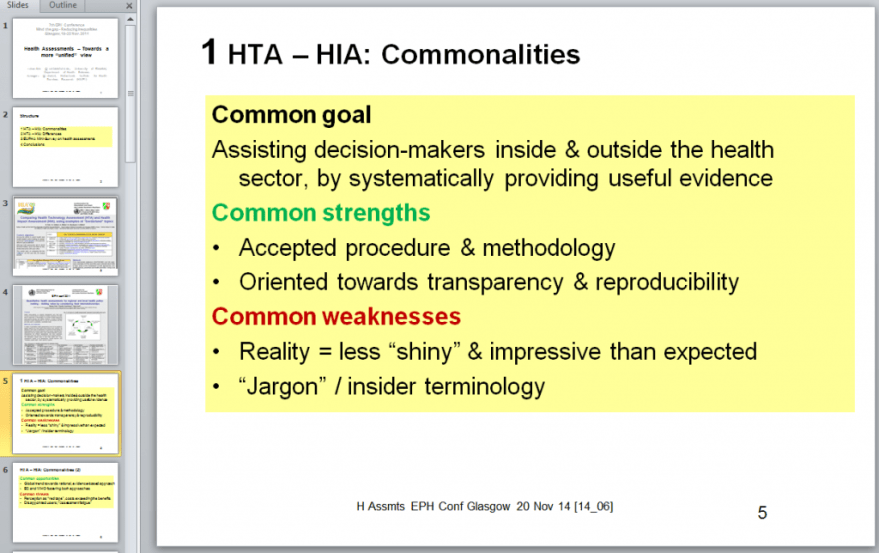
  • Both HIA and HTA would benefit from a ‘‘unified’’ perspective on assessment approaches, including commonalities, differences, and mutual learning opportunities.

Workshop presentations:

  1. Introduction to and international trends in Health Impact Assessment through case study experiences. Salim Vohra, Public Health by Design, London, UK; Health Section, IAIA, Fargo, USA
  2. Three approaches to quantitative health impact assessment in Copenhagen. Astrid Ledgaard Holm, H Bronnum-Hansen, F Diderichsen, Section of Social Medicine, Department of Public Health, University of Copenhagen, DK
  3. Assessing health technologies through HTA: requisites, methods, challenges and perspectives. Chiara de Waure, F Kheiraoui, C Favaretti, W Ricciardi, Catholic University of the Sacred Heart, Rome, IT
  4. Bridging research and policy making: what do decision makers have and what do they want? Aileen Clarke, Division of Health Sciences, Warwick Medical School, University of Warwick, Coventry, UK
  5. Health assessments – Towards a more ‘‘unified’’ view. Rainer Fehr, University of Bielefeld, Bielefeld, DE; Dineke Zeegers Paget, EUPHA [14-6]. „Lessons: In many countries, HIA and/or HTA already play important roles for the protection and promotion of human health. The assessments (especially in a ‘‘unified’’ perspective) deserve closer attention in research projects, in the science – policy discussion, and in Public Health curricula.”
2014_11_20-glasgow


Poster: Health in Impact Assessments – Opportunities & Challenges. Julia Nowacki, WHO Regional Office for Europe; Francesca Viliani, SOS International; Rainer Fehr, University of Bielefeld; Marco Martuzzi, WHO Regional Office for Europe [14-4]

2014_11_20-14_04


Presentation: Health foresight – A survey on quantifying tools. Odile Mekel, NRW Centre for Health (LZG.NRW), Bielefeld, DE; R Fehr, University of Bielefeld, DE; JP Mackenbach, Erasmus Medical Centre (EMC), Rotterdam, NL; F Hurley, Institute of Occupational Medicine (IOM), Edinburgh, UK [14-7]

Discussion: “Interpretations of, and attitudes towards, tool evaluation differ and need to be explored further. Results of this current survey will be merged with existing knowledge, including from earlier workshops on impact quantification. In additional steps, two further groups are planned to be surveyed: (i) advanced HIA practitioners as key users of quantifying tools, and (ii) policymakers as primary target group for the information produced with these tools.”

Key messages:

  • For quantitative health foresight and impact assessment, a diverse and valuable set of tools does exist; but most tools have emerged individually – and unnoticed by many potential users.
  • If existing tool developments interacted more closely with each other and with potential users, this could booster health foresight as a contribution to health-supportive policy-making.

3-4 Nov 2014, Φ Bielefeld: Gesundheitsförderliche Stadtlandschaften der Zukunft

Junior research group “StadtLandschaft & Gesundheit” in the research program “City of the Future”, conference “Future health-promoting urban arenas” = 4th  conference “City of the Future”, supported by Fritz und Hildegard Berg‐Stiftung; Zentrum für Interdisziplinäre Forschung (ZiF) Bielefeld / Juniorforschungsgruppe „StadtLandschaft & Gesundheit“ im Förderschwerpunkt „Stadt der Zukunft“, Fachtagung „Gesundheitsförderliche StadtLandschaften der Zukunft“ = 4. Fachtagung „Stadt der Zukunft“ der Fritz und Hildegard Berg‐Stiftung; Zentrum für Interdisziplinäre Forschung (ZiF) Bielefeld, 3.-4.11.2014


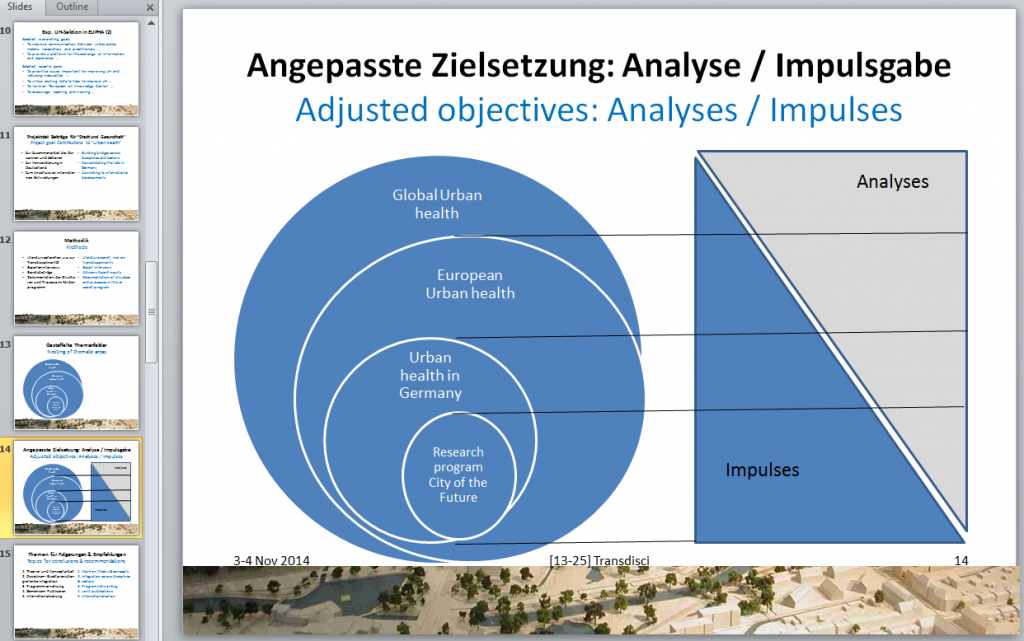
Beitrag (Fehr, McCall, Hornberg): „Das Querschnittsprojekt ‘Transdiszi’ zum disziplinären und sektoralen Brückenbau” [13-25]

Vorschläge zur Ausgestaltung der Initiative „Stadt der Zukunft“, u. a.: weitere Vernetzung der Forschungsarbeit sowie der durchführenden Konsortien; Praxispool transdisziplinärer Arbeitsbeispiele; transdisziplinärer Diskurs; Kontinuität innerhalb der Initiative, und Verstetigung darüber hinaus

2014_11_04-biel


Die Zielsetzung der Tagungsreihe ist es, den international hochaktuellen Forschungsbereich Urban Health in Deutschland zu etablieren und auf nationaler Ebene einen Wissenschaft‐Praxis‐Dialog auf der Grundlage aktueller Forschungsergebnisse anzustoßen. Die Bielefelder Fachtagung zielte darauf ab, interdisziplinäre und praxisorientierte Ansätze zur gesunden, nachhaltigen Entwicklung urbaner Räume in Deutschland aufzuzeigen, mit Fokussierung auf folgende Aspekte:

  • Gesundheitliche Bedeutung urbaner Grünräume (Stadtgrün / urban green spaces),
  • Gesundheitliche Bedeutung urbaner Gewässerstrukturen (Stadtblau / urban blue spaces),
  • Ansatzmöglichkeiten und innovative Wege für eine gesundheitsförderliche Stadtentwicklung (Urban Health),
  • Transdisziplinäre Forschung.

Statements der Mitglieder des Programmbeirats der Berg‐Stiftung (Uwe Schneidewind, Stefan Zerbe, Rainer Fehr, Jörg Knieling) zum bisherigen Verlauf der Förderinitiative und zu neuen Perspektiven.


10 Sep 2014, Φ Hamburg, Pakt für Prävention: Gemeinsam für ein gesundes Hamburg!

Hamburg Pact for Prevention, Congress 2014: „Together for a healthy Hamburg! Socio-spatial perspectives on health promotion”, Bürgerhaus Wilhelmsburg / Pakt für Prävention, Kongress 2014: „Gemeinsam für ein gesundes Hamburg! Sozialräumliche Gesundheitsförderung“, Bürgerhaus Wilhelmsburg, 10.9.2014

The Pact for Prevention’s third congress aimed to integrate the discussions on life periods “Growing up healthily”, “Health work and life” and “Healthy ageing” and to look at programs and actions from a city district perspective / Der dritte Kongress des Paktes für Prävention hatte zum Ziel, die Diskussionen über die Lebensphasen “Gesund aufwachsen”, “Gesund leben und arbeiten” und “Gesund alt werden” zusammenzuführen und die Angebote und Maßnahmen stadtteil- und quartiersbezogen zu betrachten.

In the afternoon, projects from Wilhelmsburg, Hamburg and other cities were presented. In addition, there was an opportunity to practically explore the method of “city walking” / Am Nachmittag wurden Projekte aus Wilhelmsburg, Hamburg und anderen Städten vorgestellt. Zudem hatten die Teilnehmenden die Möglichkeit, die Methode “Stadtteilbegehung” praktisch auszuprobieren.

Link: www.hamburg.de/pakt-fuer-praevention/4383842/pfp-kongress2014/

5-7 Mar 2014, Φ Manchester: 11th Int Urban Health conference. Crossing boundaries: Partnerships for Global Urban Health

11th International Conference on Urban Health (ICUH 2014), Crossing boundaries: Partnerships for Global Urban Health. 4-7 Mar 2014, Manchester, UK

International Society for Urban Health (ISUH); Manchester Academic Health Science Centre, Manchester University; National Health Service (NHS); Manchester Urban Collaboration on Health (MUCH)

Work Streams and Work Domains:

  • Transdisciplinarity, incl.: Urban Health Metrics, Urban Planning and Architecture, Environmental Urban health, Healthy Cities, Transdisciplinarity in urban health
  • Society, incl. Citizens’ Engagement / Engaging the Public in looking after health, Health Economics, Policymaking and political leadership for action on urban health / Governance
  • Global Health and Humanitarian Risk, incl. Emergency Humanitarian Assistance, Global Health: Policy and Practice, Global Women’s Health, Urban Risk and Humanitarian Response: Stress and The City, Urban Risk and Humanitarian Response: Climate change and urban insecurities
  • Health Opportunities, incl. Blood Borne Viruses in Urban Areas, Drug Users: Outcomes, Evidence and Policy, Stratified Medicine, Biomarkers and Population Health.

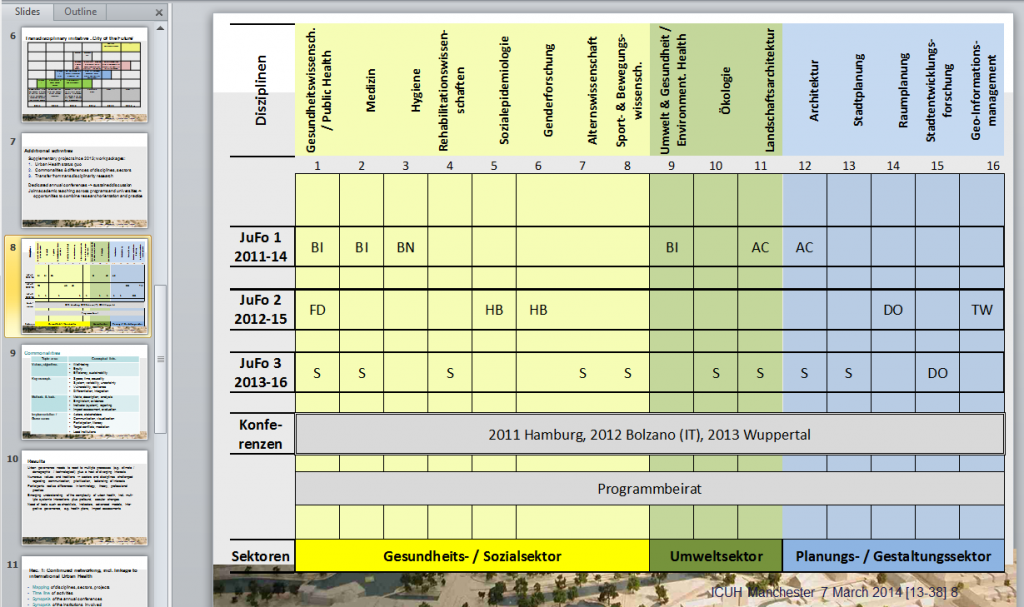
Workshop „Building bridges across disciplines and sectors in European countries“

Rainer Fehr (coord.), Catalina Chamorro, Carlo Signorelli, Gérard Salem

Urban governance needs to react to multiple ongoing changes, e.g. climate / demographic / technological. Multiple scientific disciplines and societal sectors involved are strongly challenged regarding communication, prioritization of issues, and balancing of interests.

This is particularly true of urban health where the stakes are high, subtopics and actors are numerous, and evidence is sometimes ambiguous. To ensure an adequate place for health in the urban agenda requires comprehensive and persistent efforts.

The workshop aim, beyond mutual learning, is to identify common ground for potential joint future activities. The workshop provides examples of transdisciplinary approaches to urban health from various regions and countries, including the building of (procedural, instrumental etc.) bridges across disciplines and sectors:

  • Promoting healthy places and cities. The experience of the Barcelona Provincial Council
  • The professional and scientific interaction between medical doctors and architects. The 20-year experience at the Politecnico di Milano
  • A systemic approach of urban health dynamics – Experiences from French as well as international urban health studies
  • Initiative for promoting urban health in Germany [pdf file] [12-19].

2

13-14 Feb 2014, Φ TU Dortmund: Daseinsvorsorge

Faculty of Spatial Planning, TU Dortmund, together with the Academy for Spatial Research and Planning (ARL): Dortmund Conference 2014 on Spatial Planning Research: “Services of general interest and spatial planning – Ensuring, financing, networking, qualities” / Fakultät Raumplanung der Technischen Universität (TU) Dortmund, gemeinsam mit der Akademie für Raumforschung und Landesplanung (ARL): Dortmunder Konferenz 2014 Raum- und Planungsforschung, „Daseinsvorsorge in der Raumplanung – Sicherung, Finanzierung, Vernetzung, Qualitäten“, 13.-14.2.2014, www.raumplanung.tu-dortmund.de/rp/589.html

“… challenges … to ensure equal living conditions in all regions of Germany for the range of services such as education, health, supply and disposal, housing and public transport. Equivalent living conditions in all regions? How is that possible when spatial development greatly varies due to growth and shrinkage in the regions? Planning needs to meet this challenge by addressing region-specific needs and equitable standards. To assure the availability, access and sustainability of basic services in the regions, there are quality requirements and minimum standards to define in order to ensure that competitiveness, attractiveness and quality of life can be maintained…” / „Parallele Entwicklungen einer wachsenden und einer schrumpfenden Bevölkerung in urban und ländlich geprägten Räumen … berühren … existenzielle Fragen der Grundversorgung … beispielsweise Bildung, Gesundheit, Wohnen oder öffentlicher Verkehr, aber auch die Sicherung und intelligente Vernetzung technischer Dienstleistungen wie Ver- und Entsorgung (Energie, Wasser, Abfall), Hochwasserschutz, Verkehrsinfrastruktur und –dienstleistungen. Es sollen Fragen wie Erreichbarkeit, Zugriff und Tragfähigkeit von Dienstleistungen … thematisiert werden … Qualitätsanforderungen und Mindeststandards …. Auch gilt es Erfahrungen mit neuen Organisationsformen … im Spannungsfeld der Aufgabenbewältigung durch die öffentliche Hand und Privatisierung, Markt und Wettbewerb einschließlich bürgerschaftlichen Engagements auszutauschen …“


Im Workshop “Gesundheitsvorsorge”:

Rainer Fehr, Timothy McCall, Claudia Hornberg: (Wie) Lassen sich „Transdisziplinare Ansätze“ zur Verbindung von Planung und Gesundheit einsetzen?

Abstract: Im Rahmen der Initiative „Stadt der Zukunft“ ist ein Spezialprojekt dem Brückenbau zwischen wissenschaftlichen Disziplinen, gesellschaftlichen Sektoren sowie zwischen Wissenschaft und Praxis gewidmet. Das Projekt sieht Städte und Regionen als komplexe Systeme im laufenden Wandel. Entsprechend verlangen auch die Gesundheitsthemen nach systemisch-dynamischen Konzepten. Es werden Gemeinsamkeiten, Unterschiede und Verbindungsfelder von Disziplinen und Sektoren untersucht, vorliegende Erkenntnisse zur Multi-/Inter-/Transdisziplinarität analysiert und übertragbare Instrumente und Lösungsansätze gesucht. Insbesondere geht es auch um bereits bestehende transdisziplinaräre Ansätze für „Stadtentwicklung und Gesundheit“ und deren Ausbaufähigkeit. Der Beitrag mündet in konkrete Vorschläge zur Ausgestaltung der Initative.

Book chapter / Buchkapitel: Fehr, R., McCall, T., Hornberg, C. (2014): (Wie) Lassen sich “Transdisziplinäre Ansätze” zur Verbindung von Planung und Gesundheit einsetzen? Zwischenergebnisse eines Projektes zum disziplinären und sektoralen Brückenbau. In: Haber, M., Rüdiger, A., Baumgart, S. Danielzyk, R., Tietz, H.-P. (eds.): Daseinsvorsorge in der Raumentwicklung: Sicherung – Steuerung – Vernetzung – Qualitäten. Blaue Reihe Dortmunder Beiträge zur Raumplanung, Band 143, TU Dortmund und Akademie für Raumforschung und Landesplanung (ARL), Hannover, pp.191-206

1