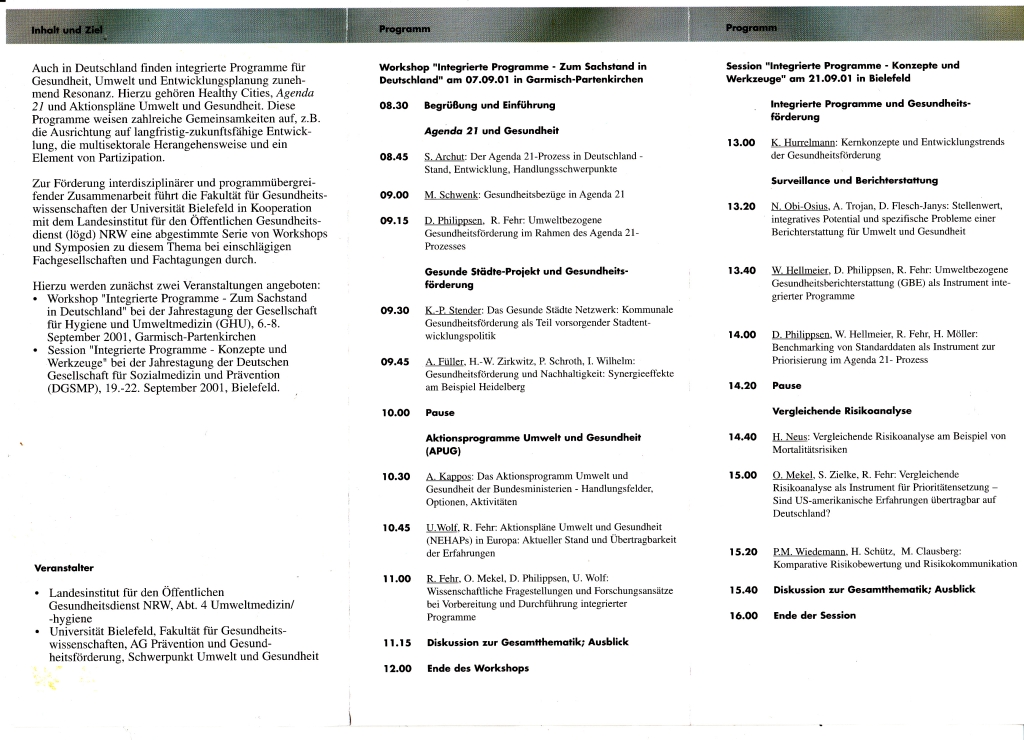
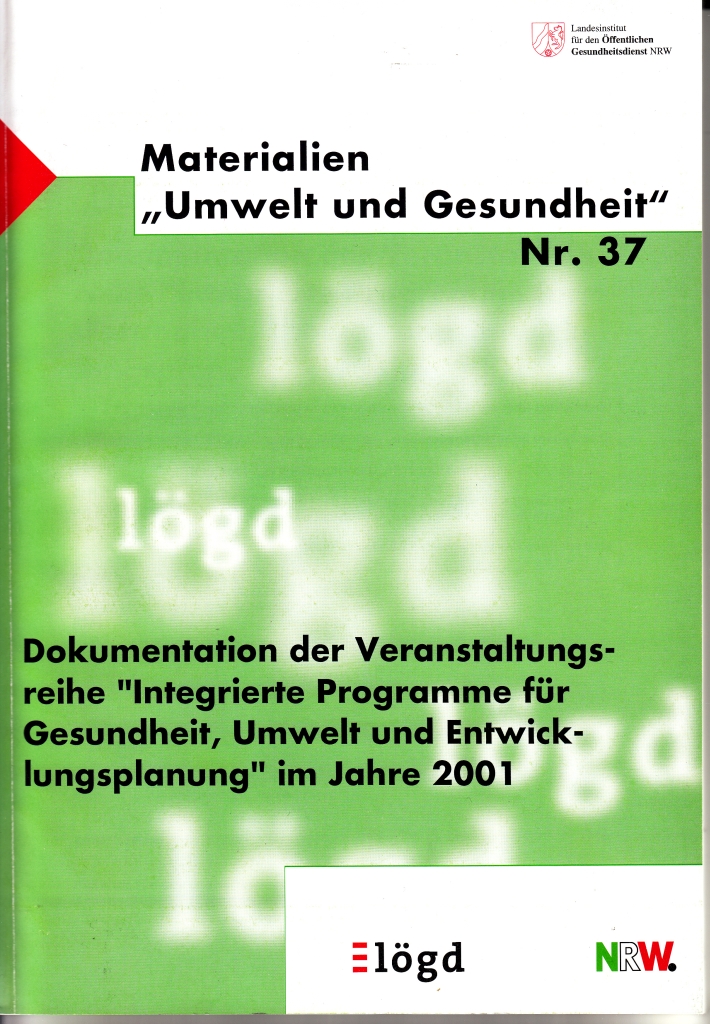
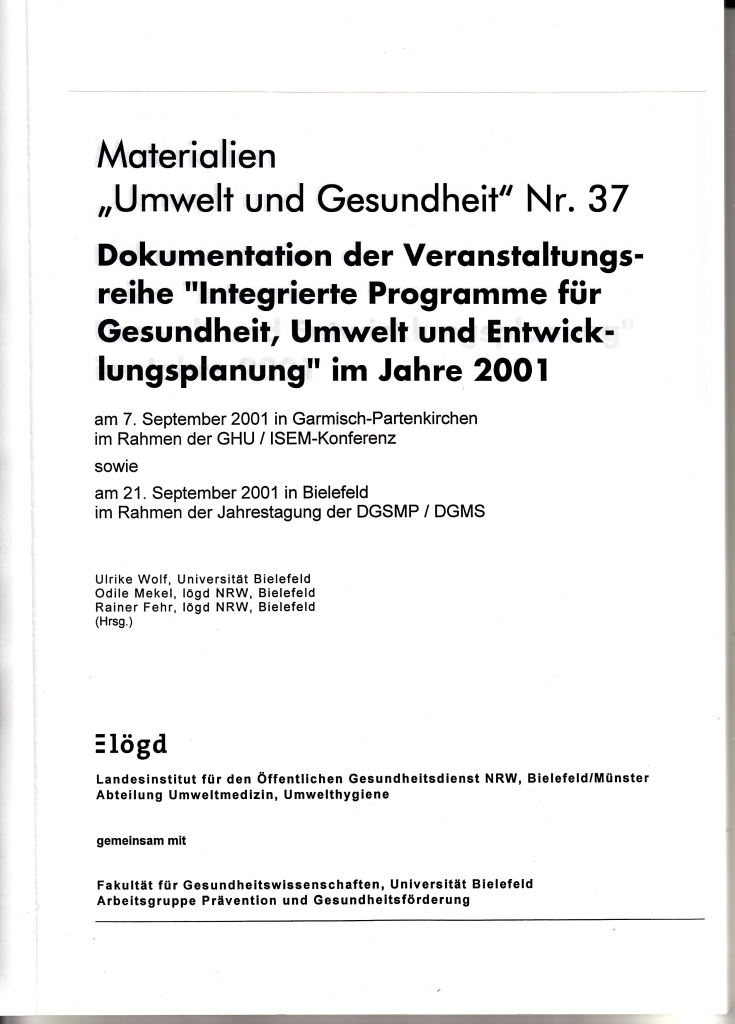
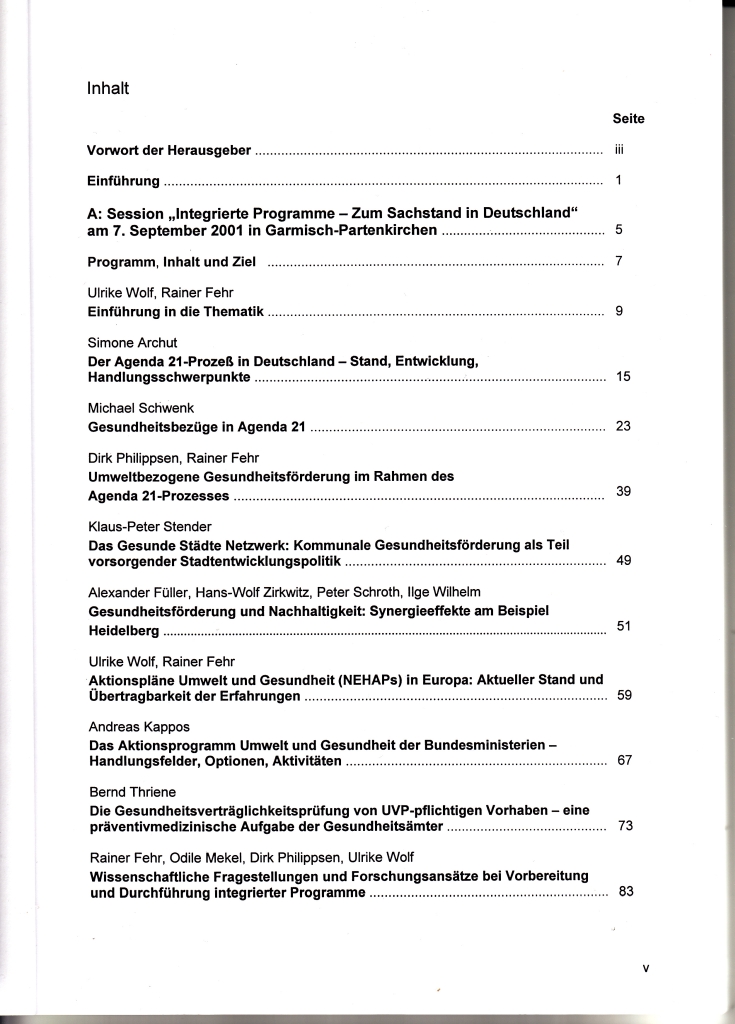
12 May 2000, Φ Schwäbisch Gmünd, ÖGD-Ärzte-Kongress, Workshop “ÖGD – Agenda 21“

2000_05_12 Ws Programm ÖGD Schwäbisch Gmünd

50. Wiss. Kongreß des Bundesverbandes der ÖGD-Ärzte und –Zahnärzte, Schwäbisch Gmünd, 11.-13.5.2000, Workshop „Effektive Einbindung des ÖGD in die Agenda-Aktivitäten“, Freitag 12.5.00, 16-18 Uhr

Programm

16:00Schwenk, Fehr: Begrüßung Teilnehmer: Erwartungen und Interessen  
16:15Philippsen: Nordrhein-westfälisches Projekt “Agenda 21 und Gesundheit”  
16:25Schwenk: Agenda 21, eine Chance für die Zukunftsgestaltung  
16:35Fehr, Schwenk: Möglichkeiten der Einbindung des ÖGD in die Agenda21-Aktivitäten (Neue Thesen zur Verbindung von „Agenda 21 und Gesundheit“)  
16:45Leykamm (Moderation): Diskussion über Möglichkeiten und Nutzen einer ÖGD-Beteiligung, Handlungsfelder, Kooperationen, Ressourcen; ggf. auch Modifizierung der Thesen
17:45Zusammenfassung der Ergebnisse; weiteres Vorgehen  
18:00Ende des Workshops

Workshop-Veranstalter:

  • LGA Baden-Württemberg, Stuttgart / Prof. M. Schwenk, B. Leykamm
  • Projekt „Agenda 21 und Gesundheit“, Universität Bielefeld / D. Philippsen, U. Wolf (gefördert vom MFJFG NRW)
  • lögd NRW, Bielefeld / PD R. Fehr

20 Thesen “Agenda 21 und Gesundheit”, formuliert anläßlich des vom lögd NRW und vom LGA Baden-Württemberg vorbereiteten Workshops “Agenda 21 und Gesundheit”; 20 Propositions on “Agenda 21 and Health” (nachträglich übersetzt: 5.9.2000)

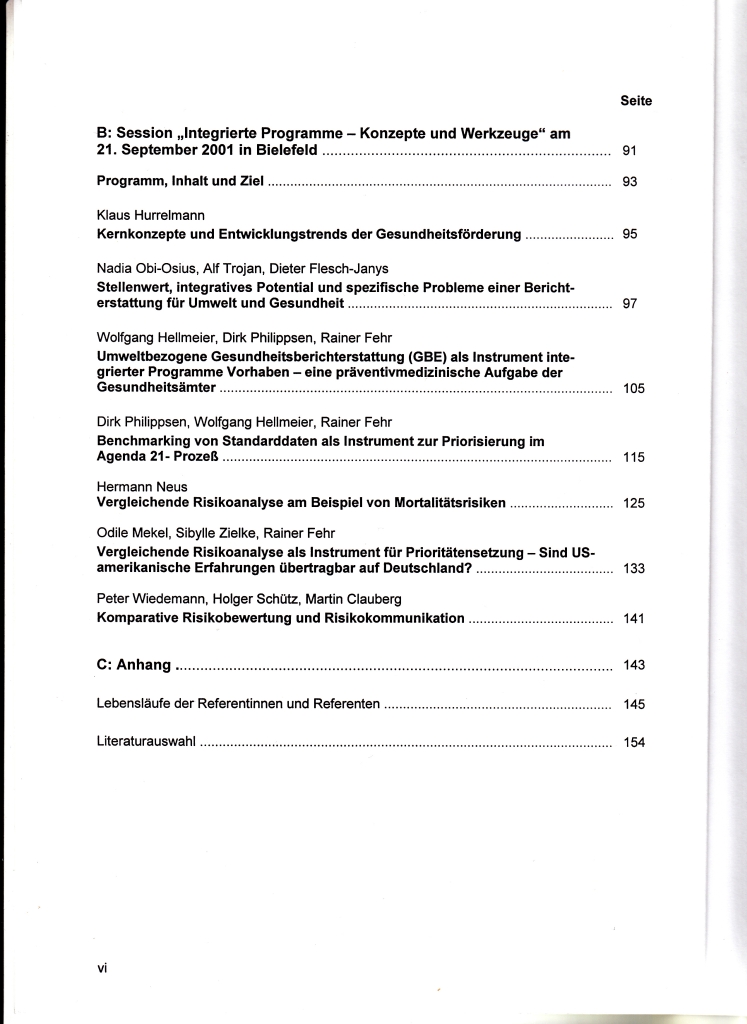
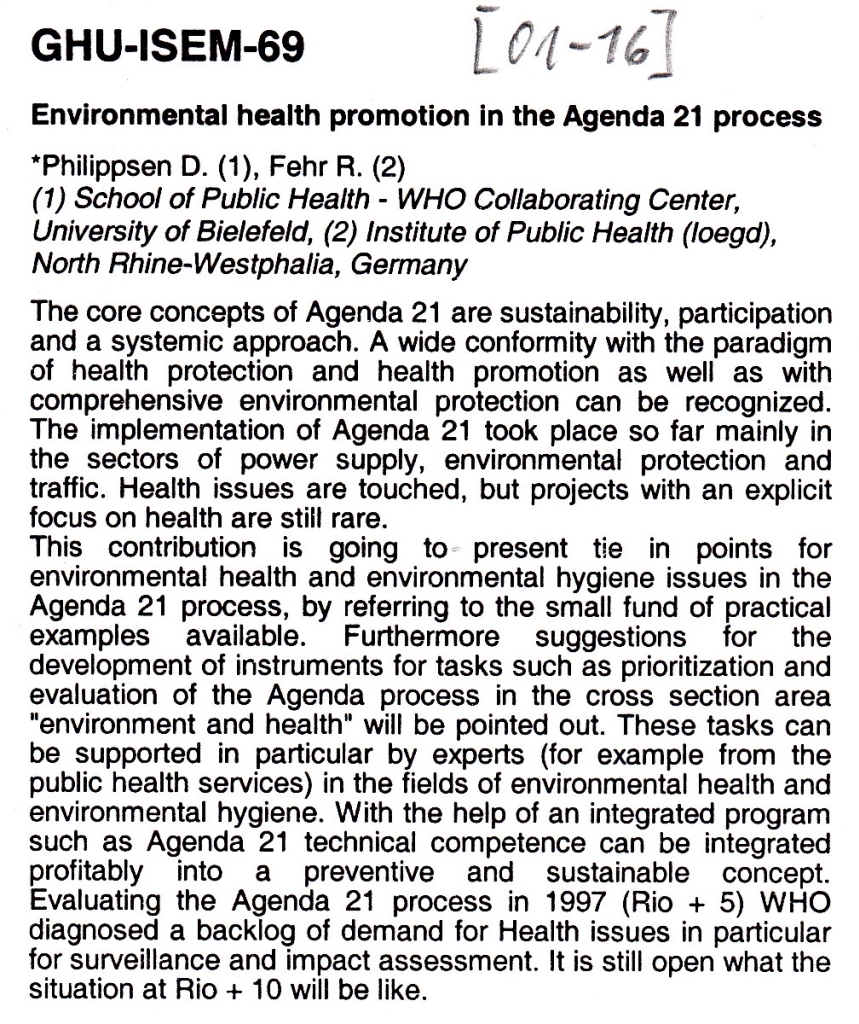
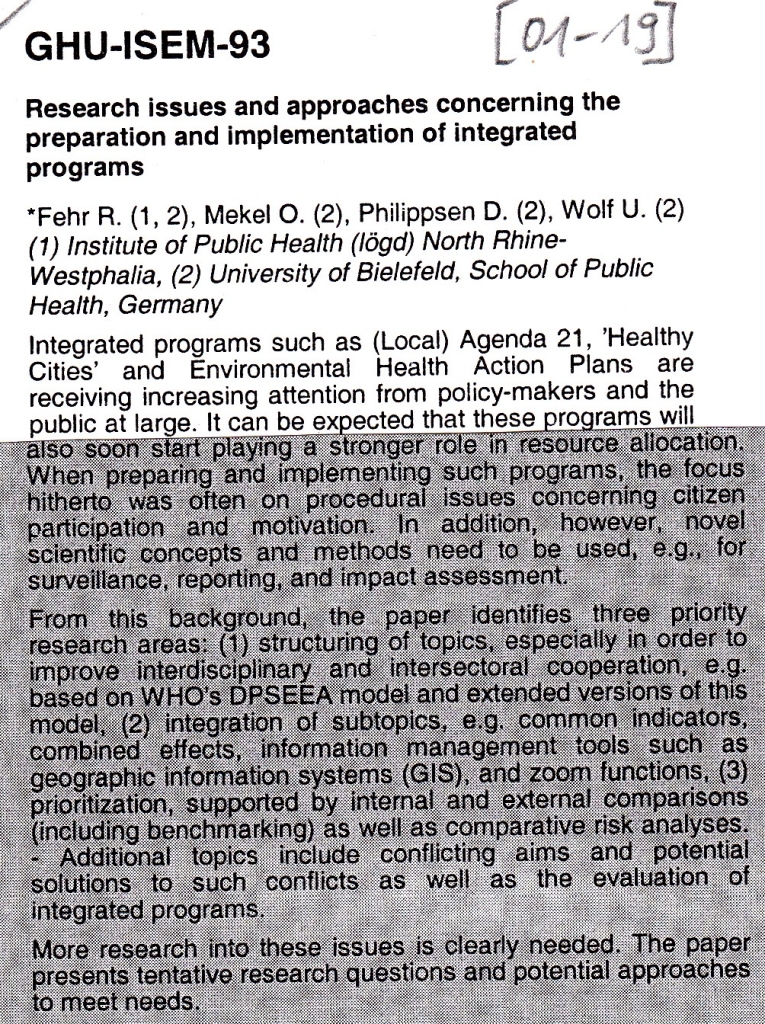
Präsentation – R. Fehr, D. Philippsen, U. Wolf: Projekt „Agenda 21 und Gesundheit – Gefördert vom MFJFG NRW“

28-31 Oct 1999, Φ Göteborg (SE): HIA workshop; Kopenhagen (DK): Statens Museum for Kunst

28.-31.10.1999, Göteborg (SE): HIA workshop; Kopenhagen (DK): Statens Museum for Kunst

1999_10_28 Nordic SPH Göteborg

Göteborg, 28-30 Oct. 1999: Participation in the Leo Kaprio Workshop, “Health Impact Assessment: from theory to practice” / Teilnahme am Leo Kaprio-Workshop, “Health Impact Assessment: from theory to practice” [99-15].

Diwan et al 2000 HIA ws Göteborg 1999 reportReport: Diwan, V., Douglas, M., Karlberg, I. et al. (eds.): Health Impact Assessment: from theory to practice. Report on the Leo Kaprio workshop, Gothenburg, 28-30 October 1999. WHO-Europe and Nordic School of Public Health, Gothenborg, Sweden. NHV-report 2000:9.

The report includes: Fehr, R. (2000): Environmental Health Impact Assessment: the example of transportation (pp.213-229), pdf file. Excerpt: … (p.213) ‘ecologic health promotion’ … (p.214) extended DPSEEA model … (p.215) WHO ‘Transport, Environment and Health’ (THE) project … HIA workshop, Bielefeld, Germany, May 1999 … (p.217) HIA components, methods, tools … (p.219) Levels of complexity, integration, and quality criteria … (p.220) Future developments … (pp.223-226) Annex 1: Chronology of HIA – Global and local events, (pp.227-229) Annex 2: Selected computer tools and resources for Environmental Health Impact Assessment.


Auf dem Rückweg am 31.10.99 Zwischenstopp in Kopenhagen: Statens Museum for Kunst. Dort besucht: Claude Lorrain (c.1630): River landscape with herdsmen. Zum Gemälde siehe 27.5.2014, https://rfehr.eu/2014/05/27/27-may-2014-statens-museum-for-kunst-asger-jorn/

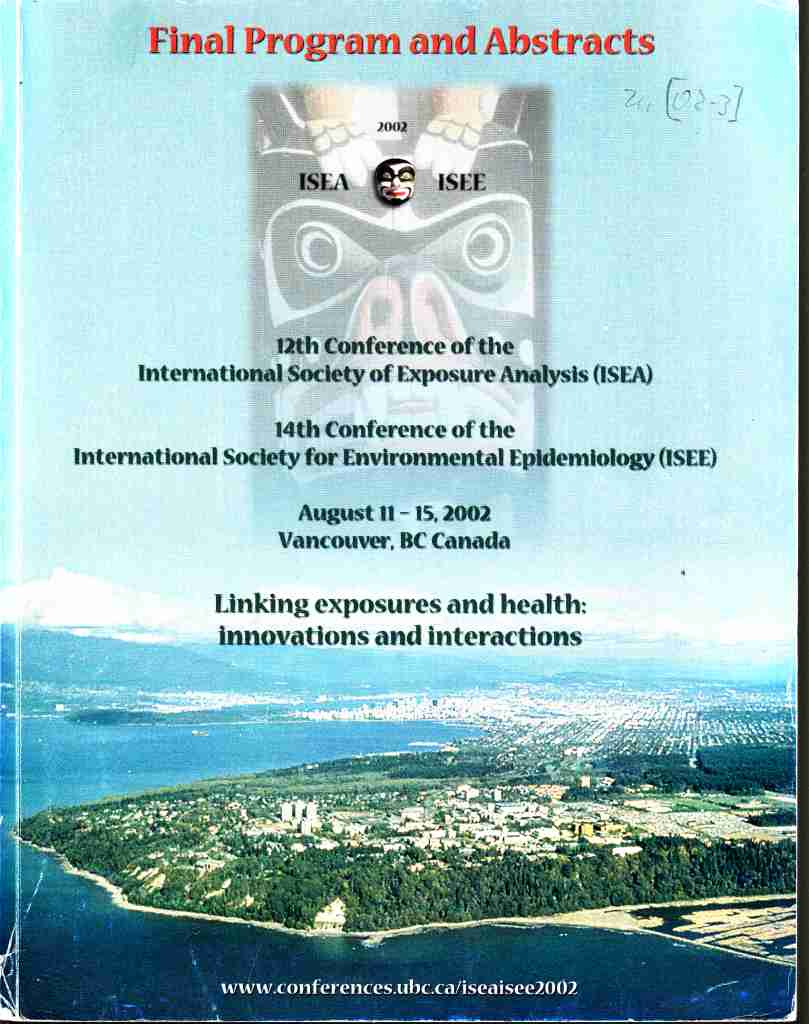
5-8 Sep 1999, Φ Athens, ISEE/ISEA ’99, Exposure assessment, environmental epidemiology and decision-making: closer interactions for better protection of public health

5.-8.9.1999, Athens, 11th Conference of the International Society for Environmental Epidemiology (ISEE), 9th Conference of the International Society of Exposure Analysis (ISEA): Exposure assessment, environmental epidemiology and decision-making: closer interactions for better protection of public health.

Host: Department of Hygiene and Epidemiology, University of Athens Medical School. Co-Organiser: Hellenic Society of Environmental Health. Organising Committee: Klea Katsouyanni (ISEE), Matti Jantunen (ISEA), Panos Georgopoulos (ISEA). Venue: Conference Halls of the hotels Nafsika and Arion, at the Astir Palace Resort in Vouliagmeni.

Own contributions:

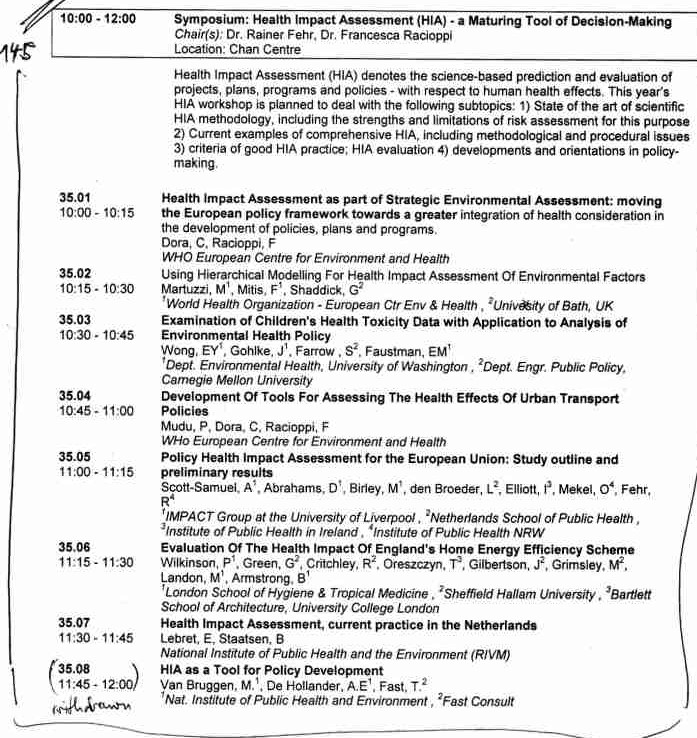
  • Fehr, R. (Chair): ISEE Policy & Planning working group. Environmental health policy development: The pros and cons of single-issue vs. integrated approaches (incl. Session introduction). Conference Program book, p.26 [99-30]
  • Fehr, R., Fletcher, T. (Chairs): Humanitarian emergencies, public and environmental health: Lessons from Yugoslavia and other emergencies. Symposium, 8.9.1999, Nafsika Conference Hall. Conference Program book, p.74 [99-31]
  • Fehr, R., Tountas, Y., Pless-Mulloli, T.: ISEE Policy & Planning group – Evaluation of scientific abstracts with respect to policy development and decision making. Symposium, 8.9.1999, Nafsika Conference Hall. Conference Program book, p.80 [99-33]
  • Fehr, R., Winkelstein, W., Santos-Burgoa, C.: Mitigation of health effects of civil unrest – what policy options? Oral presentation, Session “Environmental health policy development: The pros and cons of single-issue vs. integrated approaches”, 6.9.1999, Conference Program book, p.26 [99-32]
  • ISEE Policy & Planning working group; Fehr, R. (1999): Evaluation of scientific abstracts with respect to policy development and decision-making. 1. Introduction. Abstract: Epidemiology 10, no.4, suppl., p.S179
  • ISEE Policy & Planning working group; Fehr, R. (1999): Evaluation of scientific abstracts with respect to policy development and decision-making. 2. Methods. Abstract: Epidemiology 10, no.4, suppl., p.S179
  • Lacombe, M., Hellmeier, W., Olberding, P., Weber, H., Fehr, R. (1999): Drinking water surveillance as a tool of exposure assessment and health protection. Oral presentation 109 O, in Session “Waterborne infectious diseases and disinfection processes”. Conference Programme book, p.21. Abstract: Epidemiology 10, no.4, suppl., p.S57 [98-27]
  • Mekel, O.C.L., Weber, H., Fehr, R. (presenter) (1999): Probabilistic modelling in quantitative exposure assessment: differentiating between uncertainty and true variation. Oral presentation 285 O in Session “Exposure and dose estimation and modelling 2”. Conference Program book, p.52. Abstract: Epidemiology 10, no.4, suppl., p.S104 [98-19]

28-30 Apr 1999, Φ IEEI, San Francisco: Conference “The Environmental Health Effects of Civil Unrest”

28.-30.4.1999, Φ International Environmental Epidemiology Institute (IEEI), San Francisco, Ca.: Conference “The Environmental Health Effects of Civil Unrest”

Dr. Warren Winkelstein, Jr., then professor of epidemiology at the University of California, Berkeley (UCB), was intrigued by the idea “to establish an international research center to further understanding of the links between environmental degradation and human health”.

In the early 1990s, the historic Presidio army post near San Francisco’s Golde Gate was transferred to the National Park Service. In the context of this conversion, Winkelstein proposed the establishment of an Institute of Environmental Epidemiology (later called the International Environmental Epidemiology Institute, IEEI), to be located in the Letterman Medical complex.

To further develop the idea and to explore funding opportunities, an international conference was to be held in San Francisco. A conference proposal was developed by Carlos Santos-Burgoa (Cuernivaca & Mexico City), Rainer Fehr (Bielefeld), and Warren Winkelstein (Berkeley) in 1996. A selective bibliography of 20 titles with annotations was produced:

On 28-30 April 1999, the conference “Environmental Health Consequences of Civil Unrest” was held at the Fort Mason Center, near the Presidio [98-20]. On day one, the venue was the Golden Gate room of the Conference Center (building A), on days 2 and 3 The Firehouse. By this time, the IEEI as the organizing institution had reached the status of a subsidiary project of The Tides Center (www.tides.org) of San Francisco. The conference was funded by a grant from the U.S. Institute of Peace (www.usip.org) of Washington, D.C., with additional support from the Archstone Foundation (https://archstone.org/) of Long Beach, CA, and the Jenifer Altman Foundation (www.jaf.org/).

The conference program included:

  • a keynote address, delivered by Sir Donald Acheson (London)
  • case presentations from Chiapas (Mexico) and Sarajevo (Bosnia)
  • panel sessions on (i) health surveillance and research, (ii) role of governmental agencies and NGOs, and (iii) media and public affairs
  • a presentation on the PAHO perspective on violence in urban environments
  • workshops on (i) health surveillance and research, (ii) role of governmental agencies and NGOs, and (iii) media and public affairs
  • a plenary session with workshop reports as well as policy recommendations and resolutions.

My personal conference report is available here:

In order to document key elements of the presentations and discussions, Christina Merkley and co-workers (of Grove Consultants International. San Francisco, Ca.) produced 16 “murals”. As ist says on the cover page, this graphic summary was ”intended as a memory device for those present and as a communication tool to share the proceedings with those unable to attend”.


Own contributions:

  • Introduction to: Case Presentation – Sarajevo, Bosnia [99-07]
  • Introduction to: Panel – Health Surveillance and Research / Environmental Evaluation [99-11]
  • Introduction to: Workshop – Health Surveillance and Research / Environmental Evaluation [99-12]

Cf.:

10-17 Feb 1999, Φ Helsinki und St.Petersburg/Leningrad 1999

10.-17.2.1999, Helsinki und St. Petersburg/Leningrad 1999

10.2.1999 Mi: Flug von Düsseldorf nach Helsinki

11.-13.2.1999 Do-Sa: Tagung bei STAKES (Helsinki) zu EU-Politik. Präsentation [99-01]: Overview of our recent work concerning Health Impact Assessment, risk analysis and policy development

14.2.1999 So: Weiterflug nach St. Petersburg

15.2.1999 Mo: St. Petersburg, Rundgang

16.2.1999 Di: St. Petersburg, Eremitage, erster Besuch; und State Russian Museum, http://en.rusmuseum.ru/

17.2.1999 Mi: St. Petersburg, Erneut Eremitage: Claude-Zeichnungen. Rückflug nach Düsseldorf.

Eremitage, Claude-Gemälde; Beschilderung:

  1. Claude Gelée, dit Le Lorrain, c.1602, Chamagne – 1682, Rome. Landscape with Jacob, Rachel, and Leah at the well. Acquired for the Hermitage in 1814 from the Empress Josephine collection, Malmaison, near Paris
  2. … Landscape with Jacob wrestling with the Angel. Acquired for the Hermitage in 1814 … [dito]
  3. … Landscape with dancing figures. Acquired for the Hermitage in 1930 with the Stroganoff collection, St. Petersburg
  4. … Morning in the harbor. Acquired for the Hermitage in 1779 from the Sir Robert Walpole collection, Houghton Hall, England
  5. … Landscape with the rest on the flight into Egypt. Acquired for the Hermitage in 1814 from the Empress Josephine collection, Malmaison, near Paris
  6. … Landscape with Tobias and the Angel. Acquired for the Hermitage in 1814 from the Empress Josephine collection, Malmaison, near Paris
  7. … Italian landscape. Acquired for the Hermitage in 1772 with the Crozat collection, Paris
  8. [unbeschildert].

Eremitage, Claude-Zeichnungen (West European Art Department)

  • No. 11497 Flusslandschaft. Verso: Sieben Abwandlungen landschaftlicher Kompositionen. Erworben 1924
  • No. 7134 Ansicht der Kirche Sa. Trinita dei Monti in Rom. Verso: Studien männlicher Figuren und eines Ziegenhirten. Erworben 1768, aus der Sammlung Cobenzl, Brüssel
  • No. 4786, ohne Titel
  • No. 4368, ohne Titel (Landschaft mit Flussbrücke; Gruppe von 7 Personen).

Recherchiert 4.7.2020:

  • STAKES: National Research and Development Center for Welfare and Health, 1992-2009. STAKES was merged with the Public Health Institute (KTL) to form the new Finnish Institute for Health and Welfare (THL), https://thl.fi/en/web/thlfi-en/about-us/what-is-thl-/history.
  • Petersburg, https://de.wikipedia.org/wiki/Sankt_Petersburg: die … zweitgrößte Stadt Russlands und die viertgrößte Europas … an der Mündung der Newa in die Newabucht am Ostende des Finnischen Meerbusens … die nördlichste Millionenstadt der Welt … 1703 von Peter dem Großen auf Sumpfgelände nahe dem Meer gegründet, um den Anspruch Russlands auf Zugang zur Ostsee durchzusetzen … von 1924 bis 1991 … Leningrad … genannt … war vom 18. bis ins 20. Jahrhundert die Hauptstadt des Russischen Kaiserreiches … Die historische Innenstadt mit 2.300 Palästen, Prunkbauten und Schlössern ist seit 1991 als Weltkulturerbe der UNESCO unter dem Sammelbegriff Historic Centre of Saint Petersburg and Related Groups of Monuments eingetragen … In dieser Vielfalt … weltweit nur noch mit Venedig vergleichbar.
  • Eremitage, https://de.wikipedia.org/wiki/Eremitage_(Sankt_Petersburg): … oder Ermitage … an der Newa … eines der größten und bedeutendsten Kunstmuseen der Welt. Auch der Gebäudekomplex, der das Museum beherbergt und zu dem der berühmte Winterpalast gehört … heute zusammenfassend als Eremitage bezeichnet … ein zentraler Bestandteil der zum UNESCO-Weltkulturerbe erklärten Sankt Petersburger Innenstadt … die neben dem Louvre und dem Prado bedeutendste Sammlung klassischer europäischer Kunst …