28-30 Apr 1999, Φ IEEI, San Francisco: Conference “The Environmental Health Effects of Civil Unrest”

28.-30.4.1999, Φ International Environmental Epidemiology Institute (IEEI), San Francisco, Ca.: Conference “The Environmental Health Effects of Civil Unrest”

Dr. Warren Winkelstein, Jr., then professor of epidemiology at the University of California, Berkeley (UCB), was intrigued by the idea “to establish an international research center to further understanding of the links between environmental degradation and human health”.

In the early 1990s, the historic Presidio army post near San Francisco’s Golde Gate was transferred to the National Park Service. In the context of this conversion, Winkelstein proposed the establishment of an Institute of Environmental Epidemiology (later called the International Environmental Epidemiology Institute, IEEI), to be located in the Letterman Medical complex.

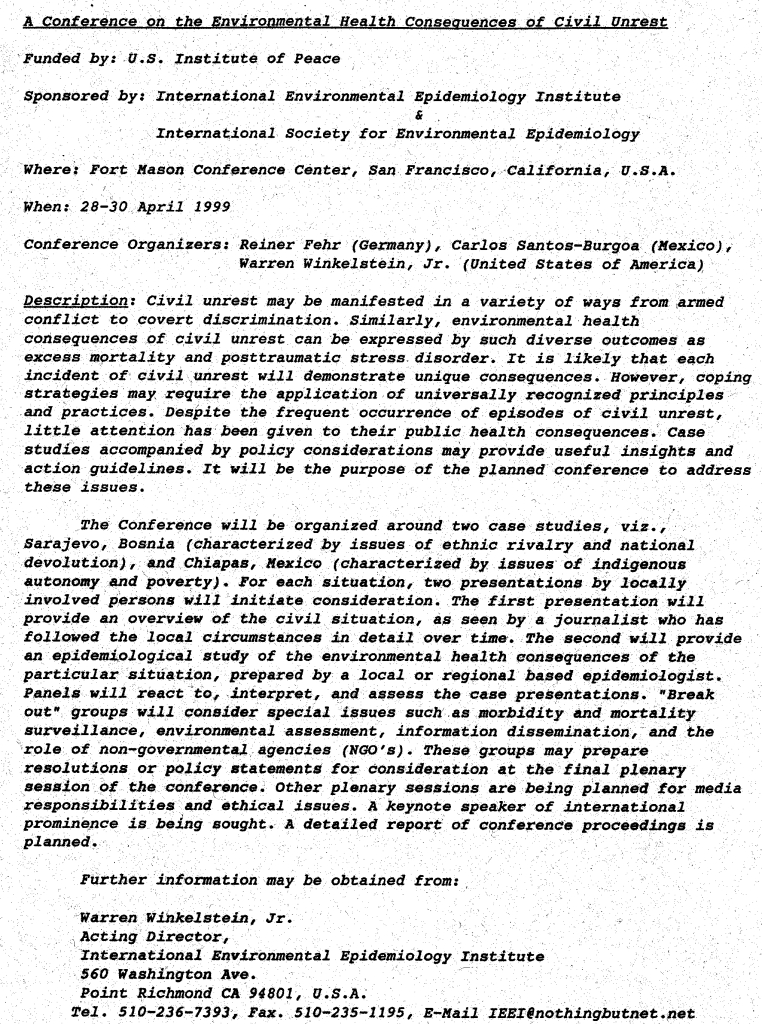
To further develop the idea and to explore funding opportunities, an international conference was to be held in San Francisco. A conference proposal was developed by Carlos Santos-Burgoa (Cuernivaca & Mexico City), Rainer Fehr (Bielefeld), and Warren Winkelstein (Berkeley) in 1996. A selective bibliography of 20 titles with annotations was produced:

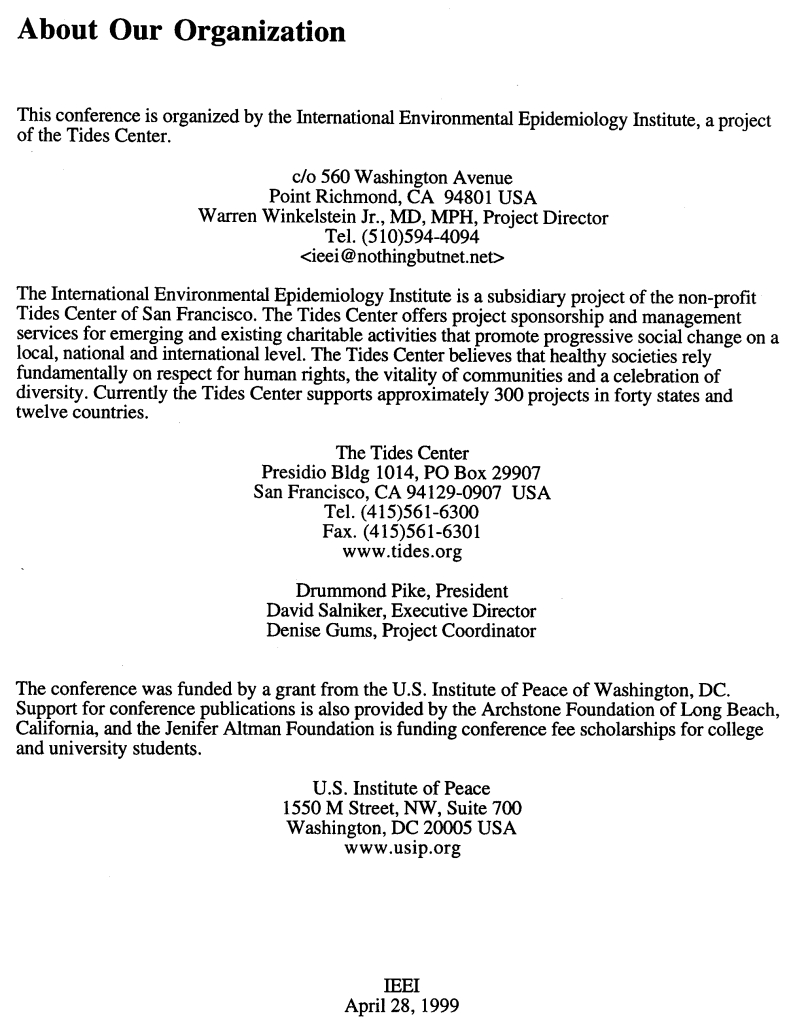
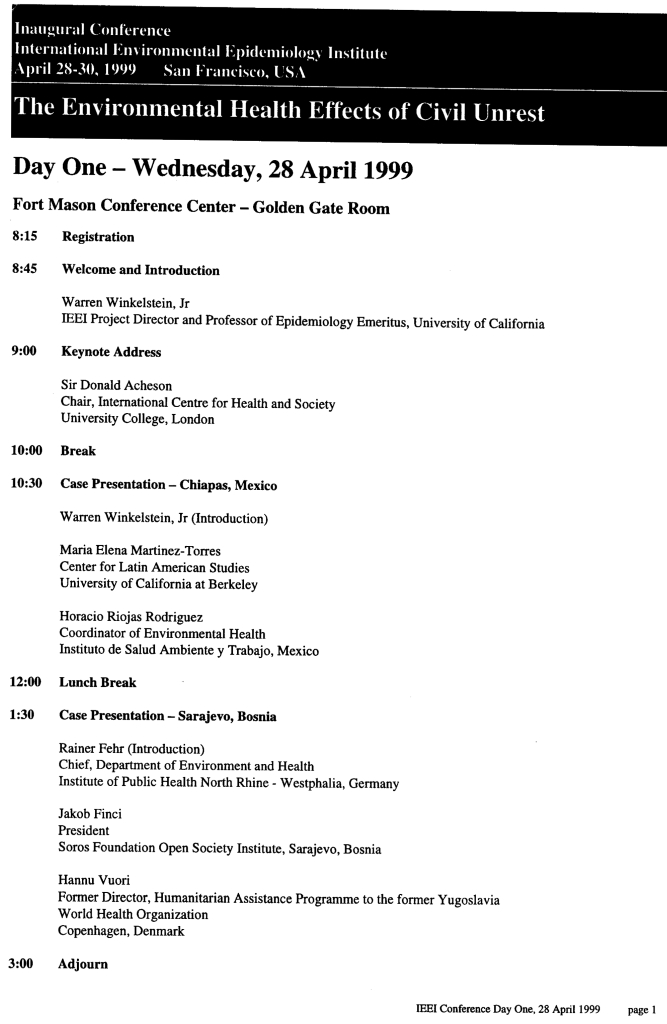
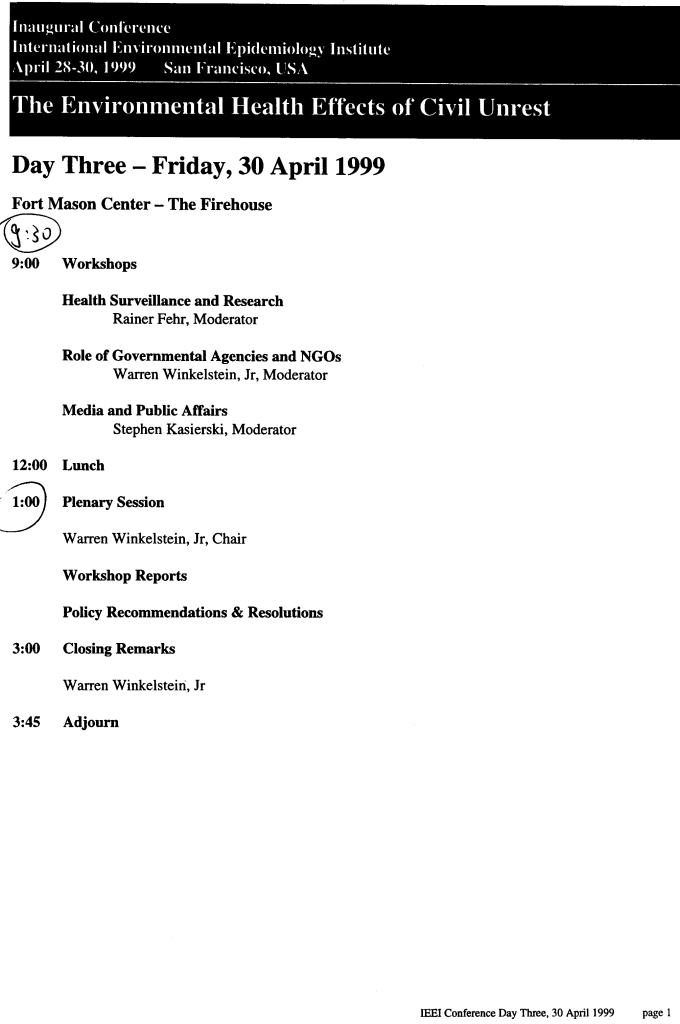
On 28-30 April 1999, the conference “Environmental Health Consequences of Civil Unrest” was held at the Fort Mason Center, near the Presidio [98-20]. On day one, the venue was the Golden Gate room of the Conference Center (building A), on days 2 and 3 The Firehouse. By this time, the IEEI as the organizing institution had reached the status of a subsidiary project of The Tides Center (www.tides.org) of San Francisco. The conference was funded by a grant from the U.S. Institute of Peace (www.usip.org) of Washington, D.C., with additional support from the Archstone Foundation (https://archstone.org/) of Long Beach, CA, and the Jenifer Altman Foundation (www.jaf.org/).

The conference program included:

  • a keynote address, delivered by Sir Donald Acheson (London)
  • case presentations from Chiapas (Mexico) and Sarajevo (Bosnia)
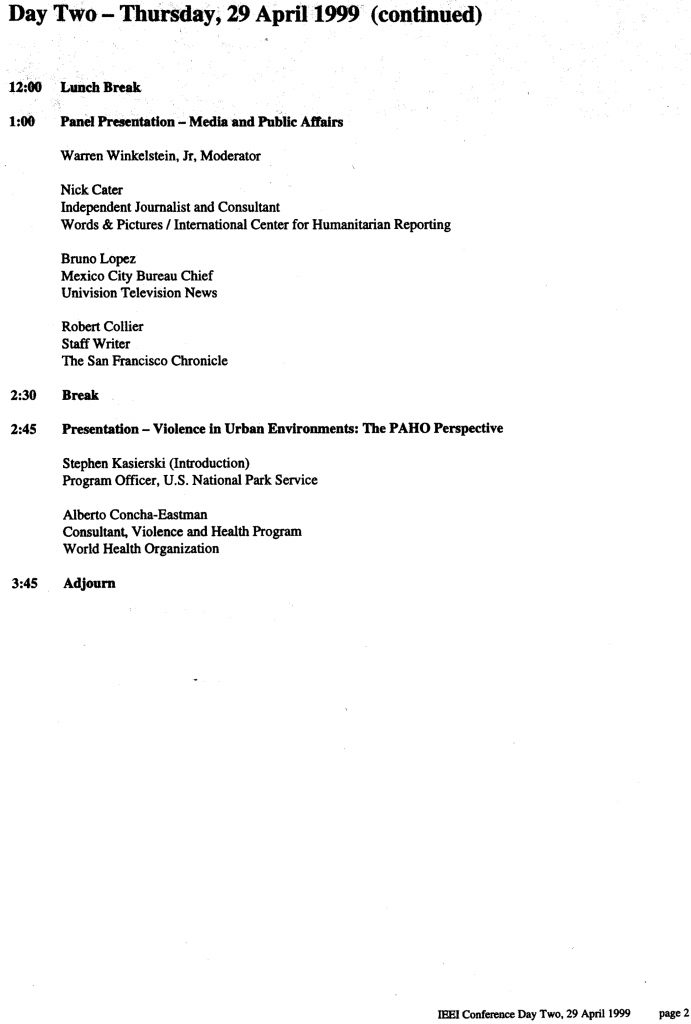
  • panel sessions on (i) health surveillance and research, (ii) role of governmental agencies and NGOs, and (iii) media and public affairs
  • a presentation on the PAHO perspective on violence in urban environments
  • workshops on (i) health surveillance and research, (ii) role of governmental agencies and NGOs, and (iii) media and public affairs
  • a plenary session with workshop reports as well as policy recommendations and resolutions.

My personal conference report is available here:

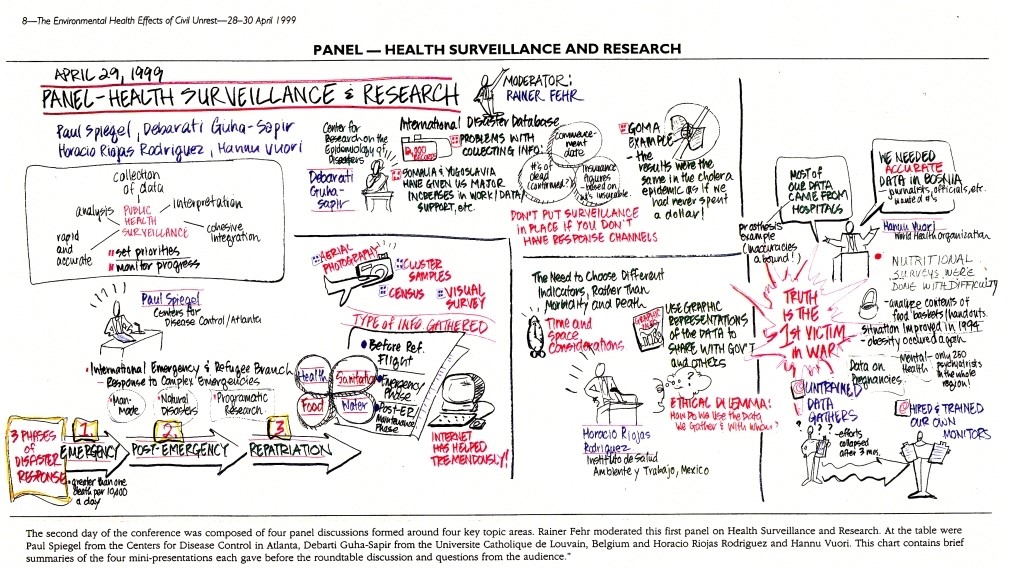
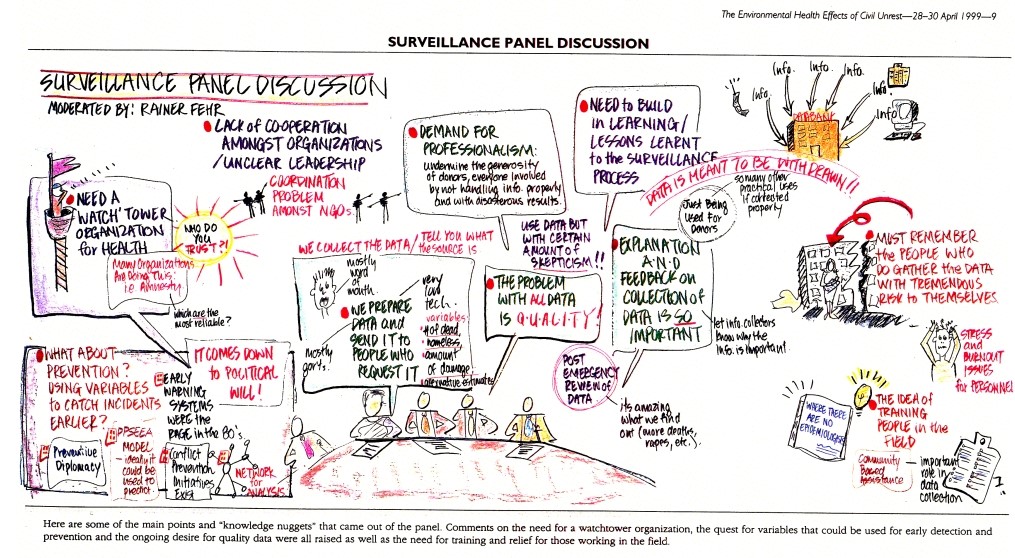
In order to document key elements of the presentations and discussions, Christina Merkley and co-workers (of Grove Consultants International. San Francisco, Ca.) produced 16 “murals”. As ist says on the cover page, this graphic summary was ”intended as a memory device for those present and as a communication tool to share the proceedings with those unable to attend”.


Own contributions:

  • Introduction to: Case Presentation – Sarajevo, Bosnia [99-07]
  • Introduction to: Panel – Health Surveillance and Research / Environmental Evaluation [99-11]
  • Introduction to: Workshop – Health Surveillance and Research / Environmental Evaluation [99-12]

Cf.:

10-17 Feb 1999, Φ Helsinki und St.Petersburg/Leningrad 1999

10.-17.2.1999, Helsinki und St. Petersburg/Leningrad 1999

10.2.1999 Mi: Flug von Düsseldorf nach Helsinki

11.-13.2.1999 Do-Sa: Tagung bei STAKES (Helsinki) zu EU-Politik. Präsentation [99-01]: Overview of our recent work concerning Health Impact Assessment, risk analysis and policy development

14.2.1999 So: Weiterflug nach St. Petersburg

15.2.1999 Mo: St. Petersburg, Rundgang

16.2.1999 Di: St. Petersburg, Eremitage, erster Besuch; und State Russian Museum, http://en.rusmuseum.ru/

17.2.1999 Mi: St. Petersburg, Erneut Eremitage: Claude-Zeichnungen. Rückflug nach Düsseldorf.

Eremitage, Claude-Gemälde; Beschilderung:

  1. Claude Gelée, dit Le Lorrain, c.1602, Chamagne – 1682, Rome. Landscape with Jacob, Rachel, and Leah at the well. Acquired for the Hermitage in 1814 from the Empress Josephine collection, Malmaison, near Paris
  2. … Landscape with Jacob wrestling with the Angel. Acquired for the Hermitage in 1814 … [dito]
  3. … Landscape with dancing figures. Acquired for the Hermitage in 1930 with the Stroganoff collection, St. Petersburg
  4. … Morning in the harbor. Acquired for the Hermitage in 1779 from the Sir Robert Walpole collection, Houghton Hall, England
  5. … Landscape with the rest on the flight into Egypt. Acquired for the Hermitage in 1814 from the Empress Josephine collection, Malmaison, near Paris
  6. … Landscape with Tobias and the Angel. Acquired for the Hermitage in 1814 from the Empress Josephine collection, Malmaison, near Paris
  7. … Italian landscape. Acquired for the Hermitage in 1772 with the Crozat collection, Paris
  8. [unbeschildert].

Eremitage, Claude-Zeichnungen (West European Art Department)

  • No. 11497 Flusslandschaft. Verso: Sieben Abwandlungen landschaftlicher Kompositionen. Erworben 1924
  • No. 7134 Ansicht der Kirche Sa. Trinita dei Monti in Rom. Verso: Studien männlicher Figuren und eines Ziegenhirten. Erworben 1768, aus der Sammlung Cobenzl, Brüssel
  • No. 4786, ohne Titel
  • No. 4368, ohne Titel (Landschaft mit Flussbrücke; Gruppe von 7 Personen).

Recherchiert 4.7.2020:

  • STAKES: National Research and Development Center for Welfare and Health, 1992-2009. STAKES was merged with the Public Health Institute (KTL) to form the new Finnish Institute for Health and Welfare (THL), https://thl.fi/en/web/thlfi-en/about-us/what-is-thl-/history.
  • Petersburg, https://de.wikipedia.org/wiki/Sankt_Petersburg: die … zweitgrößte Stadt Russlands und die viertgrößte Europas … an der Mündung der Newa in die Newabucht am Ostende des Finnischen Meerbusens … die nördlichste Millionenstadt der Welt … 1703 von Peter dem Großen auf Sumpfgelände nahe dem Meer gegründet, um den Anspruch Russlands auf Zugang zur Ostsee durchzusetzen … von 1924 bis 1991 … Leningrad … genannt … war vom 18. bis ins 20. Jahrhundert die Hauptstadt des Russischen Kaiserreiches … Die historische Innenstadt mit 2.300 Palästen, Prunkbauten und Schlössern ist seit 1991 als Weltkulturerbe der UNESCO unter dem Sammelbegriff Historic Centre of Saint Petersburg and Related Groups of Monuments eingetragen … In dieser Vielfalt … weltweit nur noch mit Venedig vergleichbar.
  • Eremitage, https://de.wikipedia.org/wiki/Eremitage_(Sankt_Petersburg): … oder Ermitage … an der Newa … eines der größten und bedeutendsten Kunstmuseen der Welt. Auch der Gebäudekomplex, der das Museum beherbergt und zu dem der berühmte Winterpalast gehört … heute zusammenfassend als Eremitage bezeichnet … ein zentraler Bestandteil der zum UNESCO-Weltkulturerbe erklärten Sankt Petersburger Innenstadt … die neben dem Louvre und dem Prado bedeutendste Sammlung klassischer europäischer Kunst …

15-18 Sep 1998, Φ Bremen: Tagungen GMDS & Umweltinformatik

15.-18.9.1998, (PH) Bremen: Tagungen GMDS & Umweltinformatik

Haasis H-D, Ranze KC (Hrsg./Eds.) (1998): Umweltinformatik ‘98 – Vernetzte Strukturen in Informatik, Umwelt und Wirtschaft. 12. Internationales Symposium „Informatik für den Umweltschutz“ der Gesellschaft für Informatik (GI) / Computer Science for Environmental Protection ‘98 – Networked Structures in Information Technology, the Environment and Business. 12th International Symposium „Computer Science for Environmental Protection“ of Gesellschaft für Informatik (GI). 2 Bände / 2 volumes. Metropolis-Verlag, Marburg.

Eigener Beitrag, publiziert in Bd. II / Vol. II, pp.722-728: Fehr R, Börner K, Wachsmuth I: AkuVis: Interactive visualization of acoustic data. [98-04]


15.9.1998 GVP-Projektgruppe; Surveillance approches

16.9.1998 AG Probabilistische Quantitative Risikoanalyse (PQRA)

14-16 Sep 1998, Φ Bremen, 43. GMDS-Jahrestagung: Methoden der Medizinischen Informatik, Biometrie und Epidemiologie in der modernen Informationsgesellschaft

14.-16.9.1998, 43. Jahrestagung der Deutschen Gesellschaft für Medizinische Informatik, Biometrie und Epidemiologie (GMDS): Methoden der Medizinischen Informatik, Biometrie und Epidemiologie in der modernen Informationsgesellschaft

Universität Bremen; BIPS; Technologie-Zentrum Informatik. Tagungsleitung: E. Greiser, M.B. Wischnewsky.

Eigener Beitrag:

  • Fehr R: Surveillance approaches for Agenda 21: Variation of regional mortality and predictors 1994-1995 in Germany. Vortrag, Session Umweltepidemiologie I, 15.9.1998, Programmheft, p.28 [98-01]

Zusätzlich: Öffentliche Arbeitssitzung des Arbeitskreises Probabilistische Expositionsabschätzung: “Probablistische Expositionsabschätzung in Umweltmedizin und Verbraucherschutz”, 16.9.1998, 15:30h, mit Einführung (RF) und 5 Beiträgen, darunter O.Mekel und R. Fehr: Probabilistische Verfahren im umweltbezogenen Gesundheitsschutz [98-15].

15-18 Aug 1998, Φ Boston (MA), 10th ISEE & 8th ISEA Conference: Conecting with the Community in Environmental Health Studies

15.-18.8.1998, Boston (MA), 10th Conference of the International Society for Environmental Epidemiology (ISEE) & 8th Conference of the International Society for Exposure Analysis ISEA): Connecting with the Community in Environmental Health Studies

Conference Co-chairs: Douglas Dockery (Harvard U), John Spengler (Harvard U). Venue: Boston Park Plaza Hotel, Boston, MA.

Workshop participation: Pre-Conference Workshop, 15 Aug 1998, 9am-5pm, Ned Butler and Kimi Klein (California Department of Toxic Substances Control), Tom McKone (Lawrence Berkeley Laboratory): Integrated Multimedia Exposure Modeling with Sensitivty and Uncertainty Analysis.

Own poster contribution:

R. Fehr: Surveillance approaches for “Agenda 21”: Geographic mortality predictors in Germany 1991 – 1995. In: Poster session “GIS and Spatial Analysis Posters”, Conference program booklet, p.18. Abstract published in: Epidemiology Vol.9, No.4 Suppl., p.S166 [97-26].