14-18 May 2001, Φ EcoInforma 2001: Environmental Risks & the Global Community, Argonne (IL, USA)

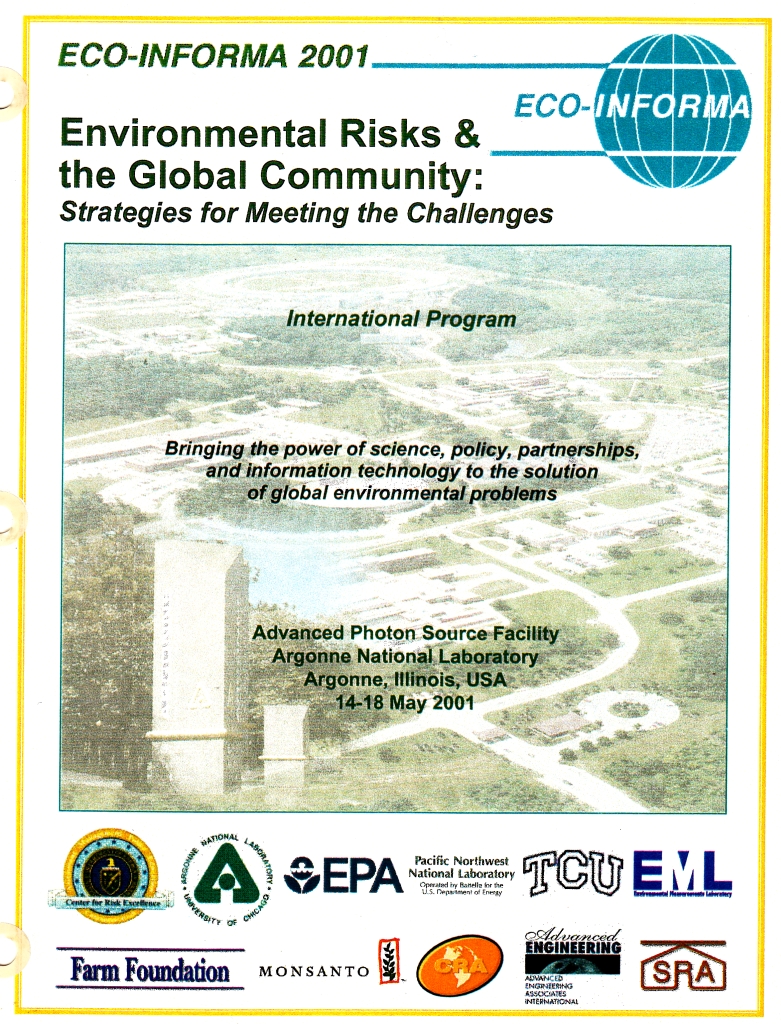
14.-18.5.2001, EcoInforma 2001: Environmental Risks & the Global Community – Strategies for Meeting the Challenges. Argonne National Laboratory, Argonne (IL, USA)

[Vgl. 18 Sep 1992: EcoInforma 1992 in Bayreuth]

00_32 Eco-Informa 2001_05_14-18a

Argonne National Laboratory – A U.S. Department of Energy Science Laboratory, 9700 South Cass Av., Argonne, IL 60439 … about 25 miles southwest of downtown Chicago … founded in 1946 as America’s first national laboratory … Major activities and research areas: Basic scientific research … Biotechnology and Environmental research … Energy Technology … Nuclear Reactor Technology and Non-Proliferation …


(1) Oral presentation in session III-5, Data management and information technology for the future: Fehr, R., Dora, C. (2001): Prospective impact assessment as a tool for Agenda 21 and Environmental Health action plans – Typology and criteria exemplified by 10 examples. [00-35]

(2) Poster platform session (Auditorium), Theme III: Environmental information in the 21st century: approaches and tools for better decisions.

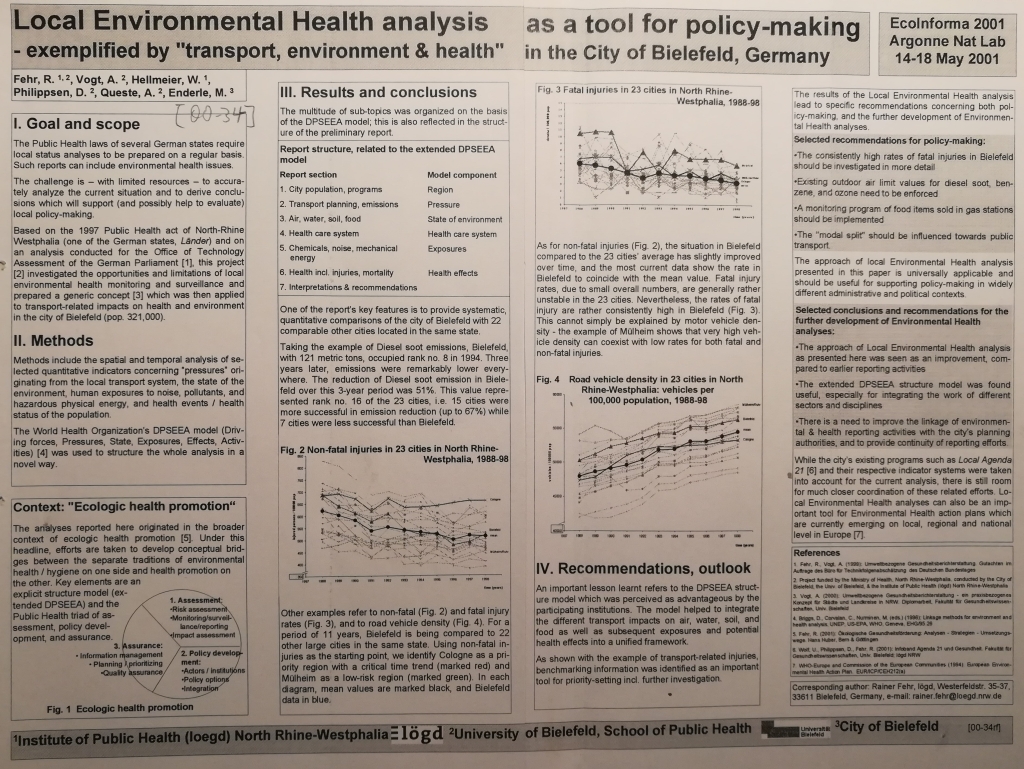
  • Poster III-PP1 (incl. brief oral presentation): Fehr, R., Vogt, A., Hellmeier, W., Philippsen, D., Queste, A., Enderle, M. (2001): Local Environmental Health analysis as a tool for policy-making, exemplified by “transport, environment and health” in the City of Bielefeld. [00-34]
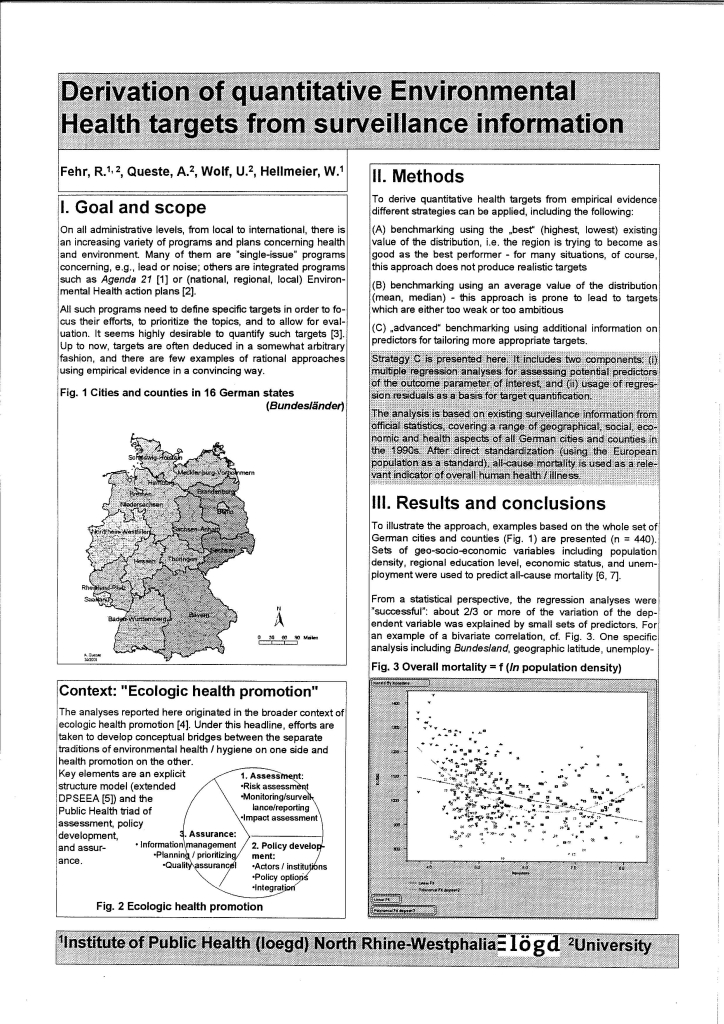
  • Poster III-P1: Fehr, R., Queste, A., Wolf, U., Hellmeier, W. (2001): Derivation of quantitative health targets from surveillance information. [00-33]

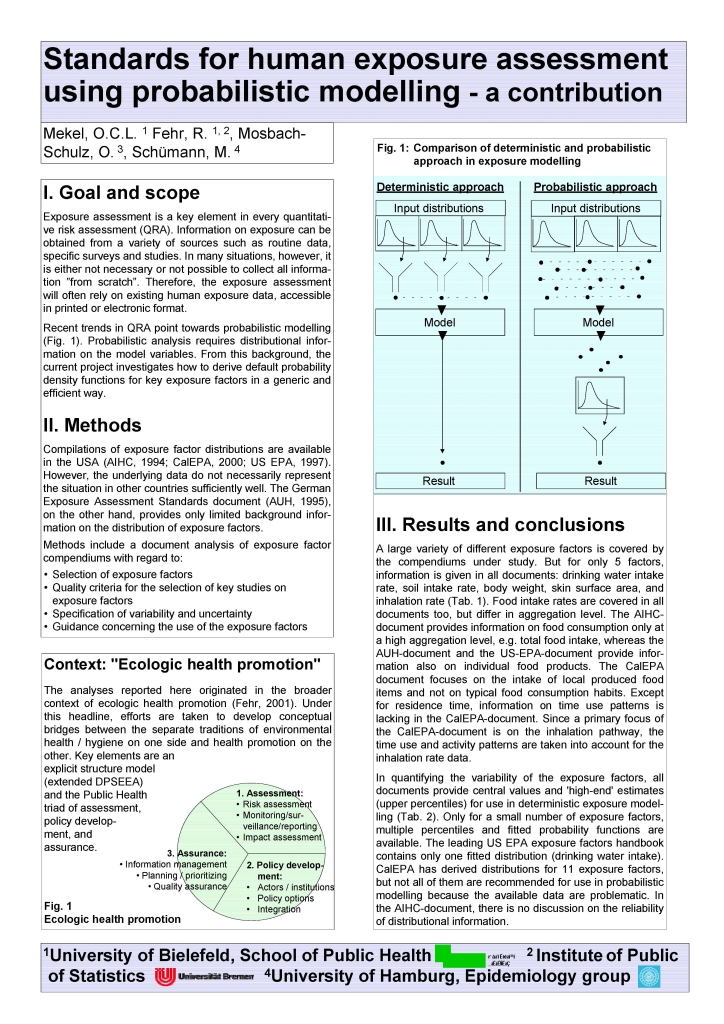
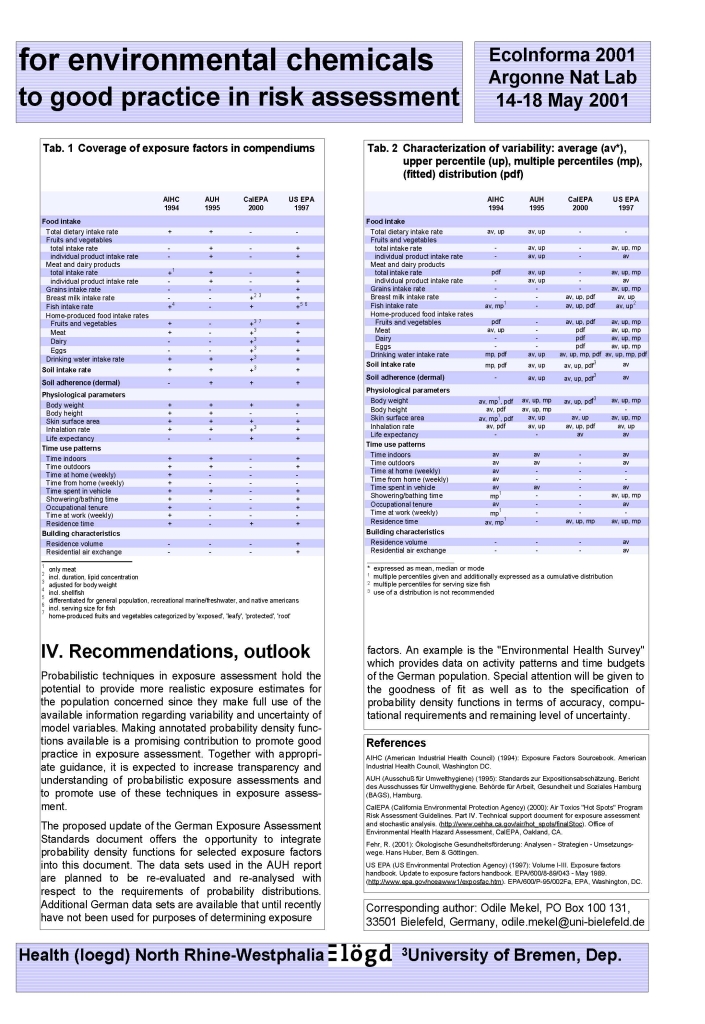
Poster III-P2: Mekel, O.C.L., Fehr, R., Mosbach-Schulz, O., Schümann, M. (2001): Standards for human exposure assessment using probabilistic modelling – a contribution to good practice in risk assessment. [00-32]

(3) Co-chairing (with Kristina Voigt, GSF) session III-3: Internet applications for integrated decisions.

  • 1 European environmental information resources on the Web. Werner Pillmann, International Society for Environmental Protection, Austria
  • 2 Generation and use of large Web-based environmental information systems. Werner Geiger, Forschungszentrum Karlsruhe Germany
  • 3 Management of data in an exabyte world. Ethel Jacob, US Department of Energy Environmental Measurements Laboratory, NY
  • 4 Internet-based corporate environmental reporting by companies: technical benefits, empirical findings, ICT architecture. Christian Lenz, University of Kaiserslautern, Germany
  • 5 Internet applications to support the EIS process: a case study. Robert Sullivan, Argonne National Laboratory, IL

28 June – 2 Jul 2000, Φ WHO-Europe Expert meeting on HIA/EIA, Dubrovnik

28.6.-2.7.2000, WHO-Europe Expert meeting on HIA/EIA, Dubrovnik (CRO)

  • D.Kello (WHO-Euro, Copenhagen; Meeting chair: M. Mikulic (Zagreb), Rapporteur: M.Birley (Liverpool).
  • Meeting context: Sofia Initiative on EIA; invitational workshop [00-42]
  • Individual contributions from experts based, e.g., in Lincoln (UK), Filzen (CZ), Gustavsberg (SE), Sarajevo (Bosnia & Herzegowina), Washington (USA), also from UN-ECE and WHO
  • Country contributions: Estonia, Lithuania, Czech Republic, Slovak Republic, Poland

Own role: Discussion participation; response to draft paper.

12 May 2000, Φ Schwäbisch Gmünd, ÖGD-Ärzte-Kongress, Workshop “ÖGD – Agenda 21“

2000_05_12 Ws Programm ÖGD Schwäbisch Gmünd

50. Wiss. Kongreß des Bundesverbandes der ÖGD-Ärzte und –Zahnärzte, Schwäbisch Gmünd, 11.-13.5.2000, Workshop „Effektive Einbindung des ÖGD in die Agenda-Aktivitäten“, Freitag 12.5.00, 16-18 Uhr

Programm

16:00Schwenk, Fehr: Begrüßung Teilnehmer: Erwartungen und Interessen  
16:15Philippsen: Nordrhein-westfälisches Projekt “Agenda 21 und Gesundheit”  
16:25Schwenk: Agenda 21, eine Chance für die Zukunftsgestaltung  
16:35Fehr, Schwenk: Möglichkeiten der Einbindung des ÖGD in die Agenda21-Aktivitäten (Neue Thesen zur Verbindung von „Agenda 21 und Gesundheit“)  
16:45Leykamm (Moderation): Diskussion über Möglichkeiten und Nutzen einer ÖGD-Beteiligung, Handlungsfelder, Kooperationen, Ressourcen; ggf. auch Modifizierung der Thesen
17:45Zusammenfassung der Ergebnisse; weiteres Vorgehen  
18:00Ende des Workshops

Workshop-Veranstalter:

  • LGA Baden-Württemberg, Stuttgart / Prof. M. Schwenk, B. Leykamm
  • Projekt „Agenda 21 und Gesundheit“, Universität Bielefeld / D. Philippsen, U. Wolf (gefördert vom MFJFG NRW)
  • lögd NRW, Bielefeld / PD R. Fehr

20 Thesen “Agenda 21 und Gesundheit”, formuliert anläßlich des vom lögd NRW und vom LGA Baden-Württemberg vorbereiteten Workshops “Agenda 21 und Gesundheit”; 20 Propositions on “Agenda 21 and Health” (nachträglich übersetzt: 5.9.2000)

Präsentation – R. Fehr, D. Philippsen, U. Wolf: Projekt „Agenda 21 und Gesundheit – Gefördert vom MFJFG NRW“

28-31 Oct 1999, Φ Göteborg (SE): HIA workshop; Kopenhagen (DK): Statens Museum for Kunst

28.-31.10.1999, Göteborg (SE): HIA workshop; Kopenhagen (DK): Statens Museum for Kunst

1999_10_28 Nordic SPH Göteborg

Göteborg, 28-30 Oct. 1999: Participation in the Leo Kaprio Workshop, “Health Impact Assessment: from theory to practice” / Teilnahme am Leo Kaprio-Workshop, “Health Impact Assessment: from theory to practice” [99-15].

Diwan et al 2000 HIA ws Göteborg 1999 reportReport: Diwan, V., Douglas, M., Karlberg, I. et al. (eds.): Health Impact Assessment: from theory to practice. Report on the Leo Kaprio workshop, Gothenburg, 28-30 October 1999. WHO-Europe and Nordic School of Public Health, Gothenborg, Sweden. NHV-report 2000:9.

The report includes: Fehr, R. (2000): Environmental Health Impact Assessment: the example of transportation (pp.213-229), pdf file. Excerpt: … (p.213) ‘ecologic health promotion’ … (p.214) extended DPSEEA model … (p.215) WHO ‘Transport, Environment and Health’ (THE) project … HIA workshop, Bielefeld, Germany, May 1999 … (p.217) HIA components, methods, tools … (p.219) Levels of complexity, integration, and quality criteria … (p.220) Future developments … (pp.223-226) Annex 1: Chronology of HIA – Global and local events, (pp.227-229) Annex 2: Selected computer tools and resources for Environmental Health Impact Assessment.


Auf dem Rückweg am 31.10.99 Zwischenstopp in Kopenhagen: Statens Museum for Kunst. Dort besucht: Claude Lorrain (c.1630): River landscape with herdsmen. Zum Gemälde siehe 27.5.2014, https://rfehr.eu/2014/05/27/27-may-2014-statens-museum-for-kunst-asger-jorn/

5-8 Sep 1999, Φ Athens, ISEE/ISEA ’99, Exposure assessment, environmental epidemiology and decision-making: closer interactions for better protection of public health

5.-8.9.1999, Athens, 11th Conference of the International Society for Environmental Epidemiology (ISEE), 9th Conference of the International Society of Exposure Analysis (ISEA): Exposure assessment, environmental epidemiology and decision-making: closer interactions for better protection of public health.

Host: Department of Hygiene and Epidemiology, University of Athens Medical School. Co-Organiser: Hellenic Society of Environmental Health. Organising Committee: Klea Katsouyanni (ISEE), Matti Jantunen (ISEA), Panos Georgopoulos (ISEA). Venue: Conference Halls of the hotels Nafsika and Arion, at the Astir Palace Resort in Vouliagmeni.

Own contributions:

  • Fehr, R. (Chair): ISEE Policy & Planning working group. Environmental health policy development: The pros and cons of single-issue vs. integrated approaches (incl. Session introduction). Conference Program book, p.26 [99-30]
  • Fehr, R., Fletcher, T. (Chairs): Humanitarian emergencies, public and environmental health: Lessons from Yugoslavia and other emergencies. Symposium, 8.9.1999, Nafsika Conference Hall. Conference Program book, p.74 [99-31]
  • Fehr, R., Tountas, Y., Pless-Mulloli, T.: ISEE Policy & Planning group – Evaluation of scientific abstracts with respect to policy development and decision making. Symposium, 8.9.1999, Nafsika Conference Hall. Conference Program book, p.80 [99-33]
  • Fehr, R., Winkelstein, W., Santos-Burgoa, C.: Mitigation of health effects of civil unrest – what policy options? Oral presentation, Session “Environmental health policy development: The pros and cons of single-issue vs. integrated approaches”, 6.9.1999, Conference Program book, p.26 [99-32]
  • ISEE Policy & Planning working group; Fehr, R. (1999): Evaluation of scientific abstracts with respect to policy development and decision-making. 1. Introduction. Abstract: Epidemiology 10, no.4, suppl., p.S179
  • ISEE Policy & Planning working group; Fehr, R. (1999): Evaluation of scientific abstracts with respect to policy development and decision-making. 2. Methods. Abstract: Epidemiology 10, no.4, suppl., p.S179
  • Lacombe, M., Hellmeier, W., Olberding, P., Weber, H., Fehr, R. (1999): Drinking water surveillance as a tool of exposure assessment and health protection. Oral presentation 109 O, in Session “Waterborne infectious diseases and disinfection processes”. Conference Programme book, p.21. Abstract: Epidemiology 10, no.4, suppl., p.S57 [98-27]
  • Mekel, O.C.L., Weber, H., Fehr, R. (presenter) (1999): Probabilistic modelling in quantitative exposure assessment: differentiating between uncertainty and true variation. Oral presentation 285 O in Session “Exposure and dose estimation and modelling 2”. Conference Program book, p.52. Abstract: Epidemiology 10, no.4, suppl., p.S104 [98-19]