
15.4.1955, Titanic-Untergang als Startpunkt für physischen und sozialen Aufbau / The sinking of the Titanic as a starting point for physical and social reconstruction
Gemeinsam mit Grundschulfreund(en) wurde jahrelang „Untergang der Titanic“ gespielt: eine kleine Gruppe Überlebender befand sich auf einer unbewohnten Insel, war ausschließlich auf lokale Ressourcen angewiesen und arbeitete sich aus primitivsten Anfängen schrittweise in eine komfortablere Wohn-, Arbeits- und Lebenssituation hoch. Das Spiel stand für uns immer unter der Überschrift „Untergang der Titanic“, obwohl es inhaltlich eher einer Robinson-Erzählung oder dem damaligen sogen. Wirtschaftswunder entsprach / For years, together with primary school friends, we played ‘The Sinking of the Titanic’: a small group of survivors found themselves on an uninhabited island, relying solely on local resources, and gradually worked their way up from the most primitive beginnings to a more comfortable living, working and social situation. For us, the game was always billed as ‘The Sinking of the Titanic’, although in terms of content it was more akin to a Robinson Crusoe-style tale or the so-called ‘economic miracle’ of that era.
Technologisch erfolgte die Aufbauarbeit vor allem mit rechteckigen, flachen Holzklötzchen (die ehemals eine Fußmatte gebildet hatten), ferner mit Spielfiguren, Fahrzeugen und diversen Utensilien. Meistens wurde im Laufe eines Nachmittags ein akzeptables Zivilisationsniveau erreicht; aber oft konnte dieser Stand – z.B. weil ein Spielzimmer auch als Esszimmer zu fungieren hatte – nicht bewahrt werden, so dass am nächsten Tag die Titanic erneut versinken musste – was dem Spiel auch ein Sisyphus-Element verlieh / In terms of the materials used, the construction work was carried out mainly using small, flat, rectangular wooden blocks (which had previously formed a doormat), as well as toy figures, vehicles and various other items. In most cases, a reasonable level of civilization was achieved in the course of an afternoon; but often this state of affairs could not be maintained – for example, because a playroom also had to serve as a dining room – with the result that the next day the Titanic had to sink all over again – which also lent the game a Sisyphean element.
Dieser Eintrag betrifft meine Grundschulzeit 1954-1958; der Post ist willkürlich datiert auf den 33. Jahrestag des Unterganges / This entry relates to my primary school years from 1954 to 1958; the post is arbitrarily dated to the 33rd anniversary of the sinking.
Ergänzende Infos / Further information, 16.7.2026
RMS Titanic, https://de.wikipedia.org/wiki/Titanic_(Schiff) (16.7.26): … britischer Passagierdampfer der Reederei White Star Line. Bei ihrer Fertigstellung im Frühjahr 1912 … das größte Schiff der Welt … für den Einsatz im Transatlantik-Liniendienst zwischen Southampton und New York entworfen … / … a British passenger steamship operated by the White Star Line. Upon its completion in the spring of 1912 … the largest ship in the world … designed for transatlantic service between Southampton and New York …
- … startete am 10. April 1912 zu ihrer Jungfernfahrt. In der Nacht vom 14. auf den 15. April 1912 stieß sie im Nordatlantik mit einem Eisberg zusammen. Aufgrund der dabei entstandenen Schäden versank sie zwei Stunden und vierzig Minuten später. Von den über 2220 an Bord befindlichen Menschen kamen 1514 Personen ums Leben … / … set sail on its maiden voyage on 10 April 1912. During the night of 14–15 April 1912, it collided with an iceberg in the North Atlantic. As a result of the damage sustained, she sank two hours and forty minutes later. Of the more than 2,220 people on board, 1,514 lost their lives …
- Das katastrophale Ende der Titanic fand enormen Widerhall in den Medien … Dazu beigetragen haben die Umstände des Unglücks, darauf beruhende Streitfragen und Verschwörungserzählungen … Eine Rolle spielt dabei der Begriff der „Unsinkbarkeit“ … / The Titanic’s catastrophic end caused a huge stir in the media … Contributing factors included the circumstances of the disaster, the disputes arising from it, and conspiracy theories … The concept of ‘unsinkability’ plays a role in this …
- Noch heute ist das Interesse in Medien und Kunst an der Titanic sehr groß … Bereits im Unglücksjahr 1912 entstanden mehrere Filme über die Titanic … Das Unglück wird in zahlreichen Sachbüchern und Romanen verarbeitet … / Even today, there is still a great deal of interest in the Titanic in the media and the arts … Several films about the Titanic were made as early as 1912, the year of the disaster … The disaster has been explored in numerous non-fiction books and novels …
- Die Titanic gehörte … zur Olympic-Klasse. Da sie außer Passagieren und Fracht auch Post beförderte, durfte sie das Kürzel RMS (Royal Mail Ship …) verwenden … / The Titanic belonged … to the Olympic class. As it carried not only passengers and cargo but also post, it was permitted to use the abbreviation RMS (Royal Mail Ship …) …
Lit.-Auswahl / Selected references
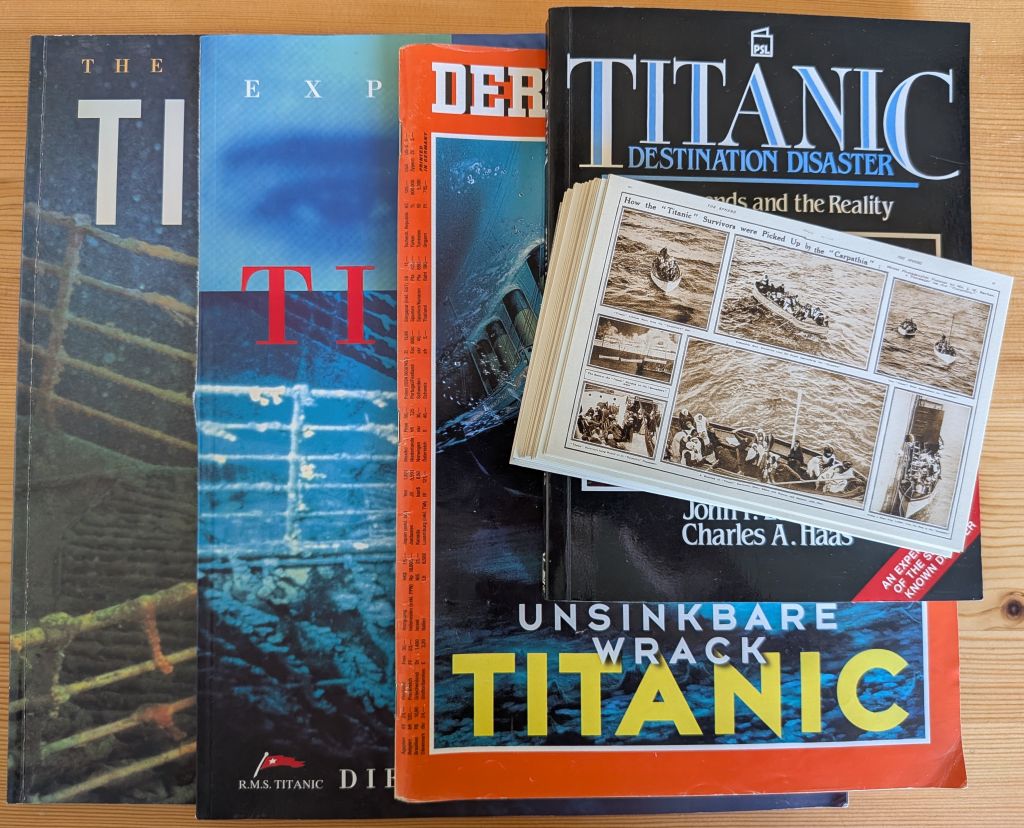
- Eaton, J.P.; Haas, C.A. (1987): Titanic – Destination disaster. The legends and the reality. Patrick Stevens Limited, Haynes Publishing, Sparkford, UK.
- Hutchinson, G. (1994): The wreck of the Titanic. National Maritime Museum, Greenwich, UK. Exhibition visited on 4 Mar 1995.
- Voyager Titanic Exhibition GmbH (1997): Expedition Titanic – Die Ausstellung, 8.5.-9.11.1997, Hamburg-Speicherstadt.
- SPIEGEL Nr.20 (12.5.1997), S.114ff: Volldampf unter Wasser. Tausende Schiffe sind sang- und klanglos versunken. Allein die „Titanic“ wurde zum Mythos, ihre Kollision mit einem Eisberg zum Inbegriff für menschliche Hybris …
Postcards
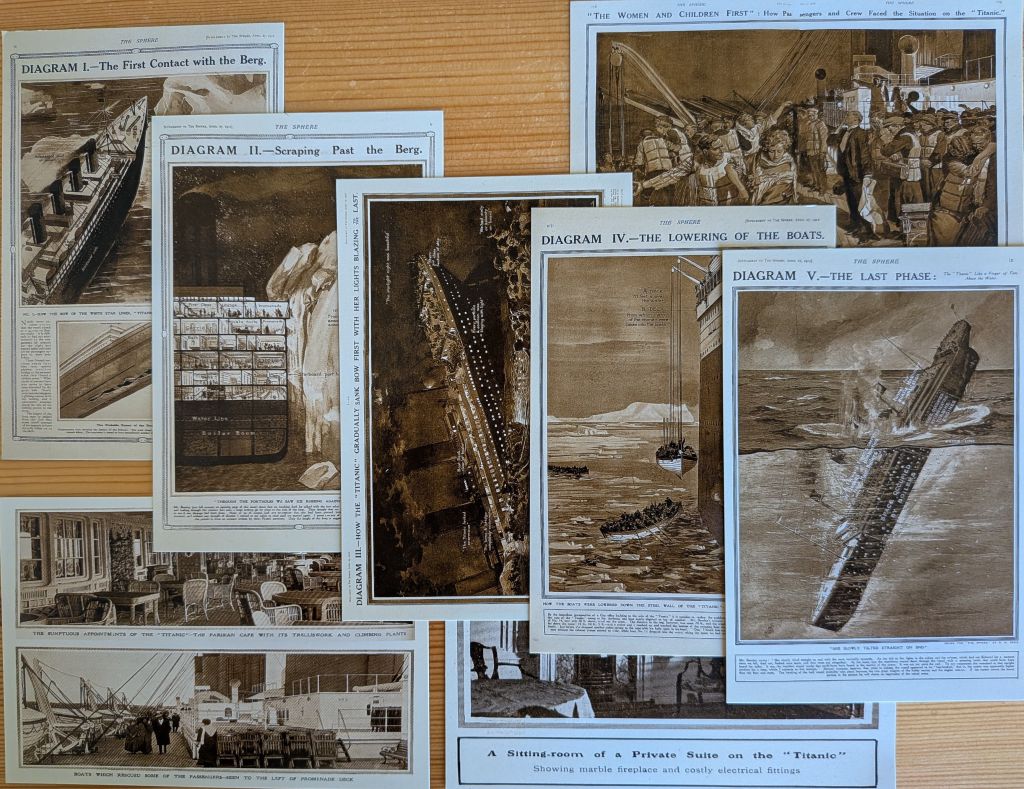
Marine Art Posters (1993): The loss of the Titanic. The Cunard Collection Cards, incl. diagrams: I. The first contact with the berg, II. Scraping past the berg, III.How the “Titanic” gradually sank bow first with her lights blazing to the last, IV. The lowering of the boats, V. The last phase.
(To be added: Epidemiology class, UC Berkeley, Fall 1985 / Exercise)
Transl.: DeepL, modif.
Cf.:
3 Mar 1995, Φ London, incl. CIEH [Exhibition].

