14 Jul 2016, Φ Urban Health in Hamburg – Accepted for publication in ‘Das Gesundheitswesen’

Today, after peer-review, the following manuscript was accepted for publication in Das Gesundheitswesen / Heute wurde nach erfolgtem Peer-Review folgendes Manuskript angenommen zur Veröffentlichung in Das Gesundheitswesen, www.thieme.de/de/gesundheitswesen/profil-1875.htm:

„Urban Health (StadtGesundheit) – The wider perspective exemplified by the City State of Hamburg“ / „StadtGesundheit (Urban Health) – eine Blickfelderweiterung am Beispiel Hamburgs“

Authors of this (German-language) journal paper / AutorInnen dieses (deutschsprachigen) Zeitschriftenbeitrages: Rainer Fehr (Universität Bielefeld, Fakultät für Gesundheitswissenschaften), Regina Fertmann, Klaus-Peter Stender (both / beide: Behörde für Gesundheit und Verbraucherschutz Hamburg, Amt für Gesundheit), Norbert Lettau (formerly / ehemals: Behörde für Gesundheit und Verbraucherschutz Hamburg, Amt für Gesundheit); Alf Trojan (Universität Hamburg, Universitätskrankenhaus Eppendorf)

Extract from the summary / Aus der Zusammenfassung:

  • Public health and city planning in many places now reunite under the heading of urban health. To organize this field adequately requires a broad, integrative view of medical care, health promotion, and health in all urban policies / Öffentliche Gesundheit und Stadtplanung kommen vielerorts erneut unter der Überschrift StadtGesundheit zusammen. Erforderlich ist ein erweiterter, integrierender Blick auf medizinische Versorgung, Gesundheitsförderung und intersektorale Stadtpolitik.
  • Using the City State of Hamburg as an example and combining historic and systematic approaches, we explore the preconditions for in-depth analyses / Am Beispiel des Stadtstaates Hamburg erkunden wir mit einem kombinierten historischen und systematischen Ansatz die Voraussetzungen für vertiefende Analysen.
  • Health proves to be a significant topic of Hamburg urban policy, featuring a broad range of structures, processes and actors, both within the health sector and far beyond / „Gesundheit“ erweist sich als bedeutendes Thema Hamburger Stadtpolitik mit ausgeprägter Vielfalt von Strukturen, Prozessen und Akteuren innerhalb des Gesundheitssektors und weit darüber hinaus.
  • Communication among the actors does not seem to focus on critical evaluations, e.g. concerning social and ecologic sustainability / Die Kommunikation zwischen den Akteuren lässt wenige Hinweise auf kritische Überprüfungen z.B. mit Blick auf soziale und ökologische Nachhaltigkeit erkennen.

Keywords: Urban health, Urban planning, Health promotion, Integration, Sustainability, Protection of records / Schlüsselwörter: StadtGesundheit, Stadtplanung, Gesundheitsförderung, Integration, Nachhaltigkeit, Quellensicherung.


See also / Siehe auch:

  • 9 Jun 2016  Urban Health in Hamburg – Expanded view via thematic integration. Abstract accepted for DGSMP 2016 presentation, Essen / StadtGesundheit am Beispiel Hamburg – Blickfelderweiterung durch thematische Integration. Akzeptiert zur Präsentation bei DGSMP 2016, Essen
  • 15-17 Oct 2015 (i) Urban health practice in Hamburg (Germany) – Integrated view to support futureproofing of the city, (ii) Identifying major trends of health policy in a German city state – using hitherto neglected sources. Two presentations at 8th EPH conf, Milano 2015 / Zwei Präsentationen bei der 8. EPH-Konferenz, Milano 2015

Work on Urban Health in Hamburg will be continued / Die Arbeit zur Hamburger StadtGesundheit wird fortgesetzt.
11 Jul 2016, Φ Urban Health project „Building bridges“, part III

As posted on 2 May, a 2-year extension was granted for the project “Building bridges across disciplines and sectors” / Wie am 2.5. gepostet wurde für das Projekt “Disziplinärer und sektoraler Brückenbau“ eine 2jährige Fortsetzung bewilligt.

My contract for the third project phase starts today. During the next 24 months, we aim to carry forward what was started in the earlier periods. The focus is on: / Heute beginnt mein Vertrag für die dritte Projektphase. In den nächsten 24 Monaten soll die bisherige Arbeit auf folgende Weise weitergebracht werden:

  • Consolidating Urban Health evidence and information (incl. on actors and transdisciplinarity) from Germany and abroad / Evidenz und Informationen (einschließlich AkteurInnen, Transdisziplinarität) zu StadtGesundheit aus dem In- und Ausland aufbereiten
  • Initiating Urban Health case studies and innovative approaches, incl. visualization / Anregung von Fallstudien und innovativen Ansätzen zur StadtGesundheit, einschließlich Visualisierung
  • Providing access to Urban Health knowledge via dedicated publications for various target groups, and enhancing the website “urban-health.de“ / Zugang zum Wissensstand “Stadtgesundheit” durch zielgruppengerechte Publikationen und Weiterentwicklung der Website “www.stadt-und-gesundheit.de“.

Jointly conducted by Claudia Hornberg and Rainer Fehr / Gemeinsames Projekt von Claudia Hornberg und Rainer Fehr.


9 Jul 2016, ♣ Horticulture & ecology

IMG_5821

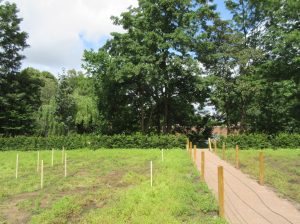
For urban leisure gardening (allotment gardening), the protection of nature and environment plays an important role. 97% of allotment holders were found to use rain water for watering, 96% to do composting. Awareness is strongest among younger allotment gardeners, i.e. those with up to 10 years of gardening experience. More than half of these organically cultivate fruits and vegetables; nearly two thirds abstain from chemical fertiliser; more than four out of five disapprove of chemical pest control / „Natur- und Umweltschutz spielen bei Kleingärtnern eine wichtige Rolle… So nutzen 97% Regenwasser zum Bewässern, 96% kompostieren. Besonders ausgeprägt ist das Bewusstsein … bei jüngeren Kleingärtnern, die ihren Garten seit höchstens zehn Jahren bewirtschaften. Mehr als jeder Zweite dieser Neu-Kleingärtner … betreibt biologischen Anbau von Obst und Gemüse, fast zwei Drittel… verzichten auf Kunstdünger, mehr als vier Fünftel… lehnen chemische Schädlingsbekämpfung ab.

This development is being fostered by specialist counselling in the gardening clubs. 84% of clubs use this approach for strengthening their members’ awareness of nature and environmental issues. Ecologic model allotment gardens give further support /  Gefördert wird diese Entwicklung durch die Fachberatung der Vereine… 84% der Vereine nutzen diesen Weg, um das Natur- und Umweltbewusstsein ihrer Mitglieder zu fördern… Ökologische Musterkleingärten … unterstützen diesen Prozess…“, https://de.wikipedia.org/wiki/Kleingarten

7 Jul 2016, Φ EUPHA 2016: Workshops update

As posted on 16 June, the 9th European Public Health Conference (EUPHA and Österreichische Gesellschaft für Public Health) takes place in Vienna, 9–12 Nov 2016, [updated:] https://ephconference.eu/conference-2016-vienna-48 / Wie am 16.6. geposted, erfolgt die 9. Europäische Public Health-Konferenz (EUPHA und Österreichische Gesellschaft für Public Health) in Wien, 9 –12.11.2016, [updated:] https://ephconference.eu/conference-2016-vienna-48.

Presentations in our workshops / Beiträge der von hiesiger Seite vorbereiteten Workshops


Workshop: Health assessments in support of decision-making / Gesundheitsanalysen zur Unterstützung von Entscheidungsfindung

Organizers: EUPHA HIA section; EUPHA Health Services Research section; EUPHA Public Health Economics section; EUPHA Public Health Practice & Policy section; WHO

This is the third workshop in a series dealing with governance-supporting health assessments, preceded by “Health Technology Assessment and Health Impact Assessment – Two key examples of health assessment” at the 7th EPH conference, Glasgow 2014 and “Health assessments: Status and perspectives of basic and advanced approaches” at the 8th EPH conference, Milano 2015 / Dritter Workshop einer Serie über governance-unterstützende Gesundheitsanalysen, nach “Health Technology Assessment and Health Impact Assessment – Two key examples of health assessment” bei der 7. EPH-Konferenz, Glasgow 2014 und “Health assessments: Status and perspectives of basic and advanced approaches” bei der 8. EPH-Konferenz, Mailand 2015.

  • Judith de Jong (NIVEL, Utrecht, NL): Health Systems Performance Assessment
  • Tek-Ang Lim (InVS, Saint-Maurice, F): Do economic evaluations add value to health assessments in the decision-making process?
  • Tim Nguyen (WHO Europe, Copenhagen, DK): Evidence-informed Policy-making – Where is the place for health assessments?
  • Marleen Bekker (Radboud U & Maastricht U, Maastricht, NL): Fostering receptive policy settings for Health Assessments: power, process, and personality
  • Martin Mengel1, Katarzyna M. Czabanowska2 (1 Agence de Medecine Préventive, Paris, F; 2 Maastricht U, Maastricht, NL): Public health leadership and training opportunities for health assessments.

Dyadic Workshop: Health impact quantification for a culture of „foresight”? / Zweiteiliger Workshop: Quantifizierung gesundheitlicher Auswirkungen als Beitrag zu vorausschauender Umsicht?

Organizer: EUPHA section Health Impact Assessment (HIA) – In cooperation with U Bielefeld, Department of Public Health, Section Environmental Health / In Zusammenarbeit mit der Arbeitsgruppe Umwelt und Gesundheit, Fakultät Gesundheitswissenschaften, U Bielefeld

Part 1

  • A Jaccard, L Webber (UK Health Forum, London, UK): Modelling the economics of chronic disease with the EConDA tool and the UKHF microsimulation model
  • L Veerman (U Queensland, Brisbane, QLD, Australia): Risk factor modelling with the Proportional Multi-State Life Table model
  • R Friedrich (U Stuttgart, Stuttgart, DE): Integrated environmental impact assessment with ECOSENSE – the impact pathway approach
  • M Wolfson (U Ottawa, Ottawa, Ontario, Canada): Assessing Cancer Control Initiatives in Canada – the Role of CRMM.

Part 2

  • O’Flaherty (U Liverpool, Liverpool, UK): Modelling the effect of food and smoking policies on the unequal distribution of the burden of coronary heart disease: IMPACT models [pending]
  • O Mekel1, R Fehr2 (1 Department of Health Data and Analyses, Health Care System, NRW Centre for Health / Fachbereich Gesundheitsdaten und -analysen, Versorgungsstrukturen, Landeszentrum Gesundheit Nordrhein-Westfalen, Bielefeld & Bochum, DE; 2 School of Public Health / Fakultät Gesundheitswissenschaften, Universität Bielefeld, Bielefeld, DE): If your mission includes „foresight“, efficient modeling tools are needed
  • D A Sarigiannis1,2,3, SP Karakitsios1,2, A Gotti1,3, E Handakas1, K Papadaki1 (1 Department of Chemical Engineering, Aristotle University of Thessaloniki, 54124, Thessaloniki, Greece, 2 Chemical Process and Energy Resources Institute, Centre for Research and Technology Hellas, Thessaloniki, 57001, Greece, 3 Environmental Health Engineering, Institute for Advanced Study, 27100 Pavia, Italy): The exposome and Health Impact Assessment
  • C Hornberg, R Fehr (School of Public Health / Fakultät Gesundheitswissenschaften, Universität Bielefeld, Bielefeld, DE): Modeling of health and disease in support of governance and decision-making – Conclusions.

Workshop: Reducing the Health & Environment footprint of European Public Health conferences? / Gesundheits- und umweltfreundlichere Gestaltung der Europäischen Public Health-Konferenzen?

Organizers: EUPHA section Health Impact Assessment (HIA), EUPHA section Environment Related Disease (ERD)

  • N Kuenzli, MS Ragettli, M Röösli (Swiss Tropical and Public Health Institute; Swiss School of Public Health, Basel, CH): “Greening” conferences – Experiences from the International Society for Environmental Epidemiology (ISEE)
  • H-H Eggers, D Huth, K Stechemesser, M Tobollik (Department of Ecodesign, Eco-Labelling and Environmentally friendly Procurement, German Federal Environmental Agency (UBA), Dessau/Berlin, DE): Guideline for a sustainable organization of events – Theory and practice
  • R Fehr1, P van den Hazel2, P Martin-Olmedo3, M Martuzzi4, O Mekel5, G Morris6 (1 Universität Bielefeld, Bielefeld, DE; 2 Public Health Services Gelderland-Midden, Arnhem, NL; 3 Escuela Andaluza de Salud Pública, Granada, ES; 4 Environment and Health Intelligence and Forecasting Programme, European Center for Environment and Health, World Health Organization Regional Office for Europe, Bonn, DE; 5 Gesundheitsdaten und -analysen, NRW Center for Health, Bielefeld/Bochum, DE; 6 European Centre for Environment and Human Health, University of Exeter Medical School, Exeter, UK): Footprint reduction: What can we learn from related initiatives within, e.g., the United Nations, World Health Organization, European Commission, and European Environment Agency?

7 Jul 2016, Bremen: Train station map in Braille writing

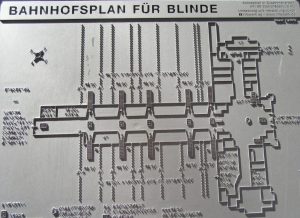
IMG_5793Main train station Bremen: Map in Braille writing, from Nov. 2001 / Bremen Hauptbahnhof: Bahnhofsplan für Blinde, datiert Nov. 2001

On the plate, it says: Concept in cooperation with DB Station&Service AG – Realization and production by infowerk / Laut Beschriftung: „Konzeption in Zusammenarbeit mit DB Station&Service AG – Umsetzung und Herstellung durch infowerk ag …“


The Braille writing was developed by Louis Braille, originally for the French language. The system’s first official publication was in 1829, www.braille.ch / Die Brailleschrift wurde ursprünglich für Französisch von Louis Braille entwickelt. Erste offizielle Veröffentlichung des Systems erfolgte in 1829,www.braille.ch/