23 Dec 2014, Museum der Arbeit: The bicycle / Das Fahrrad

Museum der Arbeit, Hamburg: Exhibition „The bicycle. Culture, technology, mobility“ / Ausstellung „Das Fahrrad. Kultur, Technik, Mobilität“, 9.5.14-1.3.15

The bicycle is today’s adequate means of transport. Based on >100 bicycle icons of the last 200 years, the exhibition presents the technological development, design, multiple bike-related scenes and mobility features of present and future times – from draisienne to Hamburg CityBike and from high wheeler to cargo bikes / „Das Fahrrad ist … das Fortbewegungsmittel der Stunde. Die Schau präsentiert … anhand von über 100 Fahrrad-Ikonen der letzten 200 Jahre die technische Entwicklung, das Design, die vielfältigen Fahrradszenen sowie Mobilitätsaspekte der Gegenwart und Zukunft – vom Laufrad … bis zum Hamburger ‘StadtRAD’ und vom Hochrad … bis zum Lastenrad“.
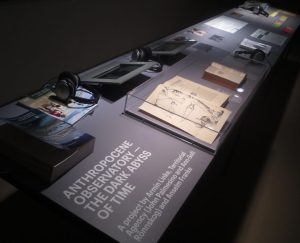
29 Nov 2014, HKW: Anthropocene

Haus der Kulturen der Welt (HKW), Berlin: Anthropocene Observatory -Documentation, Films, Exhibition, Archive 2013/2014 / Anthropocene Observatory -Dokumentation, Filme, Ausstellung, Archiv 2013/2014. Armin Linke, Territorial Agency (John Palmesino and Ann-Sofi Rönnskog), and Anselm Franke

img_0075a“Anthropocene Observatory explores the destabilizing conditions entailed by the new geological epoch that reverberate across polities, institutions, law, international organizations, infrastructures, war, land, practices of scientific investigation, the sea, cities, markets, and planning institutions” / “Anthropocene Observatory beobachtet die durch die neue geologische Epoche ausgelösten destabilisierenden Verhältnisse, die sich auf verschiedene Bereiche erstrecken: politische Ordnungen, Institutionen, Recht, internationale Organisationen, Infrastrukturen, Krieg, Land, die Praxis wissenschaftlicher Forschung, das Meer, Städte, Märkte und Planungsinstitutionen.”


Episode #4 The dark abyss  of time: “investigates how these conditions reshape territories: human spaces and their material counterparts” / Episode #4 The dark abyss  of time: “untersucht, wie diese Bedingungen Landschaften umgestalten: menschliche Räume ebenso wie ihr materielles Gegenüber.”

EN: www.hkw.de/en/programm/projekte/2014/anthropozaenobservatorium20132014/start_anthropozaen_observatorium_2013_2014.php

DE: www.hkw.de/de/programm/projekte/2014/anthropozaenobservatorium20132014/start_anthropozaen_observatorium_2013_2014.php

29 Nov 2014, Ephraim-Palais: „West:Berlin – Eine Insel auf der Suche nach Festland“

Berlin City Museum, Ephraim Palais, Berlin: West:Berlin – An island searching for the mainland / Stadtmuseum Berlin, Ephraim-Palais, Berlin: West:Berlin – Eine Insel auf der Suche nach Festland, 14 Nov 2014 – 28 Jun 2015

For more than 40 years, West-Berlin was the „Island of Freedom“, strongly subsidized “Showcase of the West”, biotope as well as cosmopolitan city. With Germany’s re-unification, West-Berlin lost its prestige, special status and symbolic supercharge. Nowadays, however, the City West has re-startet shining brightly / West-Berlin – das war über vierzig Jahre die „Insel der Freiheit“, hochsubventioniertes „Schaufenster des Westens“, Biotop und Weltstadt zugleich. Mit dem Ende der deutschen Spaltung verlor die Teilstadt ihr Prestige, ihren Sonderstatus und ihre symbolische Aufladung … Doch inzwischen beginnt die City West wieder zu leuchten…

www.stadtmuseum.de/ausstellungen/westberlin

26 Oct 2014, Germanisches Nationalmuseum: German bookplates, 15th – 18th century

Germanisches Nationalmuseum, Nürnberg: Miniature Artworks: German bookplates from the end of the 15th to the 18th century / Kunstwerke im Kleinformat: Deutsche Exlibris vom Ende des 15. bis 18. Jahrhunderts, 27 Feb 2014 – 25 Jan 2015

Since the end of the 15th century, the term ex libris (lat. “from the books”) is used. Such bookplates document who is the owner of a book. For the first time the Germanisches Nationalmuseum presents a selection of 62 prints from its extensive graphic collections – highlights of German bookplate art / Seit Ende des 15. Jahrhunderts kennzeichnen Exlibris den Besitzer eines Buches. Zum ersten Mal präsentiert die Graphische Sammlung des Germanischen Nationalmuseums ihren umfangreichen Bestand dieser zumeist kleinformatigen Druckgraphiken. Mit 62 Blättern werden Höhepunkte aus vier Jahrhunderten deutscher Exlibris-Kunst vorgestellt.

Flyer (DE): www.gnm.de/fileadmin/redakteure/Ausstellungen/pdf/Exlibris.pdf

27 Sep 2014, Berlin, Hamburger Bahnhof: Parergon

Mariana Castillo Deball: Parergon. Nationalgalerie im Hamburger Bahnhof, Museum für Gegenwart, Staatliche Museen zu Berlin, Berlin, 20.9.14-1.3.15

www.smb.museum/en/exhibitions/detail/mariana-castillo-deball-parergon.html

Selected works / Werkeauswahl:

  • Osmân Hamdi Bey: Persian carpet seller on the street (Painting, 1888; Nationalgalerie Berlin) / Osmân Hamdi Bey: Persischer Teppichhändler auf der Straße (Gemälde, 1888; Nationalgalerie Berlin)
  • The ruins of Qsar al-Mschatta (near Amman, Jordania; c. 740 AD; now Pergamon Museum) / Die Ruinen von Qsar al-Mschatta (bei Amman, Jordanien; ca. 740 AD; jetzt im Pergamon Museum)
  • Steam locomotive firebox after a boiler explosion (c. 1910; Stiftung Deutsches Technikmuseum, Berlin) / Feuerbüchse einer Lok nach Kesselexplosion (um 1910; Stiftung Deutsches Technikmuseum, Berlin)

Ixiptla, Journal on Art and Anthropology, Fall / Herbst 2014, vol. II, www.lespressesdureel.com/EN/magazine.php?id=145