15 Aug 2016, ♣ Botanic Garden Berlin-Dahlem

IMG_6522aBotanic Garden / Botanischer Garten, Freie Universität Berlin, Königin-Luise-Platz, 14195 Berlin, EN: www.bgbm.org/en, DE: www.bgbm.org/de

The design of this botanic garden is based on Adolf Engler’s concept of plant geography (1889): “The world in one garden” / Die Anlage dieses botanischen Gartens gründet sich auf Adolf Englers pflanzengeographisches Konzept von 1889: “Die Welt in einem Garten”.

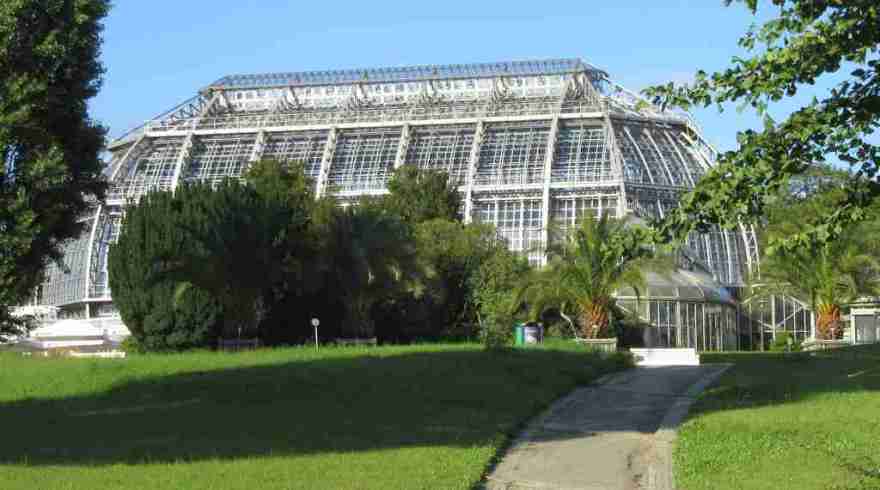
The main tropical greenhouse was built in Jugendstil (Art Nouveau); with its length of 60 m and height of 23 m is one of the largest in the world / Das Große Tropenhaus im Jugenstil, 60 m lang und 23 m hoch, zählt zu den weltweit größten.

The research program includes Biodiversity Informatics, linking and permanently securing information about organisms, in order to process knowledge on biodiversity in a “taxonomically intelligent” way / Zum Forschungsprogramm gehört Biodiversitätsinformatik, d.h. inhaltliche Verknüpfung und dauerhafte Sicherung von Informationen über Organismen mit dem Ziel, biologisches Wissen „taxonomisch intelligent“ aufzubereiten.

Garden map www.bgbm.org/en/garden/survey-garden, Gartenplan www.bgbm.org/de/node/1079


Aristolochia ridicula, Possierliche Pfeifenblume

From Hortipedia, http://en.hortipedia.com/wiki/Aristolochia_ridicula / Aus Hortipedia, http://de.hortipedia.com/wiki/Aristolochia_ridicula:

  • Described and named by Nicholas Edward Brown in 1886 / 1886 von Nicholas Edward Brown beschrieben und benannt
  • Genus: Aristolochia, Family: Aristolochiaceae (Birthwort family) / Gattung: Aristolochia, Familie: Aristolochiaceae (Osterluzeigewächse)
  • Evergreen climber, native to South America, reaching heights of 2 to 5 metres with cordate leaves and tubular flowers / Immergrüne Kletterpflanze aus Südamerika, 2-5 Meter hoch mit herzförmigen Blättern und röhrenförmigen Blüten
  • All plant parts are toxic / Sämtliche Pflanzenteile sind giftig.

8 Aug 2016, Berlin: Main libraries

Key libraries for sciences and humanities in Berlin / Führende wissenschaftliche Bibliotheken in Berlin


Berlin State Library / Staatsbibliothek zu Berlin

Founded in 1661; now Germany’s largest general scientific library / 1661 gegründet als „Churfürstliche Bibliothek zu Cölln“; jetzt größte wissenschaftliche Universalbibliothek Deutschlands

Part of the Prussian Cultural Heritage Foundation (Funding: 75% federal, 25% the German Bundesländer) / Ist Teil der Stiftung Preussischer Kulturbesitz (Finanzierung: 75% Bund, 25% Bundesländer)

Two sites (reunited in 1992) / Zwei Standorte (seit 1992 wieder vereinigt):

2016_08_12 IMG_6423Historische Forschungsbibliothek

  • Address / Adresse: Unter den Linden (Berlin-Mitte), current access / gegenwärtiger Zugang: Dorotheenstraße 27
  • Built as Royal Library in 1914; new building opened in 2013 / Erbaut als Königliche Bibliothek 1914; Neubau eröffnet 2013
  • General reading room enclosed in the translucent glass cube (30*35*36m), with 130,000 volumes in open access / Allgemeiner Lesesaal im transluzenten Glaskubus (30*35*36m), mit 130.000 Bänden in Freihandaufstellung
  • Rare books reading room, with 25,000 volumes in open access / Rara-Lesesaal, mit 25.000 Bänden in Freihandaufstellung

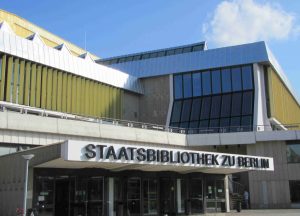
Forschungsbibliothek der Moderne2016_08_08 IMG_6328a

  • Address / Adresse: Potsdamer Straße 33 (Berlin-Tiergarten), im Kulturforum
  • Planned by Hans Scharoun; opened in 1978 / Erbaut nach den Plänen von Hans Scharoun,; eröffnet 1978
  • Internationally renowned for its “open reading room landscape“ / International bekannt für seine „offene Lesesaallandschaft“

For both sites / Für beide Standorte:


Universitätsbibliothek der Humboldt-Universität zu Berlin

Founded in 1810, the Berlin University (called Humboldt University since 1949) in its early days had no library of its own / Die 1810 gegründete Berliner Universität (seit 1949 Humboldt-Universität genannt) verfügte zunächst über keine eigene Bibliothek.

The university library was established in 1831; it evolved into one of the most efficient university libraries in Germany at the beginning of the 20th century / Erst 1831 wurde die Universitätsbibliothek gegründet, die zu Beginn des 20. Jahrhunderts dann eine der leistungsfähigsten Universitätsbibliotheken Deutschlands darstellte.

2016_08_12 IMG_6421The Jakob and Wilhelm Grimm Centre, established in 2009, is part of the Campus Mitte (Humanities, Social sciences, Economics, Theology). The Centre hosts the central library, 12 former branch libraries as well as the computer and media service / Das 2009 eröffnete Jacob-und-Wilhelm-Grimm-Zentrum als Teil des Campus Mitte (Geistes-, Sozial- und Wirtschaftswissenschaften sowie Theologie) beherbergt die Zentralbibliothek, zwölf ehemalige Zweig-und Teilbibliotheken sowie den Computer- und Medienservice.
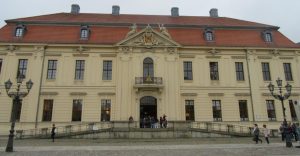
In addition, there is the branch library of natural sciences (Campus Adlershof) and the branch library of Campus Nord (life sciences) in Berlin / Daneben gibt es die Zweigbibliothek Naturwissenschaften (Campus Adlershof) und die Lebenswissenschaftliche Zweigbibliothek (Campus Nord) in Berlin.

3 Aug 2016, Berlin: Jewish Museum and Memorial to the Murdered Jews of Europe

Jewish Museum / Jüdisches Museum

2016_08_03 IMG_6272aEstablished in 2001; Building ensemble: Old building (Collegienhaus in baroque style), postmodern Libeskind building, Glass courtyard / Gegründet 2001; Gebäude-Ensemble: barocker Altbau („Kollegienhaus“), postmoderner Neubau von Daniel Libeskind; Glashof
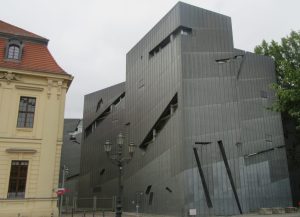
Permanent exhibition „Two Millennia of German Jewish History“ including, e.g., the following topics / Dauerausstellung „Zwei Jahrtausende deutsch-jüdische Geschichte“ u.a. mit folgenden Themen:

2016_08_03 IMG_6273a

  • The Ashkenas world / Welt von Aschkenas, 950 – 1500
  • Female life / Frauenleben, 1646 – 1724
  • City, countryside, farm / Stadt, Land, Hof, 1500 – 1800
  • Moses Mendelssohn and the Enlightenment / Moses Mendelssohn und die Aufklärung, 1750 – 1800
  • German and Jewish at the same time / Deutsche und Juden zugleich, 1800 – 1914
  • Modern Judaism / Modernes Judentum, 1800 – 1933
  • Equity at jeopardy / Gefährdete Gleichberechtigung, 1914 – 1933
  • National socialism / Nationalsozialismus, 1933 – 1945

www.jmberlin.de/, EN: www.jmberlin.de/main/EN/homepage-EN.php


Memorial to the Murdered Jews of Europe (Holocaust Memorial) / Denkmal für die ermordeten Juden Europas

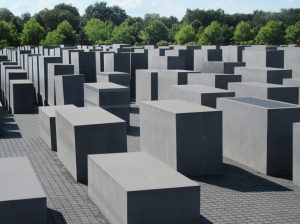
2016_08_08 IMG_63242,711 concrete steles (rectangular blocks) laid out in grid formation, recalling tombstones; designed by US architect Peter Eisenman and established in 2005 / Stelenfeld mit 2.711 grabsteinähnlichen Stelen, entworfen vom New Yorker Architekten Peter Eisenman und eröffnet 2005


1 Aug 2016, Park estate Neukladow / Gutspark Neukladow

The historic park estate is located on a plateau above the Havel river, opposite the Wannsee. In 1799, King Friedrich Wilhelm Ill. gave „Neu-Cladow“ to his cabinet councillor A.L. Menken who built a manor house in early classicist style and a park here  / Der historische Gutspark liegt auf einem Plateau oberhalb der Havel, dem Wannsee gegenüber. 1799 überließ König Friedrich Wilhelm Ill. “Neu-Cladow” seinem Kabinettsrat A.L. Menken, welcher hier ein Gutshaus im frühklassizistischen Stil errichten und einen Park anlegen ließ.

Menken’s daughter Louise Wilhelmine, Otto von Bismarck’s mother, spent part of her youth in this place / Menkens Tochter Louise Wilhelmine, die Mutter Otto von Bismarcks, verbrachte hier Jugendjahre.

In 1909, the art historian Dr. Johannes Guthmann remodeled the estate, involving the painter and architect Paul Schultze-Naumburg. Neukladow evolved into a meeting point of celebrities, including Paul Cassirer, Gerhard Hauptmann, Max Liebermann, Walther Rathenau, Max Reinhardt und Max Slevogt / 1909 ließ der Kunsthistoriker Dr. Johannes Guthmann das Anwesen umbauen, unter Beteiligung des Malers und Architekten Paul Schultze-Naumburg. Neukladow entwickelte sich zu einem Treffpunkt bedeutender Persönlichkeiten wie Paul Cassirer, Gerhard Hauptmann, Max Liebermann, Walther Rathenau, Max Reinhardt und Max Slevogt.

The citizen’s foundation Gutspark Neukladow and the KulturparkBerlin – Veranstaltungen im Gutspark company aim to revitalize the estate as a meeting place for the arts and the Berlin society / Die Bürgerstiftung Gutspark Neukladow und die KulturparkBerlin – Veranstaltungen im Gutspark GmbH wollen Gutshaus und Park Neukladow als Treffpunkt von Kunst und Berliner Gesellschaft mit neuem Leben erfüllen.

Located by the „Havel river“ cycling trail / Liegt am Flussradwanderweg Havel, www.havelradweg.de/.

19 Jul 2016, Corvey Abbey and castle (UNESCO)

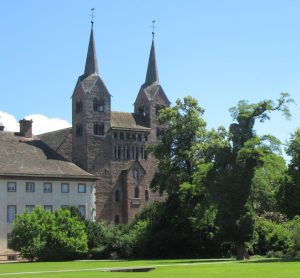
2016_07_19  Corvey1Founded in the 9th century, the Benedictine abbey of Corvey which is located by the Weser river (now: city of Höxter) was an important cultural centre for Northern Europe for long periods of time. The Carolingian westwork of the abbey church and the sunken city of “Civitas” near the former monastery district are recognized as UNESCO World Heritage site since 2014 / Die an der Weser in Höxter gelegene, im 9. Jahrhundert gegründete Benediktinerabtei Corvey war für lange Zeit ein für Nordeuropa bedeutendes kulturelles Zentrum. Das karolingische Westwerk der Abteikirche sowie die archäologischen Reste des als Civitas bezeichneten Klosterbezirks sind seit 2014 als UNESCO-Welterbe anerkannt.

The abbey, built in baroque style, was secularized in 1803 by the Imperial Recess (Reichsdeputationshauptschluss). One of the librarians of the princely library was A.H. Hoffmann von Fallersleben (1798-1874) / Der barocke Klosterbau wurde durch den Reichsdeputationshauptschluss 1803 säkularisiert. Zu den Bibliothekaren der Fürstlichen Bibliothek gehörte A.H. Hoffmann von Fallersleben (1798-1874).


Corvey‘s early history is the topic of the epic poem “Dreizehnlinden” (1878) by Friedrich Wilhelm Weber who practiced medicine in nearby Bad Driburg / Die Frühgeschichte Corveys behandelt das Versepos „Dreizehnlinden“ (1878) von Friedrich Wilhelm Weber, der als Arzt im nahegelegenen Bad Driburg wirkte.

Annette von Droste-Hülshoff’s short novel „The Jew’s Beech“ (Die Judenbuche) is based on a murder which had taken place in the county of Höxter / Annette von Droste-Hülshoffs Novelle „Die Judenbuche“ beruht auf einer Mordtat im Kreise Höxter.


EN:

DE: