
Should Germany’s nuclear phaseout run for inscription to the UNESCO World Heritage list? / Sollte Deutschlands Atomausstieg für die UNESCO-Welterbeliste kandidieren?


Nuclear power plant Würgassen, located in Würgassen (City of Beverungen), boiling-water reactor, operating 1971-1995, now hosting an interim storage of low- and medium-level radioactive waste / Atomkraftwerk Würgassen im Stadtteil Würgassen (Beverungen), Siedewasserreaktor 1971-1995; auf dem Gelände jetzt ein Zwischenlager für schwach- und mittelradioaktiven Abfall, https://de.wikipedia.org/wiki/Kernkraftwerk_W%C3%BCrgassen
E.ON Kernkraft GmbH (2009): E.ON Kernkraftwerk Würgassen. 12 Jahre erfolgreicher Rückbau, www.eon.com/content/dam/eon-com/Geschaeftsfelder/Nuclear/asset-profiles/wuergassen-power-plant/KKW_12J_Rueckbau.pdf
 Nuclear power plant Grohnde, pressurised-water reactor, operting since 1985, planned to be deactivated by c.2020 / Atomkraftwerk Grohnde, Druckwasserreaktor, 1985-ca.2020
https://de.wikipedia.org/wiki/Kernkraftwerk_Grohnde
E.ON Kernkraft GmbH (2008): Grohnde – Informationen zum Gemeinschaftskernkraftwerk, www.eon.com/content/dam/eon-com/Geschaeftsfelder/Nuclear/asset-profiles/grohnde-power-plant/Info_Standort_Grohnde.pdf
 Huguenot migrants’ planned settlement


 In the surrounding mountainous area of Weserbergland, shared today by the federal states of Hesse, North Rhine-Westphalia and Lower Saxony, numerous buildings follow the Weser Renaissance style, a regional variant of Nordic Renaissance,
 Well-known beyond Germany, the Fairy Tale Route connects locations which are associated with specific fairy tales; an example from the Weser area is the Pied Piper of Hamelin. Since 2005, the Grimm Brother‘s „Fairy Tales“ (1812) are recognized by UNESCO as elements of the World’s Documentary Heritage
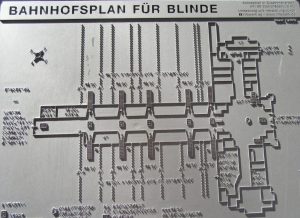 Main train station Bremen: Map in Braille writing, from Nov. 2001


