25 Nov 2016, Φ Paper: Urban Health in D, with companion material

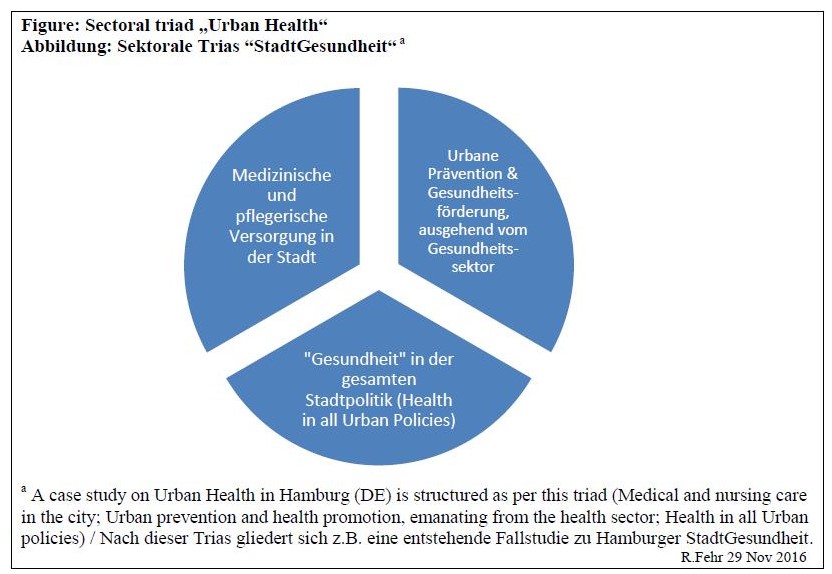
Paper: Urban Health in Germany / Urban Health/StadtGesundheit in Deutschland

Public Health Forum. Band 24, Heft 4, pp. 251–254, DOI:10.1515/pubhef-2016-2104, Nov 2016. Free access to full text of article / Freier Zugang zum Artikel-Volltext: www.degruyter.com/view/j/pubhef.2016.24.issue-4/pubhef-2016-2104/pubhef-2016-2104.xml


Companion material (unpublished) / Begleitmaterial (unveröffentlicht):
16_08-fig

16_08-tab


(Accepted for publication / Zur Veröfentlichung angenommen: 9 Sep 2016)

From the publication / Aus der Veröffentlichung:

Abstract: Urban Health means applying the theory and practice of Public Health to urban populations. Rooted in human ecology approaches, the concept re-gains recognition also in Germany, re-uniting health care and prevention/health promotion with “Health in all Policies”. Given that urban living conditions result from deliberate design decisions, the approach can complement the predominant paradigms which focus on personal behaviour and on health services / Zusammenfassung: StadtGesundheit bezeichnet die Anwendung von Public Health in Theorie und Praxis für Schutz und Förderung der Gesundheit städtischer Populationen. Das humanökologisch orientierte Konzept trifft auch in Deutschland wieder auf stärkere Resonanz und bringt gesundheitliche Versorgung, Prävention und Gesundheitsförderung sowie „Health in all Policies“ enger zueinander. Der Fokus auf Gestaltbarkeit urbaner Lebensverhältnisse ergänzt vorherrschende personale Ansätze und Versorgungsforschung.

From the summary / Aus dem Resümee:

“… lassen sich folgende Nutzenfunktionen erkennen:

  • In der Vielfalt urbaner Strukturen und Prozesse bietet das Konzept „StadtGesundheit“ den Akteurinnen Orientierung, z.B. für Priorisierungen
  • Ergänzend zu Evaluationen und Qualitätssicherung einzelner Bereiche kann der Ansatz kritische Analysen, z.B. zum Zusammenspiel von Akteuren und Aktivitäten, unterstützen
  • Bei guter Präsentation dürfte das Thema „Gesundheit“ in städtischer Planung und Entwicklung die verdiente Aufmerksamkeit erfahren und sich auch in der städtischen Zivilgesellschaft solide verankern.”

With 24 references / mit 24 Literaturangaben


Focus of the journal issue: Urban development, social environment and health / Themenschwerpunkt dieses Heftes: Stadtentwicklung, Sozialraum und Gesundheit

Selection of additional papers in same issue (in German) / Auswahl weiterer Beiträge im selben Heft (auf Deutsch):

  • Hendrik Baumeister und Claudia Hornberg: Health promoting potentials of urban nature for Everybody / Gesundheitsförderliche Potenziale von Stadtnatur für jedermann
  • Gabriele Bolte und Steffen Andreas Schüle: How may social epidemiological research contribute to healthy city planning? / Welchen Beitrag kann sozialepidemiologische Forschung für eine gesundheitsfördernde Stadtentwicklung leisten?
  • Ester Orban, Robynne Sutcliffe, Salman Ahmed und Susanne Moebus: Potentials of spatial epidemiology in the Ruhr Metropolis / Potenziale der räumlichen Epidemiologie in der Metropole Ruhr
  • Wolfgang Schlicht, Frank Oswald und Maren Reyer: The age-friendly city / Die altersfreundliche Stadt
  • Alexander Krämer: Megacities and urban health: an international perspective / Megacities und Urban Health aus internationaler Perspektive.


23 Nov 2016, Φ Einladung für: HealthyLiving, 30 Nov in Berlin

The research program “City of the Future – Healthy and sustainable metropolises”, funded by the Fritz and Hildegard Berg Foundation, supports research work under the headline of HealthyLiving in Berlin, since 1 Sept 2016 / Im Programm “Stadt der Zukunft – Gesunde und nachhaltige Metropolen” der Fritz und Hildegard Berg-Stiftung wird seit 1.9.2016 Forschungsarbeit unter der Überschrift HealthyLiving in Berlin gefördert.

A kick-off meeting takes place at TU Berlin on 30 Nov 2016. The event’s headline is “Healthy city of the future – where do we stand? Challenges on the way forward”. The meeting language is German / Eine Auftaktveranstaltung  erfolgt am 30.11.16 an der TU Berlin. Die Veranstaltung steht unter der Überschrift: “Gesunde Stadt der Zukunft – wo stehen wir? Herausforderungen auf dem Weg zur gesunden Stadt”.

Tagungsprogramm: PDF

(Updated 1 Aug 2017)

19 Nov 2016, Jim Jarmusch: Paterson

Released in Germany two days ago, this film – written and directed by Jim Jarmusch (“Night on Earth”) – calmly presents the daily life routines of the Patersons from Paterson NJ / Dieser seit zwei Tagen in Deutschland laufende Film von Jim Jarmusch („Night on Earth“) beschreibt in ruhigen Bildern die Lebensroutinen der Patersons aus Paterson, NJ.

Paterson Great Falls – National Historical Park (cf. below) in Paterson city reflect human ecologic perspectives / Die Paterson-Wasserfälle (s.u.) in der Stadt Paterson sind humanökologisch interessant.

Mr. Paterson (Adam Driver) is a bus driver who lives without a cell phone and keeps writing poetry. He draws inspiration from bus passengers’ conversations, a box of matches, and poetry written by physician and writer William Carlos Williams who wrote about Paterson, his own home town / Mr. Paterson ist Busfahrer, der ohne Handy lebt und Gedichte schreibt. Seine Inspiration bezieht er aus Gesprächen seiner Fahrgäste, aus einer Streichholzschachtel und aus der Dichtung des Arztes und Schriftstellers William Carlos Williams, der über Paterson, seine eigene Heimatstadt, geschrieben hat.

Mrs. Paterson (Golshifteh Farahani) appears a bit restless and applies black and white design to everything around her. An Asian man (Masatoshi Nagase), in Zen-like fashion, points out the merit of empty pages to Mr. Paterson / Mrs. Paterson (Golshifteh Farahani) wirkt etwas unruhig; sie gestaltet ihre ganze Umgebung in Schwarz und Weiß. Ein Mann aus Asien (Masatoshi Nagase) erinnert Mr. Paterson im Zen-Stil an das Potenzial leerer Seiten.

The bulldog Marvin is charmingly played by the bulldog Nellie (now deceased; posthumously received the Palm Dog Award) / Die Bulldogge Marvin wird sehr charmant von der Bulldogge Nellie gespielt (zwischenzeitlich verstorben; posthum mit Palm Dog Award geehrt).

  • EN: https://en.wikipedia.org/wiki/Paterson_(film)
  • DE: https://de.wikipedia.org/wiki/Paterson_(Film), www.Paterson-DerFilm.de
  • TAZ.die tageszeitung, 16.11.16, p.15: Dichter und Doggen – Poesie / Wiederholung ohne Zwang: In Jim Jarmuschs “Paterson” spielt “Star Wars”-Star Adam Driver einen lyrisch veranlagten Busfahrer …
  • Süddt. Zeitung, 17.11.16, p.12: Insel der verlorenen Seelen – In seiner Tragikomödie “Paterson” erzählt Jim Jarmusch aus dem Alltag eines dichtenden Busfahrers. Der Film ist große amerikanische Zen-Kunst im Zeitalter der Blockbuster-Hektik
  • Szene Hamburg, Nov. 2017: “Alltagspoesie. Lyrische Bilder vom Meister des Indie-Films: Jim Jarmusch setzt … einen zarten, poetischen Kontrapunkt zur Gigantomanie der Filmindustrie” … … “heißt es im Film …: ‘Gedichte übersetzen ist wie duschen im Regenmantel’.”

Paterson Great Falls – National Historical Park New Jersey, www.nps.gov/pagr/index.htm

“In 1791, Paterson, America’s first planned industrial city, was established, centered around the Great Falls of the Passaic River” / Im Jahre 1791 wurde Paterson als erste industrielle Planstadt angelegt, mit den großen Wasserfällen des Passaicflusses als Zentrum.

Water power systems provided energy for industrial production, including cotton fabrics, railroad locomotives, textile machinery, jute, and silk spinning, weaving, and dyeing / Wasserkraft war die Grundlage für industrielle Produktion, einschließlich Baumwollfabriken, Lokomotiven, Textilmaschinen, Jute- und Seidenspinnerei, Weben und Färben.

As pointed out by the Park Service, immigrants still settle today in Paterson to pursue their visions, creating a diverse and vibrant culture /  Dem Park Service zufolge zieht Patterson bis heute Einwanderer an, die hier ihr Lebensglück suchen und eine bunte, lebendige Kultur entstehen lassen.

12 Nov 2016, Φ Workshop: Health assessments in support of decision-making

img_6675
Reflections are essential

9th European Public Health (EPH) conference, Vienna, [updated:] https://ephconference.eu/conference-2016-vienna-48

Workshop 10.K: Health assessments in support of decision-making

Organized by EUPHA sections Health Impact Assessment (HIA), Health Services Research, Public Health Economics, Public Health Practice and Policy; WHO; chairs: Rainer Fehr – Germany, Piedad Martin-Olmedo – Spain

Presentations:

  • Health Systems Performance Assessment. Judith de Jong (NIVEL, NL), presented by Tit Albreht (NIPH, SVN),  Presentation: PDF
  • Do economic evaluations add value to health assessments in the decision-making process? Tek-Ang Lim (Santé publique France, FR), Presentation: PDF
  • Evidence-informed Policy-making – Where is the place for health assessments? Tim Nguyen (WHO EURO)
  • Fostering receptive policy settings for Health Assessments: power, process, and personality. Marleen Bekker (Radboud U & Maastricht U, NL), Presentation: PDF
  • Public health leadership and training opportunities for health assessments. Martin Mengel (Agence de Medicine preventive, FR), KM Czabanowska (Maastricht U, NL), Presentation: PDF

From the workshop abstract:

The commissioning, production, and utilization of health assessments of various types (assessment of status/impact/ technology/systems performance) is part of the working routine within the health sector and in other sectors, e.g. environment or economy. Such assessments, in the future, may be recognized for securing best use of evidence for decision-making. From this perspective, they should be included into Public Health curricula on a regular basis, preferably in an integrated way. Similarly, ways should be explored to advance various types of assessments in joint projects, thus fostering useful ‘‘co-evolution’’.

Key messages:

  • Based on 2014 & 2015 predecessors, the workshop illustrates how health assessments gain shape and visibility for evidence-based policy-making, both within and beyond the health sector
  • The integrative notion of health assessments calls for novel, practice-based approaches for educational curricula, and can add significantly to the development of Public Health leadership.

12 Nov 2016, Φ Double workshop: Health Impact Quantification for a culture of foresight?

9th European Public Health (EPH) conference, [updated:] https://ephconference.eu/conference-2016-vienna-48

Both workshops organized by EUPHA section Health Impact Assessment (HIA). Partial funding for several participants was provided by the University of Bielefeld; many thanks to Prof. C. Hornberg.

IMG_5801
Cardinal points (Braille)

From the workshop abstract:

An orientation of foresight and precaution is among the core virtues of Public Health. … Quantitative modeling is meant to help in estimating impacts of developments, policies and interventions, in identifying group differentials, comparing scenarios, ranking interventions, and thus to support governance and decision-making. A range of impact quantification tools are available, providing approaches to strengthen ‘‘foresight’’ awareness, and to contribute to the development of health impact modeling as a component of good Public Health practice. … The current workshop focuses on practical experiences with existing models and tools, compares and critically discusses them, and identifies appropriate steps forward. A range of reallife examples of tool application will be discussed, in the light of the following questions:

  • What was the (governance) question or problem that triggered the analysis?
  • What model was applied, what data used?
  • How were the following issues dealt with: (systemic) interactions, differential impacts/(in)equity, changes over time, uncertainty of estimates, visualization of results?
  • How did decision-makers and/or the public react?

Part 1 = Workshop 8.K

Chairs: Johan Mackenbach – Netherlands, Rainer Fehr – Germany

  • Modelling the economics of chronic disease with the EConDA tool and the UKHF microsimulation model. Abbygail Jaccard, Laura Webber (UK Health Forum, UK), Presentation: PDF
  • Risk factor modelling with the Proportional Multi-State Life Table model. Lennert Veerman (U Queensland, AUS), Presentation: PDF
  • The exposome and Health Impact Assessment. Dimosthenis A Sarigiannis, SP Karakitsios, A Gotti, E Handakas, K Papadaki (Aristotle U of Thessaloniki, GR, and other institutions), Presentation: PDF
  • Assessing Cancer Control Initiatives in Canada – the Role of CRMM [now: The Oncology Simulation Model OncoSim]. Michael Wolfson (U Ottawa, CAN), Presentation: PDF

Key messages:

  • The essential Public Health virtues of foresight and precaution call for assessing future impacts on health and disease
  • Using impact quantification tools, health impact modeling can develop into a component of good Public Health practice.

Part 2 = Wokshop 9.K

Chairs: Rainer Fehr – Germany, Johan Mackenbach – Netherlands

  • Modelling the effect of food and smoking policies on the unequal distribution of the burden of coronary heart disease: IMPACT models. Martin O’Flaherty (U Liverpool, UK), Presentation: PDF
  • If your mission includes „foresight“, efficient modeling tools are needed. Odile Mekel (LZG.NRW, DE), Rainer Fehr (U Bielefeld, DE), Presentation: PDF
  • Integrated environmental impact assessment with ECOSENSE – the impact pathway approach. Rainer Friedrich (U Stuttgart, DE), Presentation: PDF
  • Modeling of health and disease in support of governance and decision-making – Conclusions. Claudia Hornberg, Rainer Fehr (U Bielefeld, DE), Presentation: PDF

Key messages:

  • One step towards tapping the potential of health impact modeling for improving the health of the public is broadening the awareness of existing modeling tools and ‘‘good practice’’ examples
  • Typifying tasks and challenges at the science–governance interface may help to identify situations in which health impact modeling can be deployed efficiently and successfully.